
Unbiased headlines. Facts, not spin.
Every story is an unbiased news briefing written from 110+ sources across the spectrum — sources linked so you can verify it yourself.
 defense
Major Story (7/10)
August 4, 2026 at 11:25 AM
defense
Major Story (7/10)
August 4, 2026 at 11:25 AM
A $14 Billion Taiwan Arms Package Sits Unsigned While Taipei Says US Ties Are Stronger Than They Look
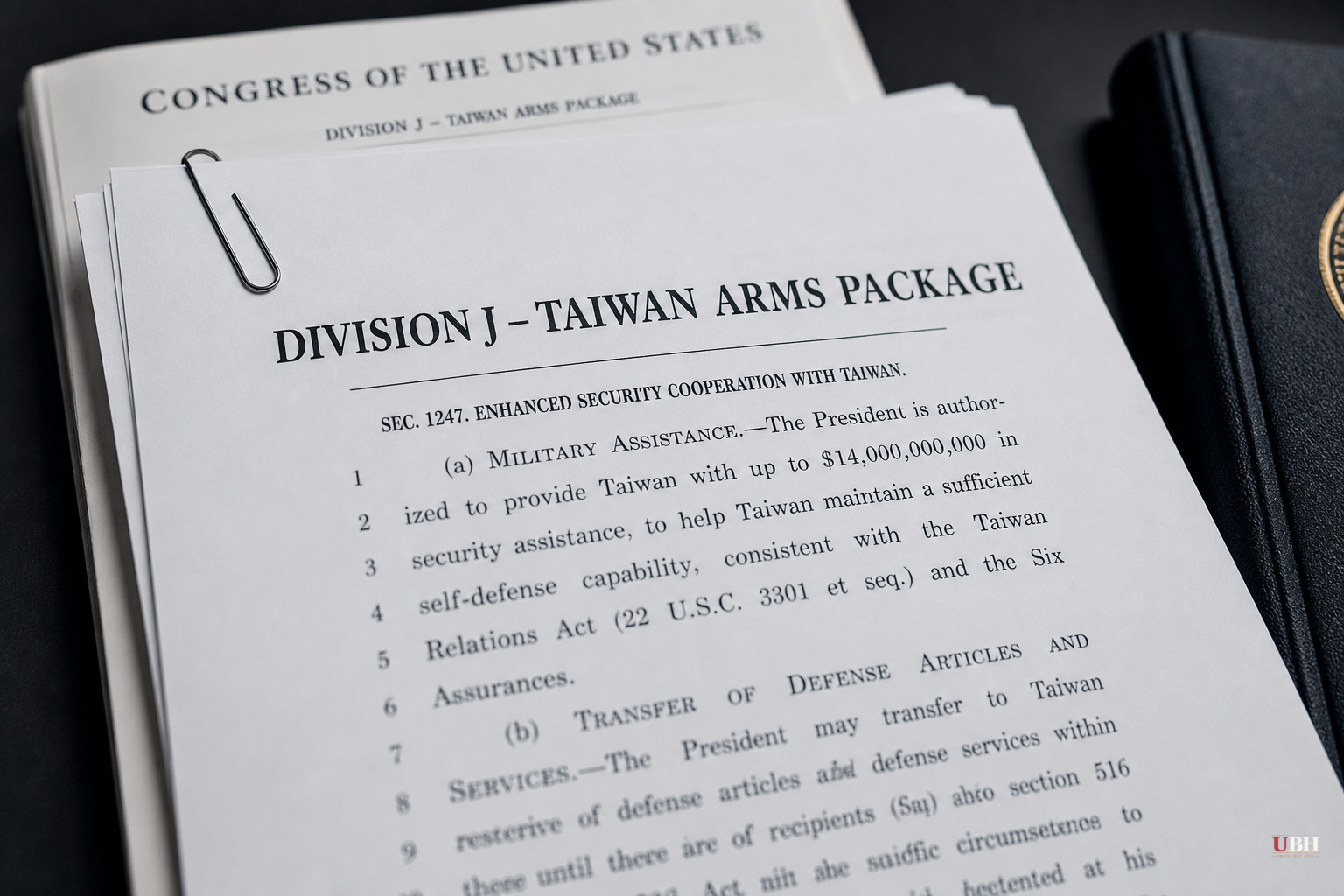
Taiwan's government is publicly downplaying doubts about American commitment while a $14 billion arms package Congress approved with bipartisan support months ago still awaits President Trump's signature.
Taiwan Defense Minister Wellington Koo told reporters Friday that military cooperation between Taipei and Washington "may be far closer than many people imagine," according to Modern Diplomacy. Koo said the coordination runs through multiple levels of engagement with U.S. Pacific Command and has directly improved Taiwan's combat readiness.
Koo credited the Pacific Command as a stabilizing force in the Indo-Pacific and pointed to Taiwan's position along the First Island Chain, the string of territory running from Japan through Taiwan to the Philippines that shapes how the U.S. and its allies would respond to any Chinese move on the island.
That's the message from Taipei. The numbers tell a more complicated story.
The Unsigned Deal
Steve Forbes laid out the practical problem in Forbes: Congress passed a $14 billion arms package for Taiwan with rare bipartisan unity, and it's been sitting unsigned for months. Forbes argued Trump should sign it immediately, framing the delay as a credibility problem, not just a paperwork one.
Forbes's case rests on three points. First, the Taiwan Relations Act commits the U.S. to helping Taiwan maintain credible self-defense, and when a president sits on an approved sale, both allies and adversaries notice. Second, Taiwan's military planners built their defense strategy, including the "porcupine strategy" of using anti-ship missiles and munitions to make any invasion prohibitively costly, around the specific capabilities in this package. Every month of delay leaves real gaps. Third, every recent administration, including Trump's first term, treated Taiwan arms sales as routine business separate from broader China diplomacy, specifically to keep Beijing from getting veto power over U.S. defense decisions.
Forbes also flagged that slow-walked deliveries from previous arms agreements are compounding the credibility problem. The U.S. has a documented backlog of already-approved Taiwan weapons deliveries that predates this current package.
Why Confidence Is Slipping
The Brookings Institution acknowledged the trust problem directly. Recent polling shows some Taiwanese have grown less confident in U.S. commitments to support Taiwan's self-defense, a shift that came in the wake of comments from President Trump about arms sales and broader uncertainty about the direction of U.S. policy.
That's a fair concern. If the people who'd actually be on the front line of a Chinese invasion are losing confidence in their main security partner, that matters. Public trust in a deterrence relationship matters because deterrence depends partly on Beijing believing Washington will actually show up.
Brookings argues that snapshot polling captures a moment, not the underlying substance of the relationship, and that the deeper story is one of expanding cooperation across defense, trade, technology and regional security since the Taiwan Relations Act was signed after the U.S. switched diplomatic recognition to Beijing in 1979. Brookings says the relationship, measured by institutional depth, is arguably stronger now than at any point in that 45-plus year span.
Both things can be true at once. Cooperation can be deepening institutionally while a specific, high-profile decision, an unsigned $14 billion package, sits stalled long enough to rattle public confidence in Taipei. Brookings doesn't fully square that tension; it leans on the institutional argument without addressing why the arms package delay itself, not just Trump's comments, might be driving skepticism.
Beijing's Response
China has consistently condemned U.S.-Taiwan military cooperation as interference in its internal affairs, according to Modern Diplomacy, and has escalated military and coast guard activity around Taiwan, particularly along the island's eastern Pacific coast, a route Taiwan considers critical for wartime supply lines.
Koo said Taiwan has responded by running military exercises simulating Chinese escalation scenarios, including a potential naval blockade. He argued any actual Chinese blockade would carry heavy costs for Beijing too, given China's dependence on international trade and shipping, and would likely trigger severe international sanctions. He also suggested a blockade attempt could create domestic political risk for Chinese President Xi Jinping.
None of that is independently verified in these sources beyond Koo's own assessment, and he's a Taiwanese official making the case for why deterrence is working. His confidence in Chinese self-restraint is also his job.
What's Actually Unresolved
The open question isn't whether the U.S. and Taiwan cooperate closely. All three sources agree they do, and Forbes and Modern Diplomacy both point to concrete, checkable defense coordination. The open question is why a bipartisan-approved $14 billion package is still sitting on Trump's desk months after Congress passed it, and what that delay signals to both Taipei and Beijing about how firm U.S. commitments actually are when they intersect with broader trade and summit diplomacy with China. Forbes's warning is specific: treat this as a bargaining chip once, and Beijing will expect to negotiate over the next one too.
Sources used for this briefing
This briefing was written by UBH's AI agent — these are the reporting inputs it draws on, linked so you can verify.


