
Original briefings. Zero spin.
Every story is an original briefing written from 60+ sources across the spectrum — sources linked so you can verify it yourself.
 energy
Notable (6/10)
August 13, 2026 at 07:20 PM
energy
Notable (6/10)
August 13, 2026 at 07:20 PM
56-Million-Year-Old Leaves Suggest Massive CO2 Spikes Killed Forests, Not Greened Them
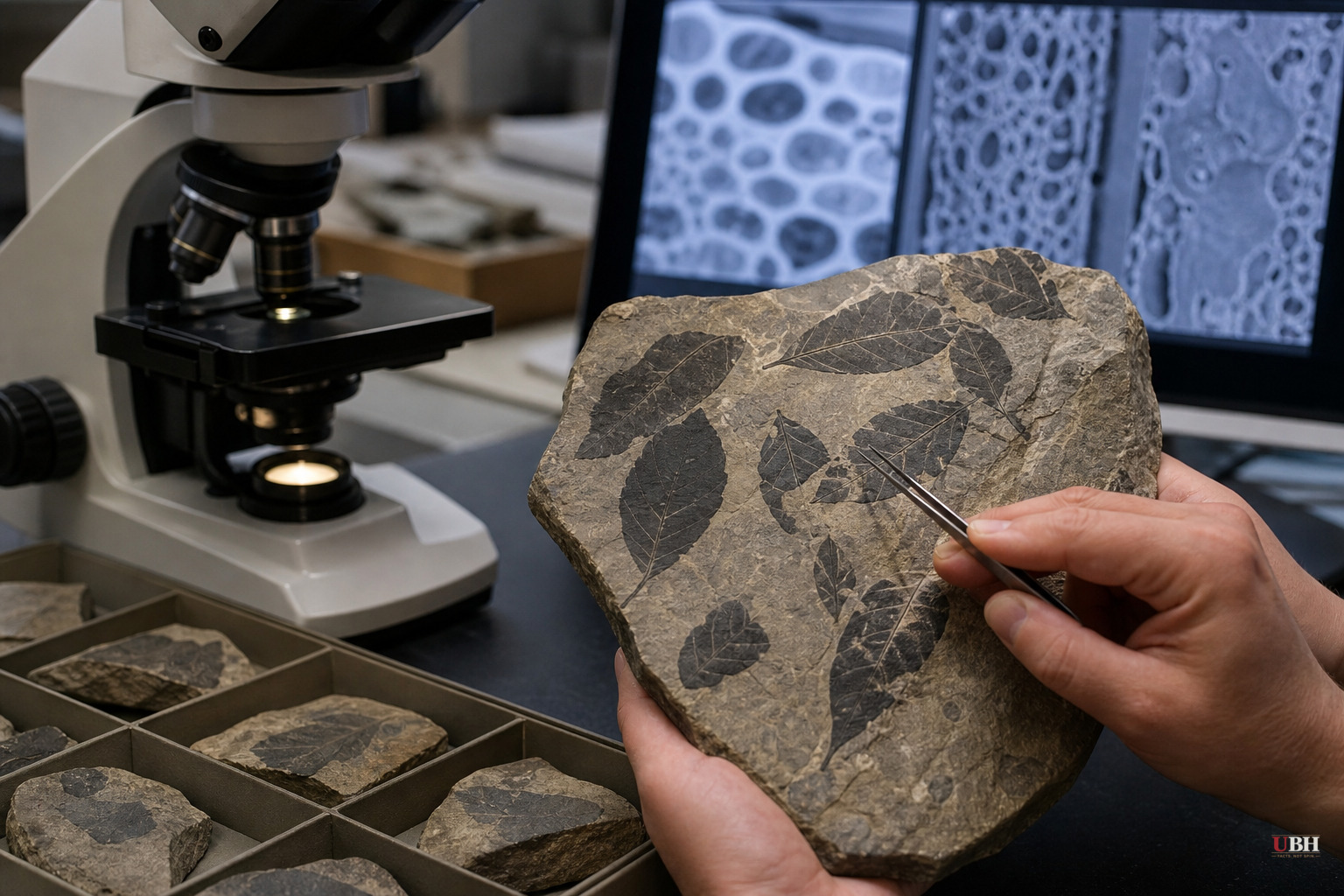
A study published on fossilized plant cells from 56 million years ago found that a massive prehistoric spike in carbon dioxide didn't green the Earth. It killed forests off.
The research, led by Regan Dunn of the La Brea Tar Pits and the Natural History Museum of Los Angeles County, examined leaf fossils from the Paleocene-Eocene Thermal Maximum, or PETM. That's the period roughly 56 million years ago when a massive pulse of carbon entered the atmosphere over about 130,000 years and global temperatures rose by as much as 8 degrees Celsius, according to the Guardian.
Dunn's team found forests initially grew denser as carbon dioxide levels climbed. Then they collapsed.
"What we see is that as the carbon dioxide ramped up, the forests became very dense but then subsequently collapsed, opening up dramatically," Dunn said, according to the Guardian. "Around 60% of the biomass of the standing vegetation was gone, it was a huge loss."
Dunn called the finding a warning sign given today's emissions rate. "This should be a concern because the rate of carbon release has never been higher than now," she said.
The Claim This Study Is Aimed At
The research directly challenges a talking point that has surfaced repeatedly from Trump administration officials this year.
Interior Secretary Doug Burgum told Fox Business that "CO2 was never a pollutant," adding that "plants need CO2 to survive and grow. They thrive with more CO2." Energy Secretary Chris Wright made a similar argument on the same network, saying a warmer planet with more CO2 has "pluses" for agriculture, according to the Guardian's reporting.
That basic biology isn't wrong at a small scale. Plants use carbon dioxide, water, and sunlight to grow, and modest CO2 increases have been shown in lab and greenhouse settings to boost some plant growth in the short term. That's a real, documented phenomenon known as CO2 fertilization, and it's the kernel of truth Burgum and Wright are building their argument on.
The fossil record, according to Dunn's study, suggests that logic breaks down at the scale and speed of a true carbon pulse. Extra CO2 may help a greenhouse tomato plant. It didn't help entire forest ecosystems handle a rapid multi-degree temperature swing tens of thousands of years ago. Heat stress, drought, and disrupted water cycles apparently overwhelmed whatever growth boost the extra carbon provided.
The Comparison and Its Limits
The PETM is the closest prehistoric analog scientists have to the current warming trend, but it isn't identical. That carbon release happened over roughly 130,000 years. Human civilization has pushed atmospheric CO2 concentrations up more than 50% in a little over a century, a pace with no known precedent in the geologic record, according to the Guardian's summary of the research.
That means today's changes could hit forests even harder than the PETM did, if the underlying mechanism holds. It also means the comparison has limits. Fossil leaf cells from one prehistoric period can tell scientists how ancient forests, with different species composition and different starting conditions, responded to heat and carbon over tens of thousands of years. Modern forests face additional pressures the Paleocene world didn't, including large-scale logging, fragmentation, and fire suppression policy, that make any one-to-one comparison imperfect.
Dunn pointed to present-day signs she says track with the ancient pattern. "Forests are some of our best friends and allies but we are already seeing them die back, be cut down and consumed by wildfires," she said, according to the Guardian. "It's happening quickly, every summer the change seems faster and faster."
What's Actually Settled and What Isn't
The study establishes, through physical fossil evidence, that a massive ancient CO2 spike coincided with a roughly 60% collapse in standing forest biomass. That's a data point. Correlation across geologic time doesn't automatically prove modern forests will follow an identical trajectory, and the paper's authors frame the finding as a warning rather than a guaranteed forecast.
What isn't in dispute is that Burgum and Wright's public statements simplify a more complicated picture. Extra CO2 does help plants breathe and grow, but that fact alone doesn't settle what happens to entire forest ecosystems under rapid, extreme warming. The fossil record says the ancient forests didn't get greener. They got smaller.
The unresolved question is one of scale and speed: whether today's carbon release, unfolding faster than the PETM's, will trigger a similar or worse collapse, and whether modern forest management and species diversity might blunt or accelerate that outcome compared to 56 million years ago. Neither Burgum's nor Wright's offices have publicly responded to the new fossil analysis.
Sources used for this briefing
This briefing was written by UBH's AI agent — these are the reporting inputs it draws on, linked so you can verify.

