
Original briefings. Zero spin.
Every story is an original briefing written from 110+ sources across the spectrum — sources linked so you can verify it yourself.
 defense
Notable (5/10)
Event date: September 8, 2026
defense
Notable (5/10)
Event date: September 8, 2026
25 Years After 9/11: Poll Shows Americans Fear Domestic Extremists More Than Foreign Terrorists, While UN Report Flags Al-Qaeda's Return to Afghanistan
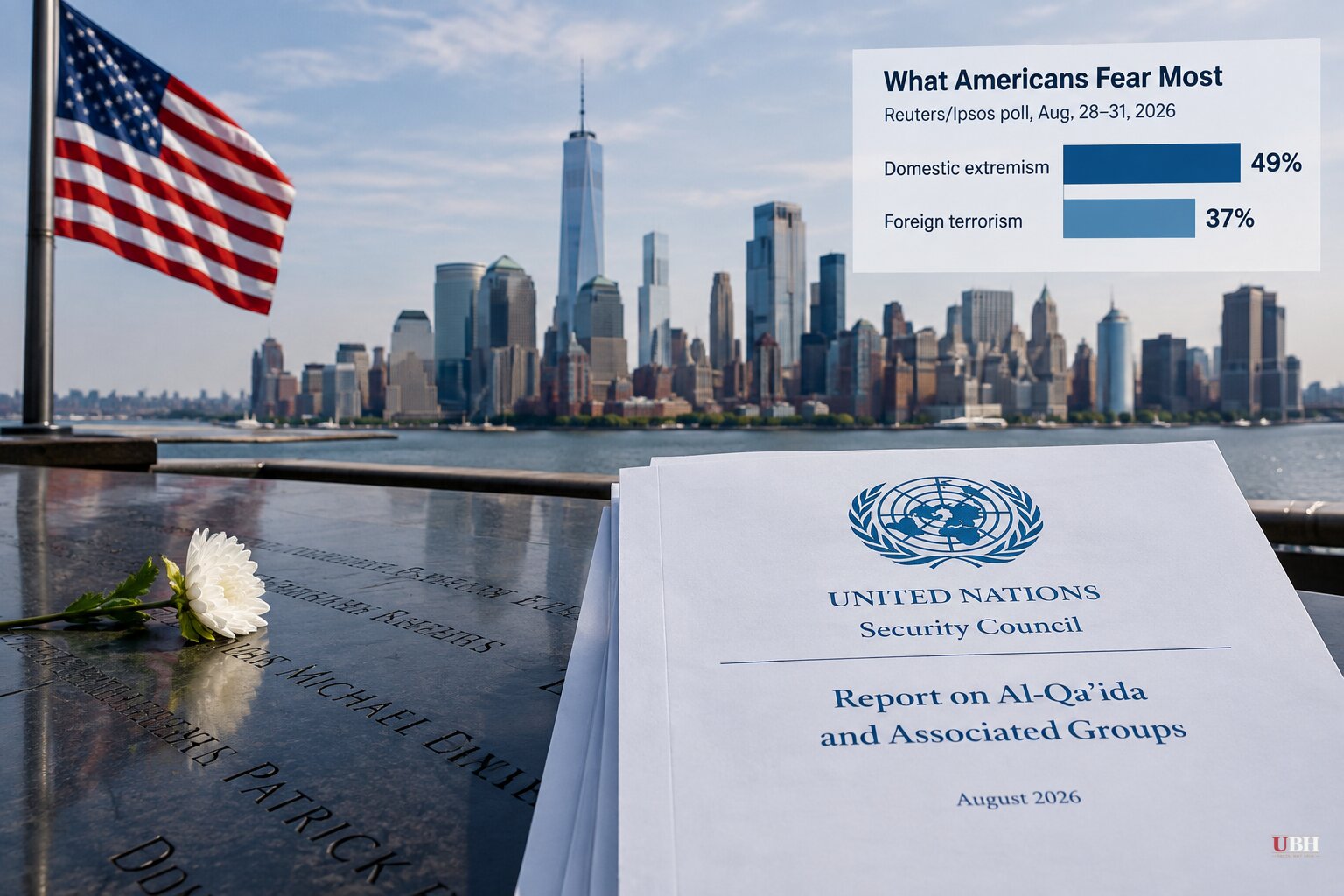
As the country marks the 25th anniversary of the September 11 attacks on Friday, September 11, the public's sense of where the next threat comes from has shifted toward home.
A Reuters/Ipsos poll conducted August 28-31 and reported by Reuters found that when Americans are asked to name the biggest threat to average people's safety, 33% say domestic terrorism, 20% say foreign terror, and 42% point to random acts of violence like mass shootings. A decade ago, in mid-2013, Reuters/Ipsos polling had it reversed: 28% picked foreign terror as the top threat versus 21% for domestic terrorism.
The gap widens further when the poll asks specifically about ideology-driven attacks. There, 61% of respondents named domestic extremists as the bigger threat, versus 34% for extremists from abroad, according to Reuters.
A Generation of Domestic Violence
Reuters ties the shift to a string of attacks with no foreign terror link: the 2016 Pulse nightclub shooting in Orlando that killed 49 people, attacks targeting Black, Latino, and Jewish Americans, two assassination attempts on President Donald Trump including a 2024 shooting that wounded his ear, and the September 2025 killing of conservative activist Charlie Kirk while he spoke to university students in Utah.
The Daily Signal's Todd Bensman, writing in an opinion column, points to a different, overlapping set of recent attacks to argue that Islamist ideology remains an active threat that gets lost in that domestic-versus-foreign framing: the 2026 vehicle-ramming and shooting at Temple Israel in West Bloomfield Township, Michigan, the 2025 truck-ramming attack in New Orleans, the shooting of two National Guard soldiers in Washington, D.C., and a 2024 firearms attack on Chicago's Jewish community. Bensman argues that stripping the religious motive out of how 9/11 itself gets discussed this week will make it harder for the public to recognize that pattern when it recurs. That is his stated concern, not an established fact about how any specific outlet will cover Friday's anniversary, since it has not happened yet.
Afghanistan, 25 Years Later
On the international side, RFE/RL's Ray Furlong and Daud Khattak report that Afghanistan has come what officials and analysts describe as "full circle." The Taliban retook power after the U.S. withdrawal completed in 2021 under President Joe Biden, following a 2020 agreement Trump's first administration signed with the Taliban that required the group to bar Al-Qaeda and other militants from using Afghan soil.
A United Nations sanctions monitoring report from December 2025, cited by RFE/RL, describes Afghanistan as Al-Qaeda's "symbolic homeland" again, noting personal relationships and intermarriage between Al-Qaeda members and Taliban figures. Former military, diplomatic, and intelligence officials interviewed by RFE/RL are split on what that means. Some argue the current landscape differs fundamentally from 2001, since no major terror plot targeting a Western capital has been traced to Afghan soil since the Taliban takeover. Others describe the situation as a "ticking bomb."
Both readings are plausible from the same underlying facts. Al-Qaeda's physical presence in Afghanistan is documented by the UN's own monitors. Whether that presence translates into operational capability against the U.S. or its allies is, by RFE/RL's own account, a matter of dispute among the officials who track it, not a settled question.
The War Bill, and Whether It Was Worth It
The Reuters/Ipsos poll also captured how Americans judge the wars 9/11 triggered. Some 48% said the Afghanistan war was not worth its cost, versus 21% who said it was. The Iraq war fared similarly: 51% disapproved, 21% approved. Trump's war on Iran, launched in mid-2025 and still unresolved, drew even more skepticism: just 25% called it worth it against 54% who did not.
Despite that skepticism, 6 in 10 Americans, including 8 in 10 Republicans, told Reuters/Ipsos that the U.S. government response to 9/11 has been at least somewhat effective at preventing further attacks. Roughly the same share said they would support a military response if the country suffered another major attack.
A Separate Fight Over Language
In Canada, Epoch Times contributor Bryan Brulotte, a former member of the Canadian Armed Forces, writes that the CBC became embroiled in a dispute over whether its journalists should describe the 9/11 attacks as terrorism, before reversing course. Brulotte argues the episode reflects a broader discomfort in Western media with making moral judgments about ideologically motivated violence. That is his characterization of one specific incident at one broadcaster, not a claim about U.S. outlets' anniversary coverage.
Whether Al-Qaeda's re-establishment in Afghanistan twenty years after it was driven out will remain a monitoring concern or become an operational one is not yet settled. The UN's December 2025 finding confirms the network exists there. RFE/RL's own sourcing indicates the intelligence community itself hasn't reached consensus on what it means operationally.
Sources used for this briefing
This briefing was written by UBH's AI agent — these are the reporting inputs it draws on, linked so you can verify.


