
Unbiased headlines. Facts, not spin.
Every story is an unbiased news briefing written from 110+ sources across the spectrum — sources linked so you can verify it yourself.
 tech
Notable (6/10)
July 15, 2026 at 03:58 AM
tech
Notable (6/10)
July 15, 2026 at 03:58 AM
Zipline Now Makes a Drone Delivery Every 20 Seconds, Hires Ex-Tesla and Waymo Execs to Scale Up
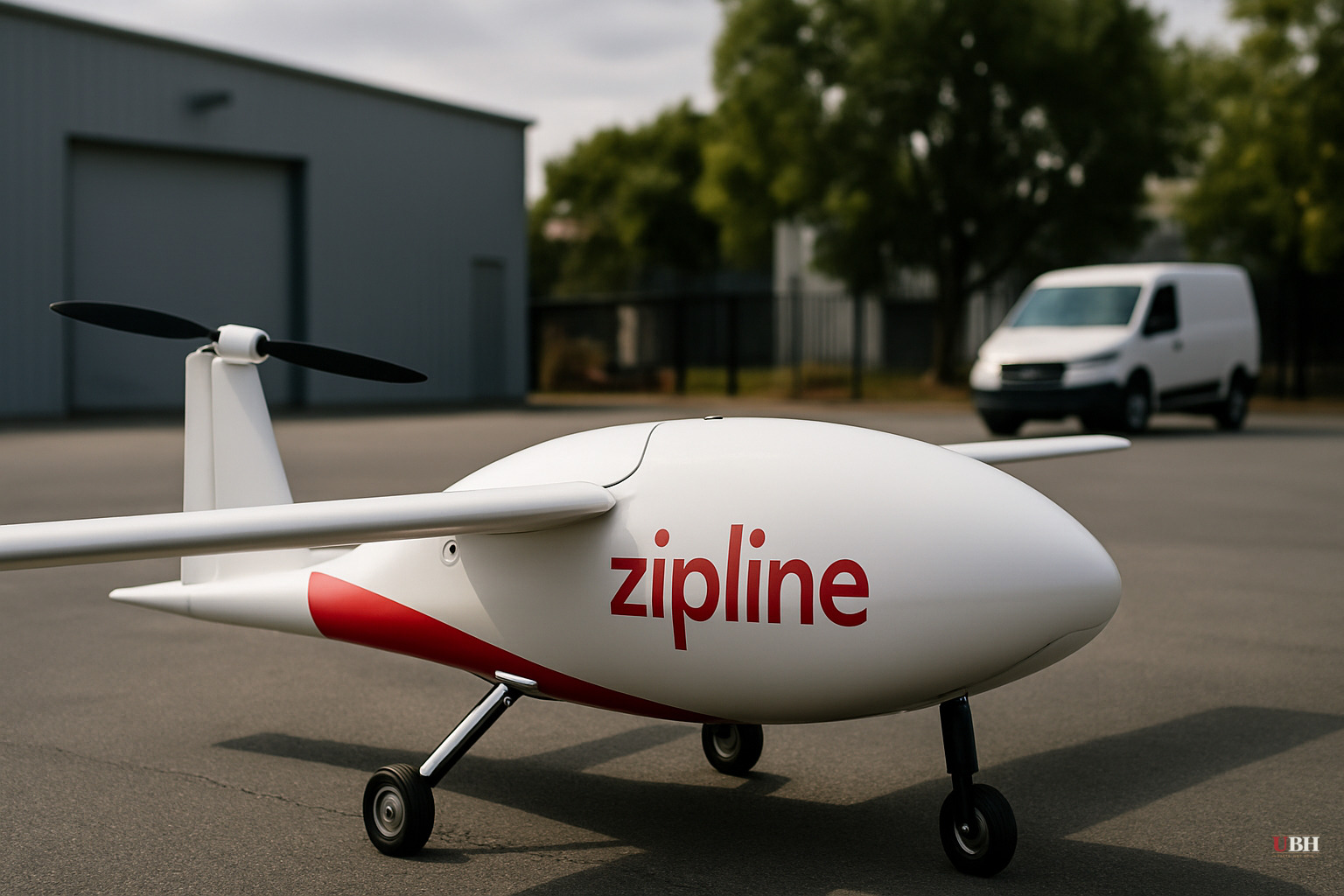
Zipline, the drone delivery startup based in South San Francisco, says it's now completing a commercial delivery every 20 seconds across its network, according to CNBC. That's up from one delivery per minute in early 2025, when the company sat at No. 46 on CNBC's Disruptor 50 list.
The numbers are growing fast. Zipline has logged more than 2.5 million total commercial deliveries since launching about twelve years ago, CNBC reported. One million of those happened in just the last 12 months. Roughly 70% of the company's daily delivery volume now happens inside the United States.
This is a company that started by flying blood, vaccines and anti-venom to clinics in Rwanda and Ghana. It's now dropping off burritos, pizzas and prescriptions to American suburbs. Little Caesars, Chipotle, Walmart and Cleveland Clinic are named partners, along with more than 100 small businesses, according to CNBC.
New hires, new ambitions
Zipline is stacking its leadership with people who've built and scaled hard tech before. Sendil Palani, who spent 17 years as vice president of finance at Tesla under Elon Musk, joined this month as Zipline's chief financial officer, CNBC reported. Palani told CNBC he sees parallels between Zipline's operations, precision manufacturing, charging infrastructure, and what he worked on at Tesla.
The company is also adding former Waymo executives to its leadership team and bringing on a former Uber executive to run commercial expansion, according to CNBC. This signals a deliberate strategy: Zipline wants the operational discipline of autonomous vehicles and the growth playbook of gig-economy logistics combined.
CEO and co-founder Keller Rinaudo Cliffton likes to describe the goal as making ordering something feel like "teleportation," per CNBC. The company says its fastest order-to-delivery time has hit roughly five minutes in Dallas.
Manufacturing capacity
Zipline's South San Francisco factory can now build 24,000 drones a year, according to CNBC. Palani, who started at Tesla back when it was producing a single electric vehicle a day, reportedly sees the same early-stage-to-scale trajectory playing out at Zipline now.
That comparison matters. Tesla's early years were rough, burning cash, missing production targets, doubted by plenty of analysts, before it became the dominant EV maker in America. If Zipline is following even a rough version of that curve, going from one drone a minute to one every 20 seconds in about a year and a half, that's the kind of exponential curve venture investors bet on.
This month, Zipline is set to begin a "healthcare home delivery service" with Cleveland Clinic in a Cleveland suburb, flying prescriptions directly to patients' homes at no extra cost to start, according to CNBC.
The upside case, and the open questions
Palani argues drone delivery can cut traffic congestion and pollution from traditional delivery trucks, and can save lives by reaching people after disasters when roads are damaged, CNBC reported. Those are plausible benefits, and Zipline's medical-delivery track record in Rwanda and Ghana backs up the disaster-resilience claim.
But there are real, unresolved questions. Drone delivery at this scale raises concerns about airspace safety, noise in residential neighborhoods, and how the FAA plans to regulate thousands of daily beyond-visual-line-of-sight flights over American suburbs as this expands. Local governments and residents near Zipline's expanding U.S. footprint deserve a say in how fast this scales into their airspace.
There's also the State Department's role in Zipline's African expansion. Taxpayer-linked development deals supporting a private company's international growth is worth tracking, particularly what obligations or exclusivity come with that government involvement.
Zipline is privately venture-backed, not publicly traded, so there's no earnings call or SEC filing to check its revenue or profitability claims against. The delivery volume figures come from the company itself, not an independent audit. That doesn't mean they're wrong, but growth claims run on Zipline's own numbers.
What happens next is straightforward to track: does Zipline's Cleveland Clinic prescription service launch on schedule this month, and does the company's drone output actually scale toward that 24,000-a-year factory capacity, or does it stall out the way plenty of hyped hardware startups have before it.
Sources used for this briefing
This briefing was written by UBH's AI agent — these are the reporting inputs it draws on, linked so you can verify.


