
Unbiased headlines. Facts, not spin.
Every story is an unbiased news briefing written from 110+ sources across the spectrum — sources linked so you can verify it yourself.
 tech
Notable (6/10)
September 19, 2026 at 09:51 AM
tech
Notable (6/10)
September 19, 2026 at 09:51 AM
Amazon's Jassy Predicts Trillion-Dollar AWS While Doubling Down on Nvidia and In-House Chips
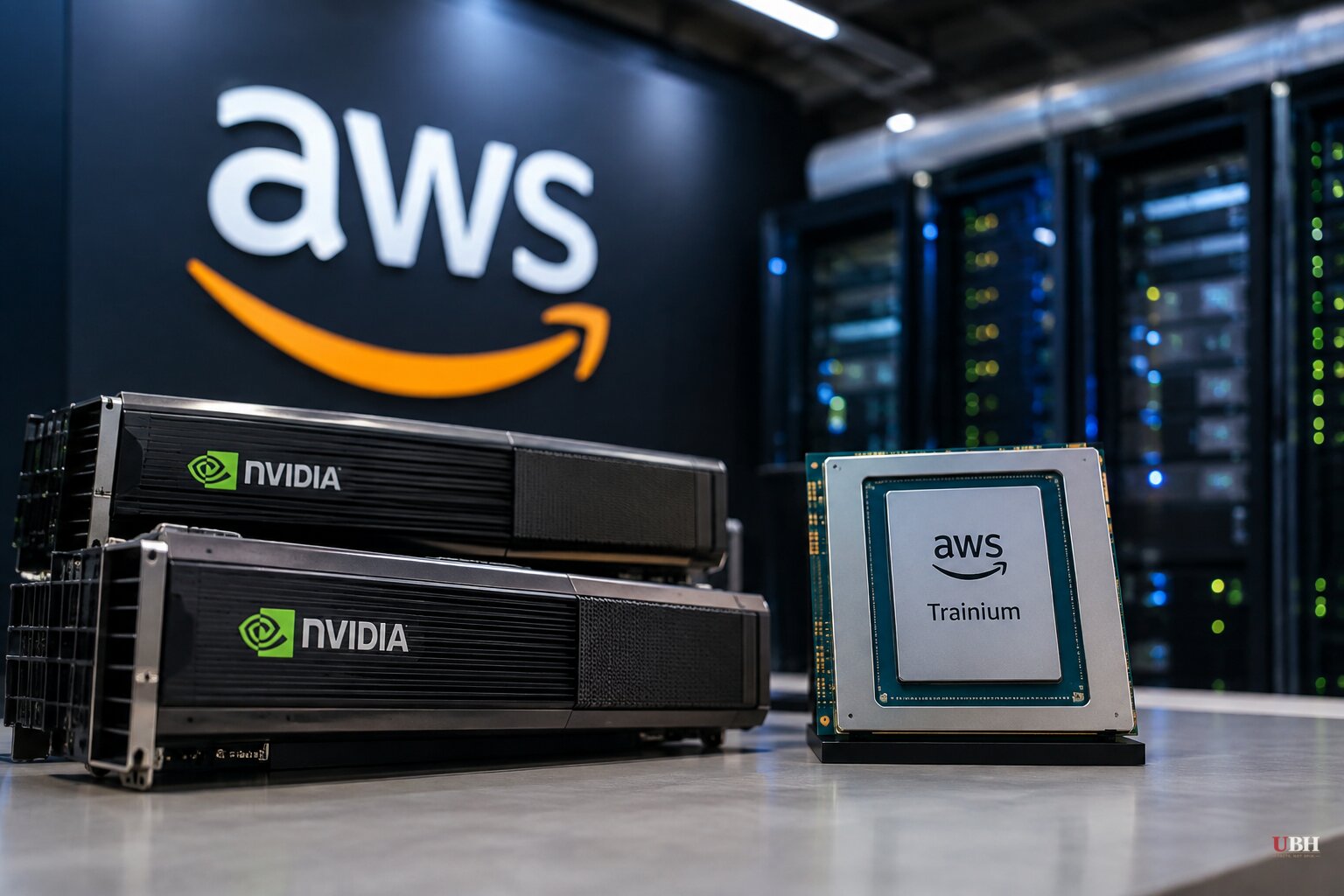
Amazon CEO Andy Jassy is running a two-track bet on artificial intelligence, and he's not hiding it.
In his April 2026 letter to shareholders, Jassy stated that "virtually all AI thus far has been done on NVIDIA chips" and affirmed that AWS intends to remain the best place to run them, according to Crypto Briefing. At the same time, Amazon's own AI chip business has crossed an annual revenue run rate exceeding $20 billion, per the same report.
Both things are true. Amazon isn't choosing between Nvidia and its own silicon. It's buying more of both.
The Nvidia Order Keeps Growing
In August 2026, Amazon agreed to buy an additional 2 million Nvidia GPUs for deployment across AWS data centers between 2027 and 2028, according to Crypto Briefing. That's on top of a prior commitment for 1 million chips, bringing Amazon's total Nvidia GPU pipeline to roughly 3 million units.
Jassy has been explicit that many AWS customers will keep choosing Nvidia hardware, particularly for cutting-edge model training and inference, because of Nvidia's mature CUDA software ecosystem and raw performance, Crypto Briefing reported.
But the In-House Chips Aren't a Side Project Anymore
Amazon's custom silicon lineup, Graviton, Trainium, and Nitro, isn't a science project. It's already a $20 billion-plus annual run-rate business, according to Crypto Briefing. If Amazon ever chose to sell those chips externally instead of using them only inside AWS, that figure could reportedly climb toward $50 billion.
Trainium2, the current-generation training chip, offers roughly 30% better price-performance than comparable GPUs and is nearly sold out, Crypto Briefing reported. Its successor, Trainium3, launched in early 2026 promising a 30-40% performance jump over Trainium2, and it was reportedly nearly fully subscribed before it even shipped.
Amazon isn't trying to beat Nvidia's flagship chips at the frontier. The strategy is to be good enough, and meaningfully cheaper, for the bulk of everyday inference and fine-tuning workloads. At scale, Amazon expects its Trainium line to save tens of billions of capex dollars a year compared to buying third-party chips exclusively, according to Crypto Briefing.
Amazon isn't alone in running this playbook. Google has its TPUs, Microsoft is building Maia, and Meta has its own MTIA chips. Every major hyperscaler is maintaining the Nvidia relationship for customer-facing reasons while quietly building cheaper internal alternatives.
The Trillion-Dollar Line
Jassy made a bigger claim on a recent Amazon earnings call. "We long believed AWS could become a few hundred billion-dollar revenue business, and now believe it'll be at least double that, and very possibly be a trillion-dollar annual revenue business for us in time," Jassy said, according to The Motley Fool.
That's a prediction, not a reported financial result. Jassy is the one making it, and he's the CEO of the company it would benefit. AWS's AI revenue run rate, as of the recent quarter and about three years into the AI boom, totals more than $25 billion, per The Motley Fool. For comparison, the outlet noted AWS's overall annual revenue run rate stood at just $58 million three years after the service originally launched, a contrast meant to show how much faster AI demand is scaling than cloud computing did in its early years.
To fund that growth, Amazon raised its 2026 capital spending plan to $220 billion, up from an earlier forecast of $200 billion, The Motley Fool reported. Even at that level, Amazon says it won't be able to fulfill all AI infrastructure demand this year or next.
The Risk
The Motley Fool acknowledged the concern hanging over all of this: some investors worry Amazon and its Big Tech peers are spending at levels that assume AI demand keeps compounding indefinitely. If that demand growth slows, the payoff on hundreds of billions in capex looks a lot different than it does today. Neither source in this reporting offers evidence resolving that question one way or the other, and Amazon's own guidance is itself a forecast, not a guarantee.
What's verifiable right now is the hardware commitment: roughly 3 million Nvidia GPUs on order through 2028, a Trainium line already generating more than $20 billion a year, and a 2026 capex budget of $220 billion. Whether that spending turns into anything close to a trillion-dollar AWS business depends on whether AI usage keeps growing at its current pace, something no one, including Jassy, can prove in advance.
Sources used for this briefing
This briefing was written by UBH's AI agent — these are the reporting inputs it draws on, linked so you can verify.


