
Unbiased headlines. Facts, not spin.
Every story is an unbiased news briefing written from 110+ sources across the spectrum — sources linked so you can verify it yourself.
 tech
Low Interest (4/10)
Event date: September 17, 2026
tech
Low Interest (4/10)
Event date: September 17, 2026
Tesla to Operate Public Megachargers at Three New California Truck Depots It Doesn't Own
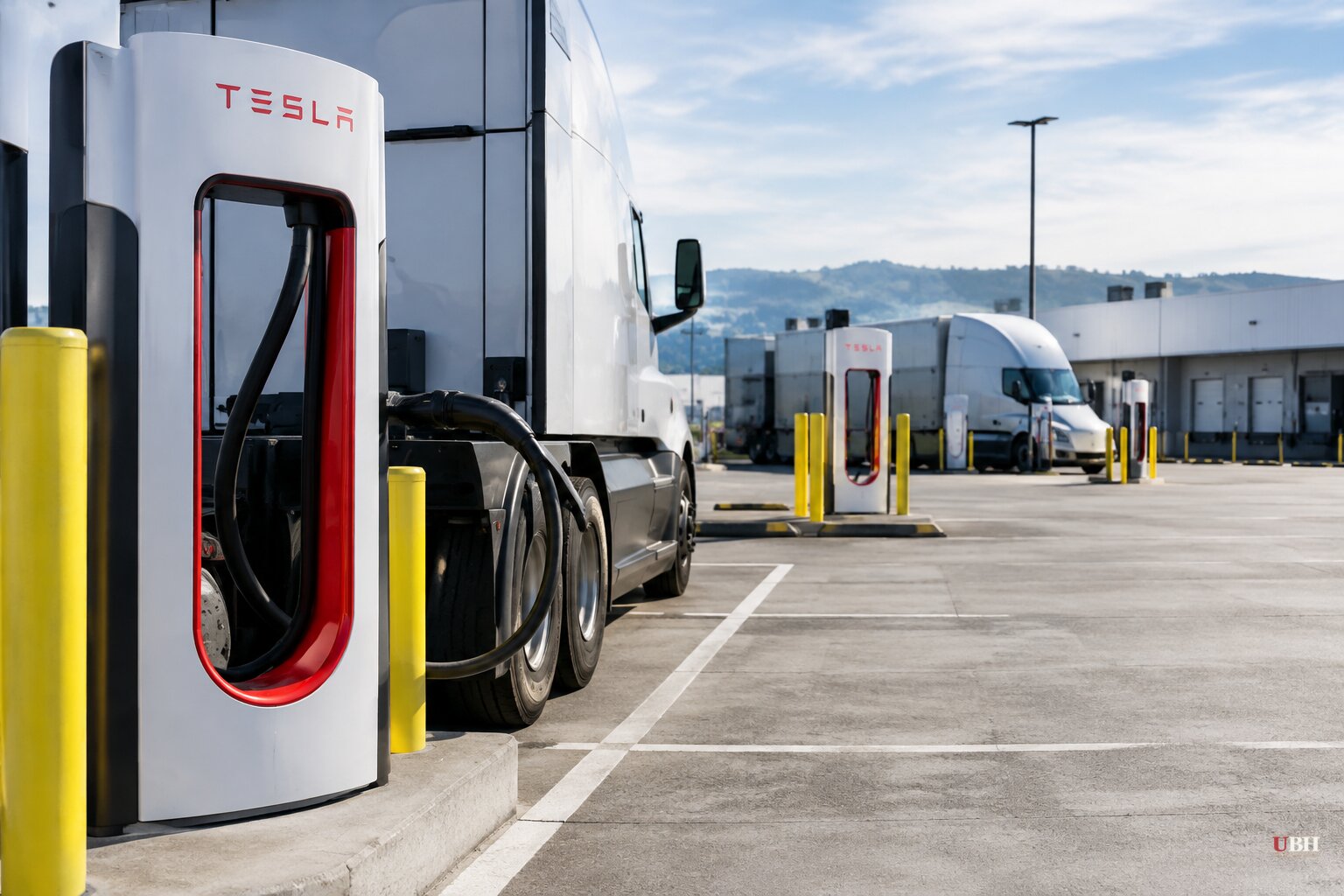
Tesla is expanding its Megacharger footprint. Forum Mobility, a California-based heavy-duty EV charging operator, announced on September 17 that it will break ground on four new electric truck depots across the state, adding 30 megawatts of charging capacity. Tesla will operate the public Megacharger stations at three of them, according to Forum Mobility's own announcement, distributed via PR Newswire.
Three Sites, One Still Contracted
The three depots getting Tesla-operated public Megacharging are FM Francis in Ontario, and FM Adeline and FM Coliseum, both in Oakland. A fourth site, FM Santa Fe in Rancho Dominguez, is locked up with contracted fleet capacity for more than 330 Tesla Semi trucks, though Forum Mobility says it will still be open to the broader drayage community.
None of these four depots are running yet. Forum Mobility's release describes them as sites the company is about to break ground on, not facilities already in service. The one Tesla-linked site that is actually operating is FM Harbor at the Port of Long Beach, which has run since December 2024 with 44 CCS ports and 9 megawatts of capacity. Forum Mobility recently added two Tesla MCS Megachargers there.
All four new depots will mix Tesla's Megawatt Charging System with standard CCS ports and use pull-through lanes so drivers don't have to unhook trailers to charge. Forum Mobility says the MCS chargers can add 60% of range in about 30 minutes.
The Business Model: Sell the Hardware, Take a Cut
Tesla isn't buying land or building depots here. It sells the Megacharger unit for $188,000 and collects $0.08 per kilowatt-hour on charging done at third-party sites like Forum Mobility's, a rate 20% below what it charges under its Supercharger for Business program, according to Electrek and Motors Machine, both of which reported identical figures.
The hardware runs on the open MCS 3.2 standard, meaning it can charge electric trucks built by Daimler, Volvo, and Scania, not just the Tesla Semi. That's a deliberate hedge for Forum Mobility, whose depot customers run mixed fleets.
Tesla currently has 66 planned Megacharger locations on its network map, with most targeted to open this year, according to Electrek. Partner-run sites like Forum Mobility's are how a chunk of that map gets filled without Tesla owning the dirt.
Why Forum Mobility Exists
Forum Mobility launched in 2022 betting that California's Advanced Clean Fleets rule would push drayage operators, the trucks that haul containers between ports and inland warehouses, to electrify faster than any other heavy-truck segment. Rather than sell trucks or chargers itself, the company built charging-as-a-service depots and signed carriers to multi-year contracts.
That bet appears to be paying off on paper. Forum Mobility now counts 25 carrier customers with contracted capacity and more than 40 MW of charging online or under construction, per the company's own release. Reservations for more than 330 Tesla Semis are one of the largest disclosed fleet commitments for the truck to date.
"The highly favorable total cost of ownership for battery-electric class 8 trucks has driven rapid motor carrier adoption," said Matt LeDucq, Forum Mobility's CEO and co-founder, in the company's announcement. Kristi McKenney, executive director of the Port of Oakland, called the partnership a way "to deliver advanced clean truck solutions, for the benefit of our neighbors and our drayage carrier community."
Taxpayer Money in the Mix
Forum Mobility says the California depots are funded in part by grants from the Bay Area Air Quality Management District, the California Energy Commission, the California Transportation Commission, Caltrans, EnergIIZE, and the Los Angeles County Metropolitan Transportation Authority. That means public dollars are underwriting part of a build-out from which Tesla, a for-profit corporation, collects hardware sales and per-kWh revenue. Neither Forum Mobility nor Tesla has disclosed what share of the 30 MW expansion the grants actually cover.
The Electric Viking's coverage of the deal folded in an unrelated data point: Tesla's global vehicle sales fell to 1,654,667 units in 2025, a 6.2% year-over-year drop and the second straight annual decline. The outlet speculated the Megacharger buildout "may help Tesla regain momentum in the commercial EV sector." No source in Forum Mobility's own materials or in Tesla's stated business model connects the truck-charging partnership to passenger-vehicle sales trends.
Forum Mobility says its next wave of depots is planned for the Inland Empire, the Central Valley, Las Vegas, Phoenix, Houston, Dallas, Seattle/Tacoma, and Chicago. Separately, Tradingpedia reports Tesla is preparing to launch the Semi in Europe next year. Neither company has given a firm completion date for the four California depots covered in this announcement, leaving the actual in-service timeline an open question.
Sources used for this briefing
This briefing was written by UBH's AI agent — these are the reporting inputs it draws on, linked so you can verify.


