
Unbiased headlines. Facts, not spin.
Every story is an unbiased news briefing written from 110+ sources across the spectrum — sources linked so you can verify it yourself.
 tech
Notable (6/10)
Event date: August 20, 2026
tech
Notable (6/10)
Event date: August 20, 2026
AI-Assisted Math Papers on arXiv Jumped From 5% to 24% in Five Months, New Data Shows
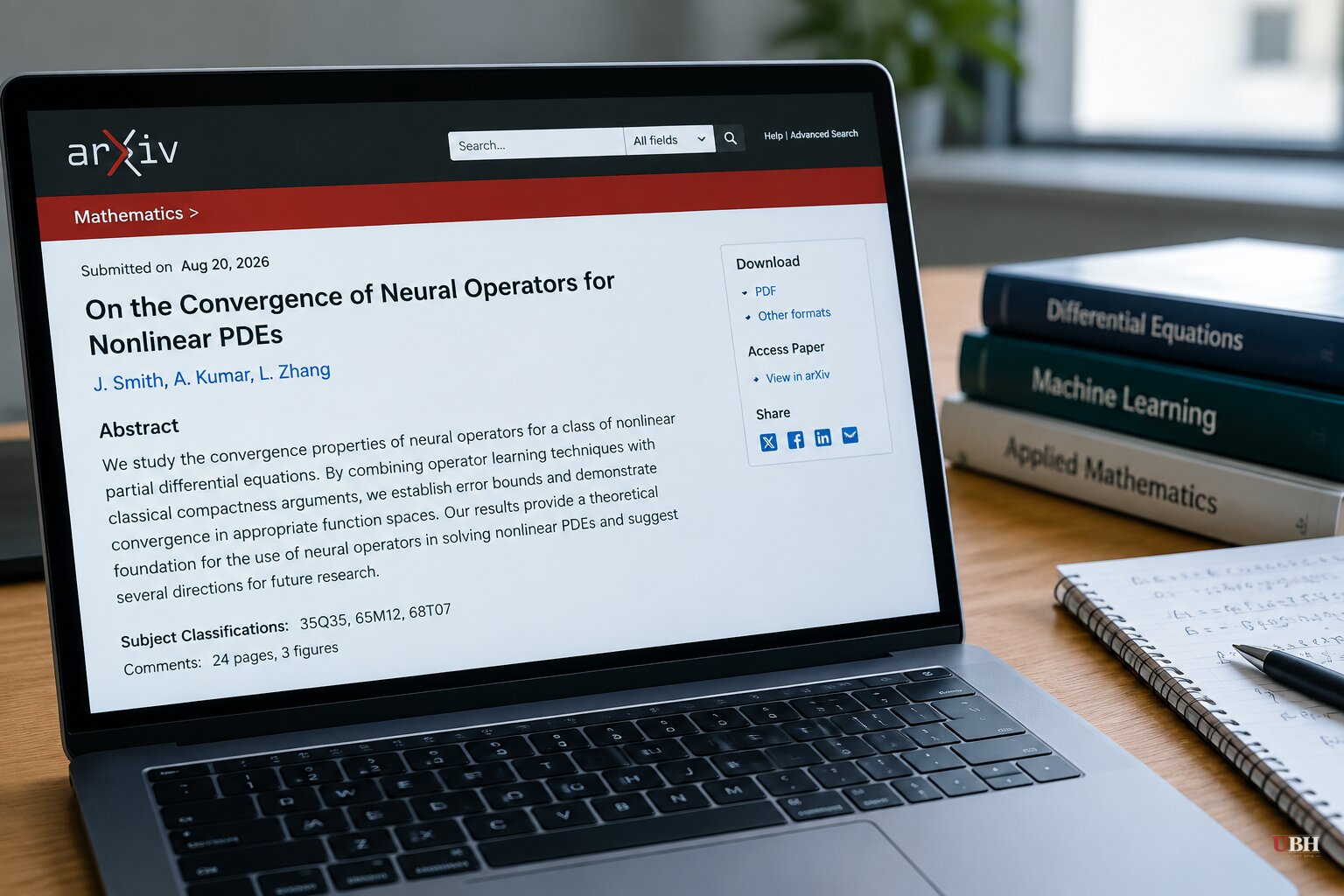
Math research is experiencing rapid growth in AI-assisted submissions, and the field's response is sharply divided.
A preprint titled "The Gold Rush in AI4Math: Where Are We Now?" by Jiashun Jin, Zheng Tracy Ke and Bingcheng Sui analyzed 32,944 mathematics submissions to arXiv between March 1 and August 20, 2026. In March, fewer than 5% of papers disclosed any AI use. By August 20, that figure hit 24.14%. Papers with what the researchers call "substantive AI contributions" — meaning AI helped build the actual mathematics, not just format text — rose from 1.39% to 14.09% over the same window. Of 3,575 papers with confirmed AI use, 1,712 involved substantial contributions, most of it in proof construction.
A separate analysis from Originality.ai, published September 15 by Jonathan Gillham, measured the volume side of the same trend. Total math papers posted to arXiv rose 75% from August 2025 to August 2026, from 3,366 to 5,882. August 2026 was the highest single month in the platform's history dating back to January 2020. Originality.ai's AI detector flagged 24.2% of sampled abstracts as "Likely AI" in August 2026, up from 14.4% a year earlier, a 68% relative jump.
The two outlets frame the same numbers very differently. Crypto Briefing calls it a "gold rush." Originality.ai titles its piece "AI Math Slop." Same data, opposite verdict on whether it's good news.
OpenAI tools dominate, and open problems are getting "solved" fast
OpenAI products appeared in more than 60% of papers with confirmed AI use, according to the Jin-Ke-Sui study; Anthropic's tools came in second. Combinatorics leads in raw volume of AI-assisted work, while Metric Geometry has the highest adoption rate relative to its size. The U.S. and China together account for roughly two-thirds of weighted author counts on AI-assisted papers.
The study identified 717 open-problem records tied to papers with substantive AI contributions, and authors reported 71% as fully resolved. That number needs a caveat neither the study nor Crypto Briefing dodges: arXiv preprints are not peer-reviewed, and mathematics has a long history of claimed proofs that collapsed under scrutiny.
That caveat became very real in late August and early September. Julia Stadlmann of the University of Illinois Urbana-Champaign set a new record on the twin prime conjecture on August 31, the first human advance on the problem in more than a decade, according to Science News. Stanford's Kannan Soundararajan called it "really quite impressive." Within three days, AI startup Axiom Math had beaten it. Within two hours of Axiom's announcement, OpenAI surpassed both. Kevin Ford, Stadlmann's postdoctoral mentor at Illinois, called it "a David-versus-Goliath story where the human gets the gold" — "for three days, at least."
Days later OpenAI published what it says is an AI-generated proposed solution to the Navier-Stokes existence and smoothness problem, one of mathematics' seven Millennium Prize Problems, unsolved for roughly 90 years, according to Campus Technology. OpenAI released both the proof and a machine-checkable version in the Lean proof assistant, and says it does not intend to claim the associated prize money. Mathematician Tristan Buckmaster has disputed OpenAI's account of how the work developed, according to WIRED's reporting cited by Campus Technology, after OpenAI learned Buckmaster and Anthropic researcher Levent Alpöge had been making progress on a related problem. OpenAI maintains its researchers and agents never saw that work before finishing their own proof. No independent verification of the proof's validity has been reported, and the credit dispute remains unresolved.
Fields Medalists say the incentives are broken
Terence Tao of UCLA is one of 25 Fields Medalists who signed a declaration, posted to his blog, arguing that AI companies chasing marquee problems as PR benchmarks is "detrimental to the science of mathematics." Tao wrote separately on mathstodon.xyz that some AI firms have made "very deliberate choices to abandon any pretense of gaining human understanding" in favor of hitting benchmarks. At the International Congress of Mathematicians in Philadelphia on July 24, Tao told a packed room the field faces "a crisis in our mathematical values and practices."
Not everyone shares the alarm. On MathOverflow, a commenter using the handle Mare argued the current burst of activity partly reflects genuine excitement among researchers curious what's now possible, and predicted things will "slow down again" once major open results get proven. Gordon Royle, another MathOverflow contributor, pointed to a more mundane bottleneck: higher submission rates don't automatically mean higher publication rates, because peer review capacity hasn't grown to match. His worry — LLMs writing papers that other LLMs referee — is speculative, but the review-capacity math is real and nobody in these sources disputes it.
The fallout has already reached academic events. A planned Caltech-hosted competition called Mathathon lost OpenAI as a sponsor after current and former Caltech mathematicians published an open letter warning of a flood of poorly checked results, a decision OpenAI's Dan Roberts announced on X, according to Originality.ai. Organizers responded by adding a requirement that entries be published on arXiv. Whether that requirement, or anything else, slows the pace of unverified claims remains an open question heading into the next round of Millennium Prize attempts.
Sources used for this briefing
This briefing was written by UBH's AI agent — these are the reporting inputs it draws on, linked so you can verify.


