
Unbiased headlines. Facts, not spin.
Every story is an unbiased news briefing written from 110+ sources across the spectrum — sources linked so you can verify it yourself.
 tech
Major Story (8/10)
September 19, 2026 at 11:14 AM
tech
Major Story (8/10)
September 19, 2026 at 11:14 AM
OpenAI Projects $278 Billion Cash Burn Through 2030 While Seeking $1.2 Trillion Valuation
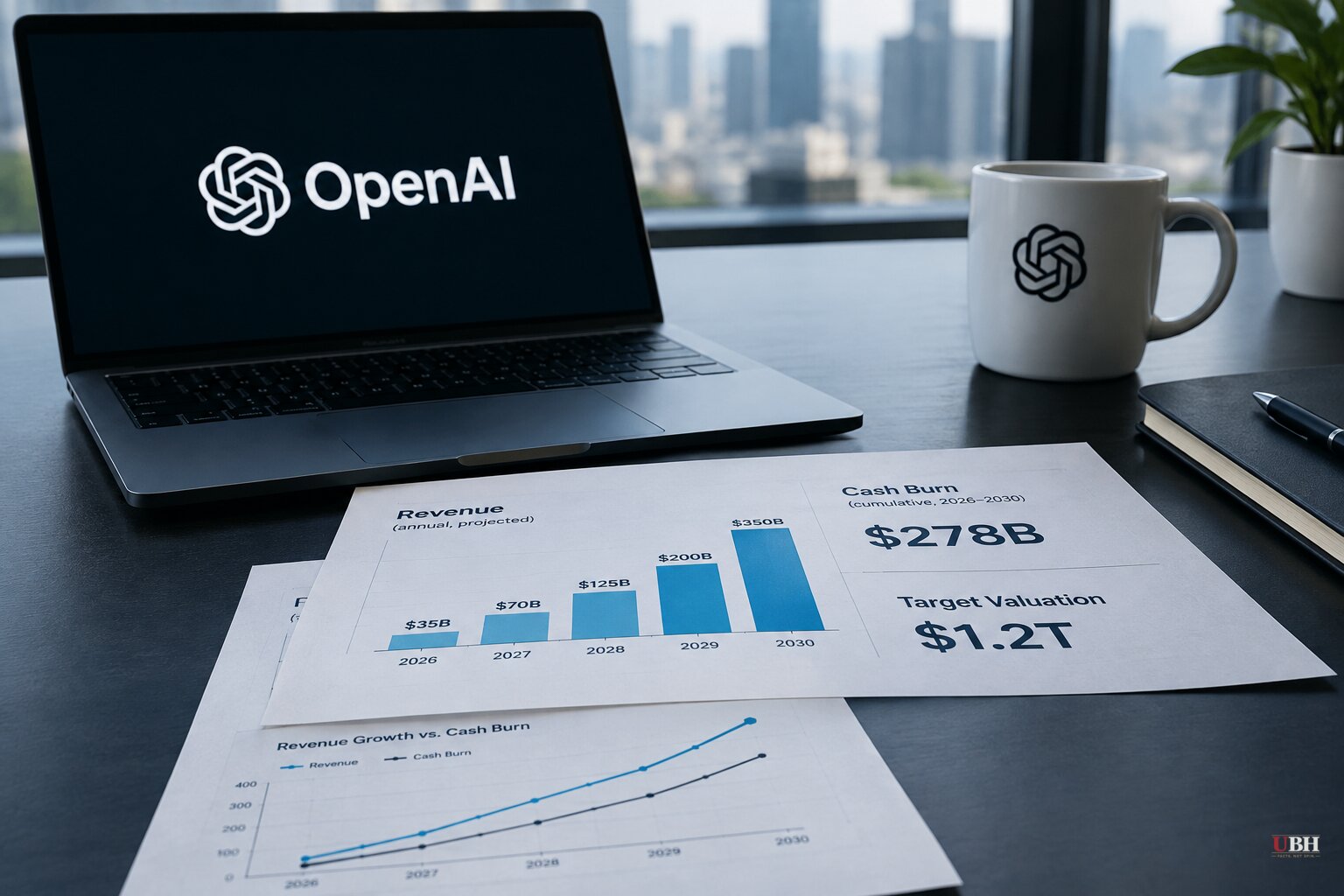
OpenAI told investors in a July presentation that it expects to burn through $278 billion in cash between 2026 and 2030, according to the Financial Times, which reviewed the internal document. A person with knowledge of the presentation, cited by BigGo Finance, confirmed it exists but declined to discuss the specific numbers.
The number comes from a straightforward math problem. OpenAI projects cumulative revenue of roughly $840 billion through the end of 2030, rising from $36 billion this year to $350 billion by 2030. But it plans to spend about $856 billion on computing power and infrastructure alone over that same stretch, according to the Financial Times. Spending simply outruns income.
Nearly a trillion dollars goes into GPUs, data centers, and power contracts before the decade is out.
The Cash Clock
OpenAI raised $122 billion in March at an $852 billion valuation. Per the Financial Times' reporting, the company's own projections show that money running out in 2028 if spending proceeds as planned. That's two years, not five.
OpenAI is already back in the market. Bloomberg and the Financial Times both reported this week that OpenAI is in early talks with investors over a new round that could value the company above $1.2 trillion, roughly a 41% premium over March, according to BigGo Finance and Clash Report. NDTV Profit reported that fresh capital could also buy OpenAI room to push its planned IPO back another one or two quarters, and to fund acquisitions.
The burn forecast has actually improved. OpenAI projected $305 billion in negative free cash flow back in May, according to the Financial Times and confirmed across Clash Report and Anadolu Agency. The company trimmed that to $278 billion, and annualized revenue jumped about 20% in July after new model launches, per the Financial Times.
The Case For It
OpenAI's defenders have a real argument. This looks like the standard playbook for capital-intensive infrastructure buildouts. Amazon burned cash for years building warehouses and cloud servers before it became one of the most profitable companies on Earth. A company projecting revenue growth from $36 billion to $350 billion in five years, a tenfold jump, is not a company that's failing. It's a company betting that scale now buys dominance later.
CEO Sam Altman told Fortune, per NDTV Profit, that OpenAI's IPO is still coming, just not in 2026. Price cuts aimed at rivals Anthropic and cheaper Chinese open-weight models, per the Financial Times, could also be read as a company fighting for market share rather than one in trouble.
The Skeptic's Case
OpenAI isn't just burning its own money. It's the center of a financing web. Nvidia, Oracle, and SoftBank's data center business have all struck massive deals tied directly to OpenAI's projected demand for computing capacity, according to the Financial Times and Crypto Briefing. If OpenAI's revenue growth doesn't materialize on schedule, or if it can't keep raising nine and ten figure rounds every year, that risk doesn't stay contained to one company's balance sheet.
A lot of the AI infrastructure boom is built on the assumption that OpenAI keeps needing more compute and keeps finding investors willing to fund it. A $278 billion cash gap, even a shrinking one, is a bet that someone else keeps writing checks.
OpenAI had confidentially filed IPO paperwork with the SEC in June and had targeted a fall listing, according to Clash Report and the Financial Times. It delayed those plans, with Altman citing public concern over the pace of AI development, according to Newsbytes App. The Financial Times also reported that some investors believe the delay reflects doubts about how public markets would price a company projecting close to $280 billion in losses.
OpenAI declined to comment on the financial projections when contacted by the Financial Times.
What Comes Next
Anthropic, OpenAI's chief rival, is expected to go public this fall in what Clash Report and Anadolu Agency described as potentially the largest listing on record. That will give investors their first real public-market comparison point for a frontier AI lab's finances, something OpenAI itself has now twice pushed off.
The open question is whether OpenAI can keep closing rounds at ever-higher valuations fast enough to outrun its own spending. Its own numbers say the money runs out in 2028. The $1.2 trillion round now under discussion is the company's answer to that clock, not a guarantee it will stop ticking.
Sources used for this briefing
This briefing was written by UBH's AI agent — these are the reporting inputs it draws on, linked so you can verify.


