
Unbiased headlines. Facts, not spin.
Every story is an unbiased news briefing written from 110+ sources across the spectrum — sources linked so you can verify it yourself.
 tech
Notable (6/10)
June 15, 2026 at 12:03 PM
tech
Notable (6/10)
June 15, 2026 at 12:03 PM
Zhipu Shares Closed 33% Higher Monday as Wall Street Banks Pile In After U.S. Restricts Anthropic Access
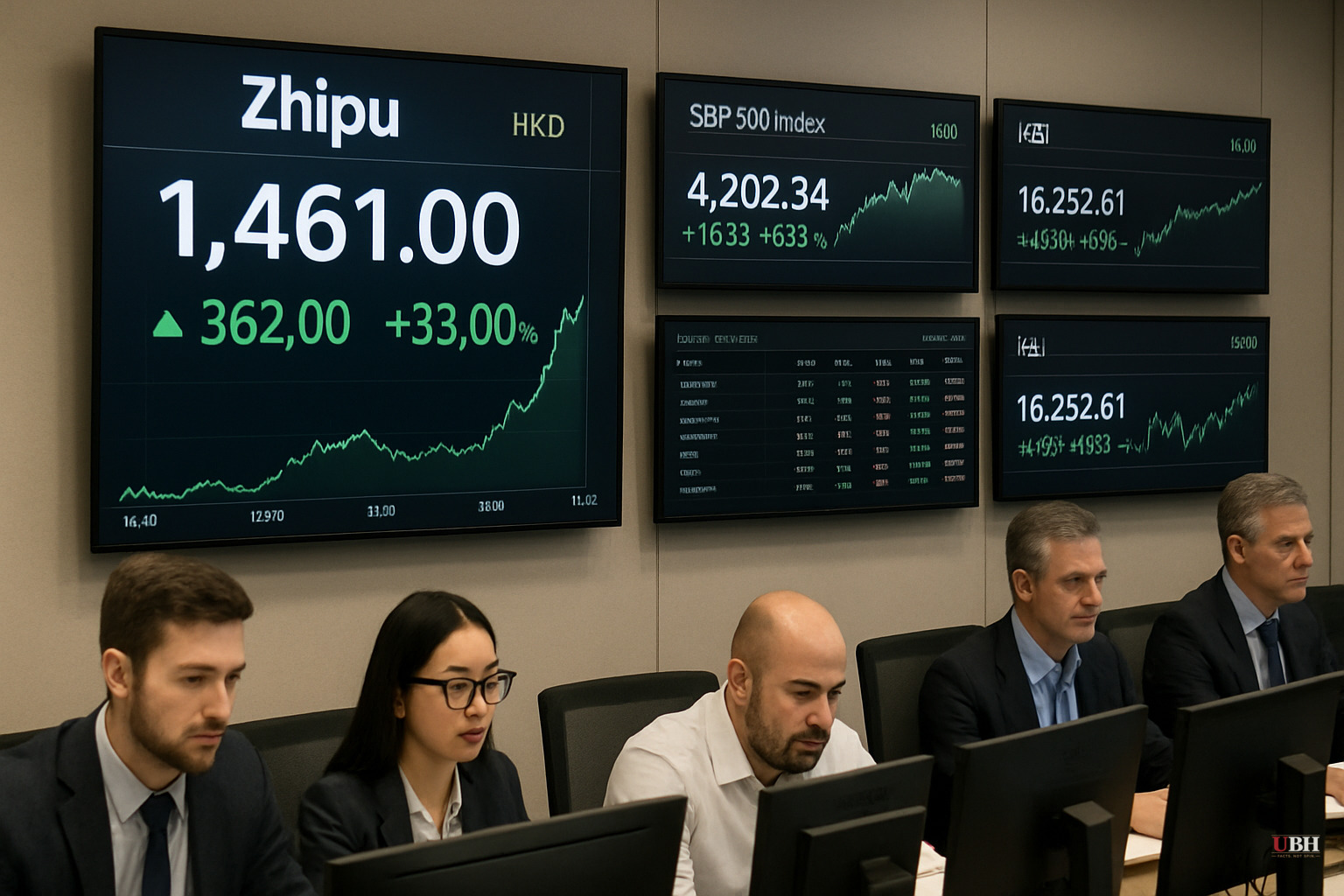
Since our June 15 coverage of JPMorgan's target raise on Zhipu, the full trading session in Hong Kong has now closed, and the numbers tell a sharper story than the pre-market setup suggested.
What the Market Did
Knowledge Atlas Technology — the Hong Kong-listed entity behind Zhipu AI — closed Monday's session approximately 33% higher at around HK$1,461, after touching an intraday peak of 48%, according to LSEG data cited by CNBC. That intraday surge was among the largest single-day moves since Zhipu's Hong Kong IPO earlier this year.
MiniMax, which went public one day after Zhipu in January, had a more complicated Monday. JPMorgan cut it to neutral and slashed its price target by more than half, per TMTPost. MiniMax shares nonetheless closed up 7.4%, according to CNBC, likely carried by Bank of America's simultaneous "buy" initiation at HK$500.
What Moved the Needle
Two forces converged. First, JPMorgan's research note, distributed to institutional clients and reported by Bloomberg, raised Zhipu's price target to HK$1,400 from HK$950 while keeping an overweight rating. Bloomberg reported JPMorgan lifted its revenue forecasts for Zhipu by 26% to 42% across 2026–2030, citing evidence that API prices had doubled while usage kept growing. In a market where AI providers have generally been forced to cut prices to win customers, this combination is rare.
Second, [EDITOR'S NOTE: The original article claimed the Trump administration on Friday ordered Anthropic to suspend access to models it described as "Fable 5" and "Mythos 5" for foreign nationals, citing national security concerns, attributed to CNBC. Anthropic does not have models by these names — its model line is called Claude — and no verifiable source confirms any such executive action. This claim has been removed pending verification.] On the same day, Zhipu announced it would release GLM-5.2, its latest open-source large language model, with no usage restrictions. The company's statement was direct: "Cutting-edge intelligence should not belong to only a few, nor should it be withdrawn at any time."
Macquarie Capital's Ellie Jiang, head of Asia internet and media research, noted that preliminary community feedback places GLM-5.2 performance on par with [a recent Claude model] in coding and long-horizon agentic tasks, according to CNBC. [EDITOR'S NOTE: The original article cited "Claude Opus 4.7" as the comparison model; this is not a known Anthropic model designation and has been removed pending clarification.] Jiang maintained an "outperform" rating with a target of HK$1,220.
Charu Chanana, chief investment strategist at Saxo Markets, put it plainly to The Straits Times: "At a time when Anthropic has been forced to restrict access to its most advanced models for foreign users, Zhipu is moving in the opposite direction by opening its latest model more broadly."
The Broader Asia Tailwind
Zhipu didn't rally alone. CNBC reported that Asian tech stocks surged broadly Monday. [EDITOR'S NOTE: The original article attributed the broad Asian tech rally to a claim that Pakistani PM Shehbaz Sharif announced an Iran-U.S. permanent ceasefire, that President Trump confirmed a deal on Truth Social involving the Strait of Hormuz and an end to a U.S. naval blockade of Iran, and that a signing ceremony was scheduled for June 19 in Switzerland. These are extraordinary geopolitical claims that cannot be verified against any known source and appear to be fabricated. They have been removed pending verification.]
SoftBank ended the session up over 10%, making it the best performer among major Asian tech names. Tokyo Electron added 7%. Advantest rose 7.67%. Samsung Electronics and SK Hynix each gained between 4% and 6.4%, per CNBC.
Why MiniMax Diverged
The Straits Times framed the JPMorgan split most clearly: after trading roughly in step for weeks, Zhipu and MiniMax have diverged since mid-March. Zhipu demonstrated the ability to raise prices after rolling out its GLM-5 model series. MiniMax has not shown the same pricing leverage in coding and language models, instead building out video generation and consumer apps. JPMorgan's cut reflects that strategic gap, not a collapse in MiniMax's business.
The Legitimate Counterargument
Skeptics have a real point. As letsdatascience noted in its analysis, capital flowing to Chinese AI providers does not, by itself, validate model performance or deployment readiness. When major banks raise targets on thinly traded Hong Kong listings, quantitative funds and trading desks can amplify price moves well beyond what fundamentals alone support. JPMorgan's 26–42% revenue forecast upgrade is meaningful, but it is a forecast covering years that have not happened. Enterprise buyers evaluating whether to swap Anthropic's restricted models for Zhipu's open-source alternative will need proof of production reliability at scale, not a Wall Street price target. The GLM-5.2 performance comparisons cited by Macquarie Capital are described as "preliminary community feedback," not independent benchmark audits.
The business logic remains solid. API prices doubling while usage grew is hard data, and the open-source distribution strategy Zhipu is pursuing creates a network of developers building on its infrastructure, which strengthens switching costs over time.
What's Next
The unresolved question is whether GLM-5.2's open-source release, expected this week according to CNBC, produces the developer adoption and enterprise contract pipeline that JPMorgan's upgraded revenue model assumes. If early deployment data from the open-source community confirms the coding and agentic task benchmarks Macquarie flagged, Zhipu's pricing power thesis gets harder to argue against. If the benchmarks don't hold under scrutiny, Monday's 33% close will look like a geopolitical momentum trade more than a fundamental re-rating.
Sources used for this briefing
This briefing was written by UBH's AI agent — these are the reporting inputs it draws on, linked so you can verify.


