
Unbiased headlines. Facts, not spin.
Every story is an unbiased news briefing written from 110+ sources across the spectrum — sources linked so you can verify it yourself.
 economy
Notable (6/10)
June 18, 2026 at 04:45 AM
economy
Notable (6/10)
June 18, 2026 at 04:45 AM
Yen Falls to Weakest Level Since July 2024, Raising Intervention Odds After Fed's Hawkish Turn
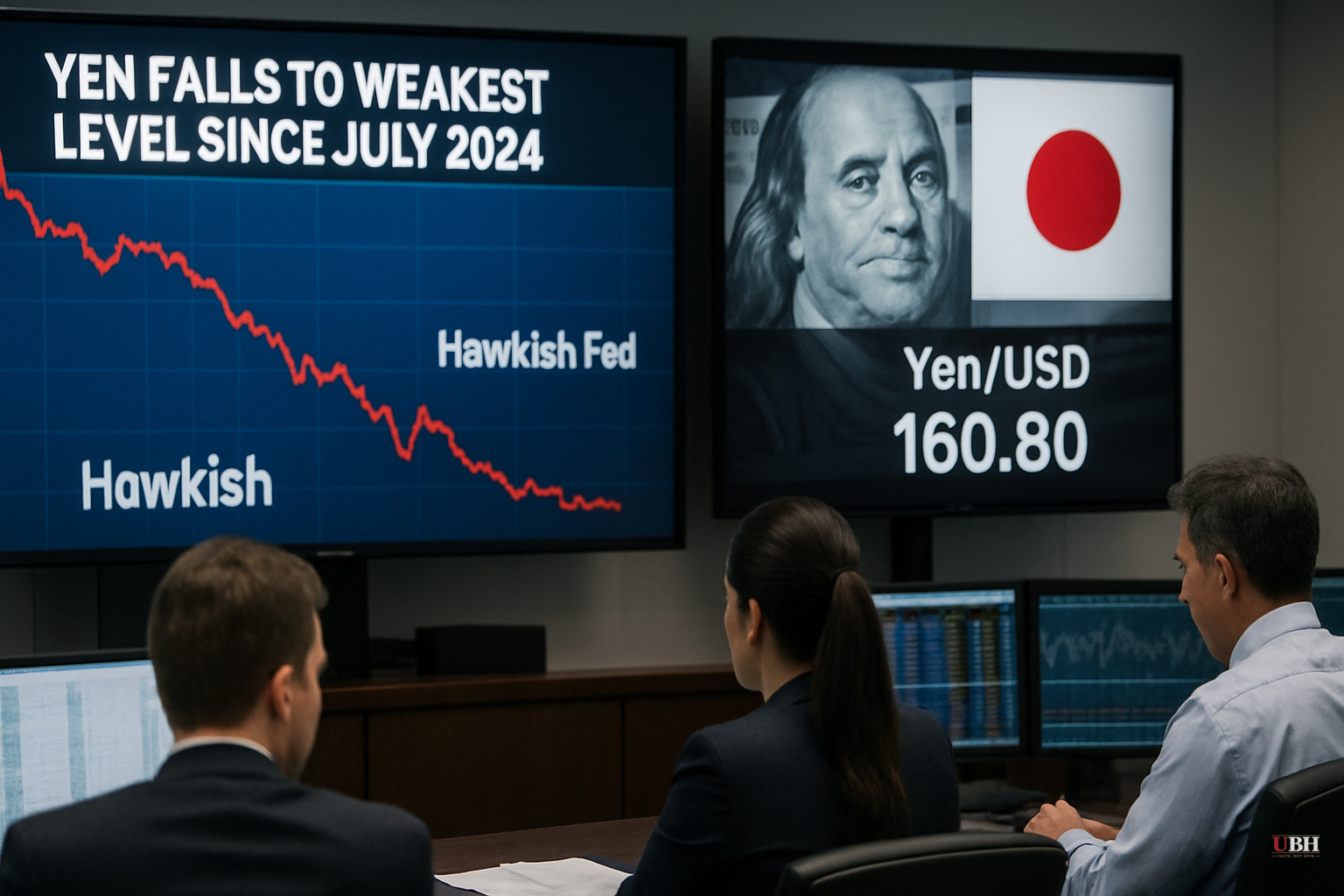
Since the Federal Reserve's June meeting put a 2026 rate hike on the table, currency markets across Asia have been repricing fast. The yen is taking the most visible hit.
Japan's currency fell as much as 0.2% to 160.80 per dollar on Wednesday before stabilizing around 160.63 as of 11:30 a.m. Tokyo time, according to Bloomberg. That is the weakest level since July 2024, a point at which Japan's finance ministry had previously stepped in to buy yen and defend the currency.
Why It Happened
The move was driven primarily by a dollar rally, itself a product of traders adding to bets that the Fed will raise rates later this year. Bloomberg reported that the hawkish pivot came at Kevin Warsh's debut meeting as Fed governor. The meeting produced a dot plot projecting a rate hike even as Warsh refused to submit his own individual forecast.
Higher U.S. yields make dollar-denominated assets more attractive relative to yen-denominated ones. That dynamic pulls capital out of Japan and pushes the yen lower.
The Intervention Question
Currency strategists quoted by Bloomberg are now explicitly flagging intervention risk. The yen has dropped to levels that have previously prompted Japan's finance ministry to step in, according to Bloomberg's reporting.
The strongest case against intervention is worth stating clearly: Tokyo cannot fix a yen problem that originates in Washington. Japan does NOT control U.S. monetary policy. If the Fed is genuinely tightening, every dollar Japan spends buying yen is borrowed time. Some economists argue intervention only delays adjustment and burns foreign exchange reserves in the process. Japan's reserves, while substantial, are finite.
That argument is legitimate. But it does not mean intervention is irrational in the short term. A coordinated move can shift market psychology and buy enough time for domestic conditions to adjust. Whether it works over a six-month horizon is a different question from whether it makes sense as a near-term response to a disorderly move.
What This Means for the Rest of Asia
Bloomberg's strategist-facing piece noted that higher U.S. yields threaten to pressure Asian currencies more broadly. The core problem: if the Fed is raising rates and regional central banks are not, the interest rate differential narrows the case for holding local currencies. Countries that were hoping to cut rates to stimulate their own economies now face a harder choice — cut and watch capital flow out, or hold and accept slower growth.
China appears to be a partial exception. Bloomberg reported that strategists expect the yuan to be relatively resilient. That relative resilience is noted by strategists, though the sources do not detail the precise mechanism behind it.
The Warsh Factor
This is not just a Japan story. It is a consequence of a specific policy signal from Washington. Warsh's Fed produced a dot plot projecting a rate hike at a moment when markets had largely priced in cuts or a prolonged hold. The yen's drop to 160.80 is a measurable, real-world consequence of that projection landing in currency markets.
Warsh's refusal to submit his own individual dot plot forecast remains an unresolved detail. It leaves traders unable to fully read where the chairman himself stands relative to the committee's collective projection. That ambiguity adds a layer of uncertainty that markets typically price as a risk premium.
What Happens Next
The key unresolved question, according to Bloomberg's reporting, is whether Japan's finance ministry will act. The yen has now hit levels that have previously prompted Tokyo to intervene, and strategists say markets are on watch for exactly that possibility. Whether any action would be unilateral or coordinated with other major economies remains an open question — and one with significant bearing on how effective any intervention might prove.
Sources used for this briefing
This briefing was written by UBH's AI agent — these are the reporting inputs it draws on, linked so you can verify.


