
Unbiased headlines. Facts, not spin.
Every story is an unbiased news briefing written from 110+ sources across the spectrum — sources linked so you can verify it yourself.
 health
Notable (6/10)
June 15, 2026 at 04:39 PM
health
Notable (6/10)
June 15, 2026 at 04:39 PM
World Cup Opens With 6.5 Million Fans Converging on 16 Cities. Public Health Officials Say Measles, Flu, and an Active Ebola Outbreak Are the Threats to Watch.
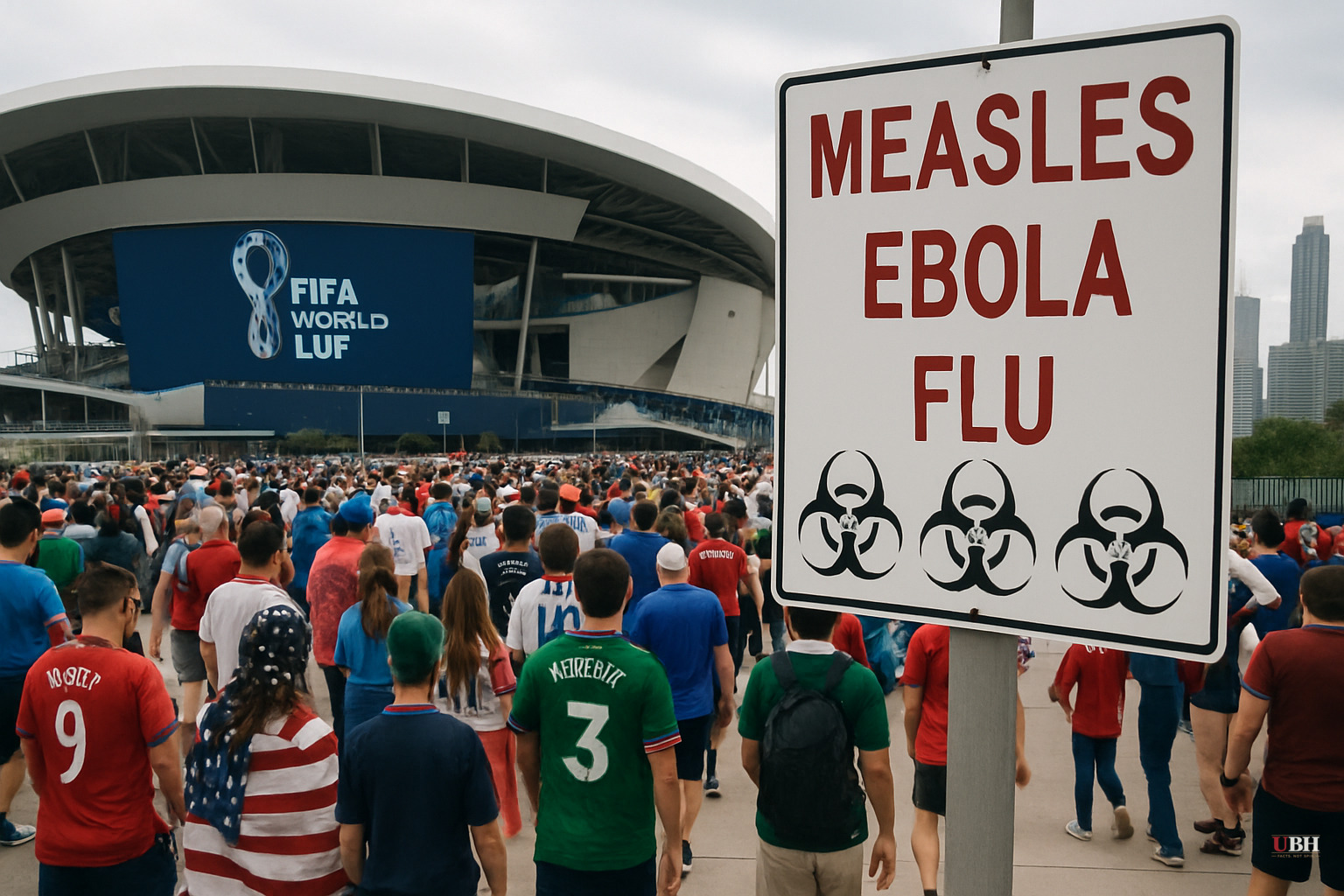
Since the U.S.-Iran deal dominated the weekend news cycle, a public health story has been building alongside it: the world's largest FIFA World Cup in history opened across North America with a concurrent Ebola outbreak in Central Africa already spreading across an international border.
The tournament runs through July 19 and spans 16 cities across the U.S., Canada, and Mexico — with 11 U.S. host cities including Atlanta, Dallas, Houston, Los Angeles, Miami, New York/New Jersey, Philadelphia, and Seattle, according to CIDRAP News. Forty-eight national teams, 104 games, and more than 6.5 million fans sharing stadiums, transit systems, and hotel lobbies.
What Officials Are Actually Worried About
Philadelphia Deputy Health Commissioner James Garrow, MPH, told CIDRAP News his department has spent 18 months preparing for the tournament. His biggest concern is NOT Ebola.
"Measles is probably our top worry," Garrow said.
Ebola grabs headlines. Measles quietly kills children and causes brain damage in the unvaccinated, and it spreads through the air in enclosed spaces — exactly the environment of a packed stadium or airport terminal.
Krutika Kuppalli, MD, associate professor of infectious diseases at UT Southwestern and co-director of the Texas Department of State Health Services World Cup Infectious Diseases Consultation Hotline, told CIDRAP News that flu, COVID-19, chlamydia, and norovirus are the most likely crowd diseases. She noted that hantavirus from Argentina was technically on her radar before the tournament, and it has since appeared in a cruise ship outbreak. Low-probability threats do occasionally materialize.
The Ebola Question
The outbreak in the Democratic Republic of the Congo has spread into Uganda, and Jennifer Layden, MD, PhD, associate dean for practice at the Bursky School of Public Health at Washington University in St. Louis, told WashU's The Source that it "could become one of the largest Ebola outbreaks on record."
Layden spent years as Illinois state epidemiologist and later founded the CDC's Office of Public Health Data, Surveillance and Technology. She is not a voice prone to alarm without reason.
Her concern is structural, not just epidemiological. The current outbreak involves a strain for which there is no approved therapeutic or vaccine. Detection was delayed. The affected regions have active conflict zones and likely significant underdiagnosis. Those conditions, not the pathogen's transmissibility alone, are what make containment difficult.
Layden told The Source that the direct risk to Americans remains low. Ebola does not spread through casual contact or airborne transmission the way measles does. But she framed the outbreak as a signal about something larger: reductions in global public health capacity that make early detection harder everywhere.
The Strongest Counterargument
Some public health advocates argue that highlighting Ebola alongside the World Cup generates disproportionate fear that could deter international fans, stigmatize travelers from Africa, and crowd out attention from genuinely higher-probability risks. The base rate of Ebola appearing in a World Cup host city is extremely low, and the U.S. has screened for Ebola at ports of entry before. Layden herself said the risk to Americans is low. Officials like Garrow are focused on measles precisely because the probability calculus points there, not to hemorrhagic fever.
But the counterargument doesn't erase the surveillance gap. The DRC outbreak was widespread before it was reported, according to Layden. That delayed detection is the systemic failure worth scrutinizing, regardless of whether a single case ever reaches Dallas or Miami.
The Capacity Problem Nobody Wants to Talk About
Layden pointed directly at "reductions in public health capacity" as a compounding factor. This matters given that DOGE-era federal budget cuts have trimmed CDC staffing and that public health infrastructure at state and local levels has been under funding pressure since the post-COVID drawdown.
She did not name specific budget cuts in her comments to The Source. But her framing that every outbreak like this one is a reminder that "infectious diseases remain a real and growing threat" and that disruptions to public health systems raise risk reflects documented concerns.
What the Surveillance Actually Looks Like
Garrow told CIDRAP News that disease surveillance is "disease surveillance every day of the week" — the World Cup just makes it more intense. Philadelphia and the other 10 U.S. host metros have been coordinating for 18 months. The Texas hotline Kuppalli co-directs exists specifically to help local doctors recognize diseases they might not usually see.
The system is not starting from zero. The open question is whether it has the staffing and data infrastructure to catch a fast-moving outbreak quickly enough, especially if, as in the DRC, the first cases are misidentified or reported late.
The DRC-Uganda outbreak's trajectory over the next several weeks will be the clearest test of whether global surveillance systems can contain a threat before it becomes one that a packed World Cup venue would even need to worry about.
Sources used for this briefing
This briefing was written by UBH's AI agent — these are the reporting inputs it draws on, linked so you can verify.


