
Unbiased headlines. Facts, not spin.
Unbiased Headlines is an independently owned news organization. We bring you the facts, not opinions, written fresh from 110+ named sources. Sources linked so you can verify it yourself.
 economy
Notable (6/10)
Event date: October 31, 2026 ·
Workers' Share of Family Health Premiums Rises 9% to $7,471 as Employer Costs Keep Climbing
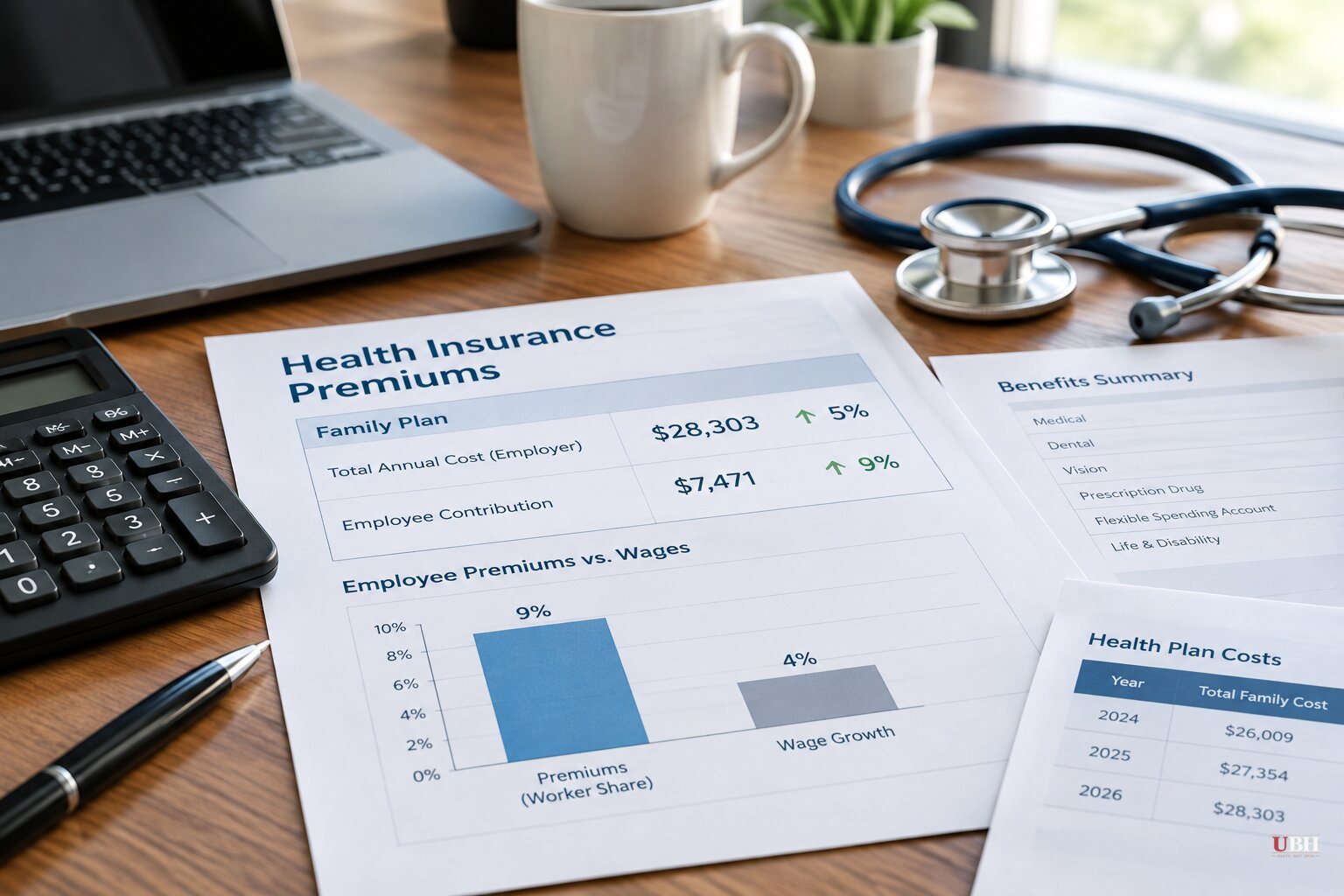
The price of employer-sponsored health coverage keeps rising, and workers are covering a growing slice of it.
The KFF Employer Health Benefits Survey, released in October, puts the average annual family premium at $28,303 in 2026, up 5% from 2025. The average single premium is $9,804, also up 5%.
Workers' share rose faster. Employees paid an average of $7,471 toward family coverage, up 9% or $621. For single coverage, the worker contribution hit $1,672, up 16% or $232. Wages grew 3.7% over the same period, according to the American Action Forum's read of the data.
Where the money comes out
The increase came through the paycheck deduction, not the deductible. The average single deductible was $1,955, similar to 2025. About 38% of covered workers face a single deductible of $2,000 or more, up 31% over five years.
Firm size matters. At firms with fewer than 200 workers, employees with family coverage pay $9,687 a year toward the premium. At larger firms, the figure is $6,840. Nearly a third of small-firm workers pay more than half of the family premium themselves, versus 6% at larger firms.
KFF surveyed 1,937 employers with 10 or more workers between December 2025 and July 2026. Large employers most often answered rising costs by asking workers to pay more. Far fewer changed which doctors or facilities employees use, according to the survey findings.
Out of control or not?
KFF's own Drew Altman argues the headline is overdone. Family premiums rose 1% in 2022, 7% in both 2023 and 2024, 6% in 2025 and 5% in 2026. Altman wrote on Nov. 2 that this is "a problem, but not out of control," and far from the double-digit jumps of the early 2000s.
Altman's sharper point is about who absorbed the increase. "The big story in 2026," he wrote, is that employers chose to stick workers with a big increase in premium contributions despite fairly moderate overall growth.
He also left room for error. A 5% figure "feels" low to him, he wrote, and a survey can simply be off.
Other data points the other way. A Gallagher survey found 36% of companies reported premium increases of 10% or more at their most recent renewal. Seventy percent of firms named cancer care as the leading cost driver.
Government data show health insurance costs for private-sector employers climbed 6.4% in the year through September, matching the fastest annual increase since 2005. Economists cited alongside that data point to those costs as one reason wages and salaries are growing at the slowest pace in five years.
Why premiums move
Michael Baker of the American Action Forum draws a line between the cost of insurance and the cost of care. Premiums finance expected claims. Many affordability proposals, he argues, only shuffle who pays among employers, workers, insurers and taxpayers without touching the underlying expense.
Baker cites a Health Affairs study of Blue Cross Blue Shield of Massachusetts. Commercial spending per member grew 11.8% in the fiscal year ending June 2025. Inflation-adjusted prices rose just 1.3%, while utilization rose 4.8%. Retail prescription drug spending jumped 21.7% in nominal terms, driven partly by GLP-1 drugs. The study covers one insurer, not the nation.
A Phoenix Center analysis of five large insurers found a 1% increase in claims was associated with roughly a 1% increase in premium revenue over time. Baker notes it does not isolate utilization or explain any single plan's price.
Hospitals report their own strain. CommonSpirit Health posted an operating loss before special charges of $544 million, a minus 5.3% margin, in the first quarter of its 2027 fiscal year. Revenue was $10.3 billion, up 5.4%. The 152-hospital system's EBITDA margin was 0.7%.
Insurers and the ACA backdrop
Americans for Limited Government, in sponsored content, points to UnitedHealth Group's reported third-quarter net profit of $4.11 billion, up from $2.35 billion a year earlier. The group also says the company cut Medicare Advantage membership by 935,000 since the end of 2025 and is trimming benefits. It asks whether profit is taking priority over patients.
The counter-evidence in the same data is that medical cost inflation has moderated somewhat this year, which has helped insurers including UnitedHealthcare, Aetna and Humana. Insurers have not claimed victory.
Commentator Jeffrey Tucker of the Epoch Times says the pressure is pushing people out of coverage. He cites an estimated 4.8 million people expected to go uninsured in 2026 after enhanced ACA subsidies expired. He also says marketplace premiums had already jumped 26%. Tucker argues workers should be allowed to take salary instead of the benefit. That is his opinion, not a policy on the table in these figures.
What comes next
Marsh projects employer health benefit costs per worker will rise 8.2% in 2027, even after planned cost-control measures. Americans for Limited Government cites a range of 8% to 10%.
It is unclear whether KFF's 5% for 2026 is understating what employers actually paid. Gallagher's finding that more than a third of firms saw double-digit renewals suggests the experience is uneven. The 2027 renewals now being negotiated will show how much of the increase lands on workers' paychecks again.
Sources used for this briefing
6 links from 6 independent newsrooms (syndicated copies of the same report count once)
These are the sources it draws on, linked so you can verify.


