
Unbiased headlines. Facts, not spin.
Unbiased Headlines is an independently owned news organization. We bring you the facts, not opinions, written fresh from 110+ named sources. Sources linked so you can verify it yourself.
 economy
Major Story (7/10)
Fed Chair Warsh Outlines Three AI Scenarios: Faster Growth, Job Losses or Disappointing Returns
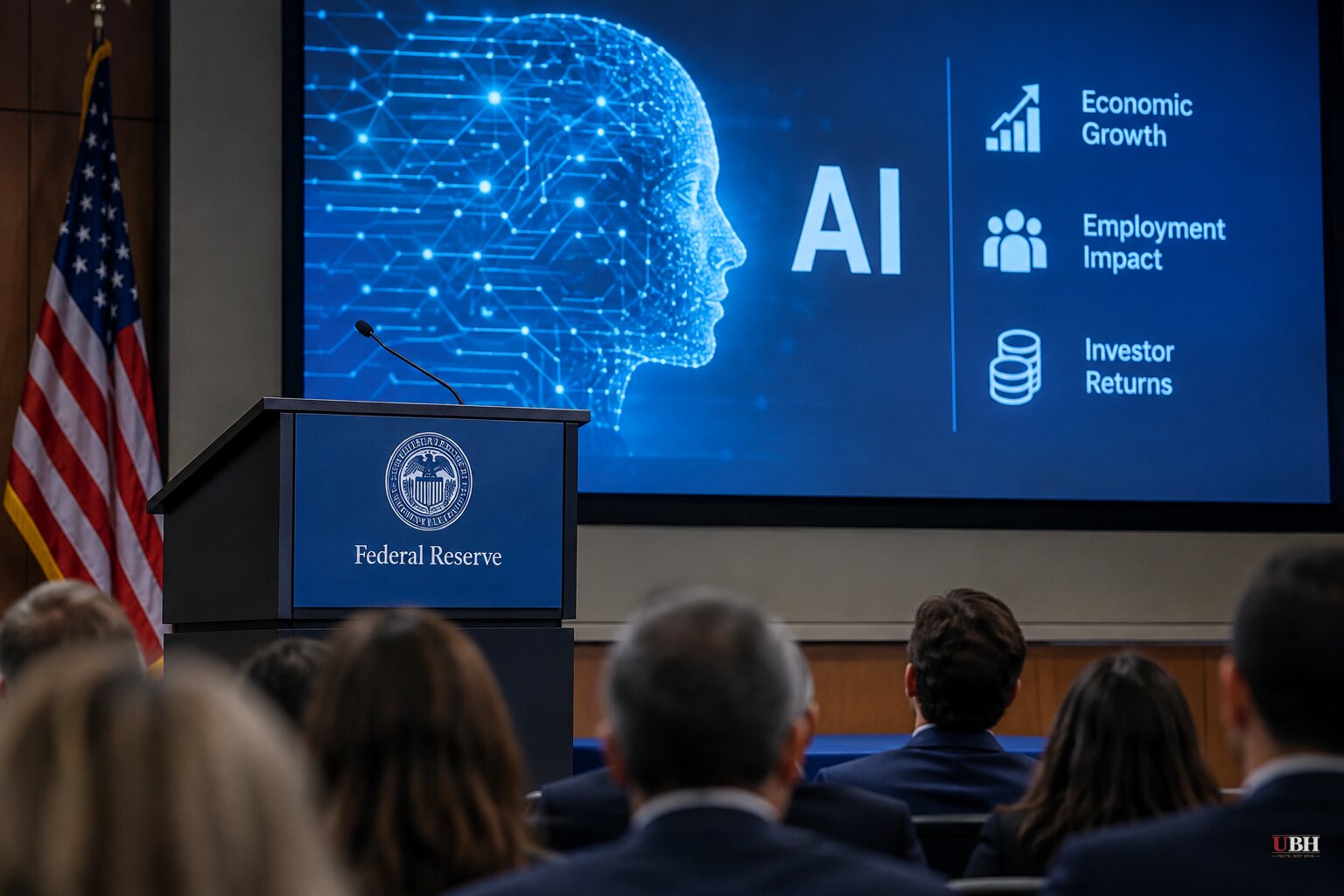
Federal Reserve Chair Kevin Warsh used the opening of a Fed conference in San Francisco today, Nov. 16, to lay out three paths for the economy under what he calls "super intelligence." One is a boom. One is mass job displacement. One is a bust.
He stressed he was not forecasting. "I'm not here to offer predictions," he said in prepared remarks, adding that he is "not exactly impartial about American leadership in a time so filled with both challenge and possibility."
The three scenarios
In the best case, Warsh said, AI produces "an increase in productivity and economic gains that are shared broadly across labor and the owners of capital." Real GDP growth then runs persistently above its long-run average, and the U.S. stays close to full employment.
He described the technology as potentially distinct from earlier ones because it could "supercharge idea generation." He called it "an entirely new force in economic life and society."
The second path is "less positive." Businesses use AI to replace workers, and unemployment rises. That outcome does not depend on investment returns falling short.
The third path is the one that touches Wall Street directly. "After significant capital investment and stock market gains, expected returns could turn down and equity valuations could fall, leading to an economic slowdown and a more notable rise in unemployment," Warsh said. "In time, the economy would recover, but without the productivity gains."
He also flagged use of the technology by "bad actors" as a risk that could be "highly disruptive and economically costly."
What the Fed says its role is
"Our role in all this is neither advocacy nor opposition," Warsh said. "The big questions are about magnitude, scope, and timing." He said the technology will have "important implications for monetary policy down the road."
The conference is the first event of the Fed's Productivity and Jobs Task Force, which Warsh created. He set up four other task forces covering Fed communication, data reliance, balance sheet policy and inflation frameworks. CNBC reported that Warsh noted this was his first visit to a regional Fed bank as chair.
The agenda includes panels with business leaders, economists and academics. It is scheduled to close with a fireside chat between Warsh and task force leader Marc Andreessen, co-founder of Andreessen Horowitz.
Warsh used the term "super intelligence," which President Trump prefers, instead of "artificial intelligence." Trump recently ordered the federal government to use it almost exclusively.
The inflation fight inside the Fed
The prepared remarks did not address inflation or say what the Fed will do on rates. That is the live dispute.
Since taking the job, Warsh has argued that AI could be a disinflationary force. The Washington Post reported that more than a dozen of his Fed colleagues, including two other Trump appointees, now say the AI boom is helping push prices up. Its reporting says that could mean higher rates on credit cards, car loans and mortgages.
On Nov. 12, Fed Governor Michael Barr warned that AI adoption could cause serious short-term job disruption and widen inequality. Vice Chair for Supervision Michelle Bowman cautioned that expensive AI infrastructure spending is raising costs before productivity gains show up.
The case from those officials is about sequence. Data centers, chips, power and construction labor all draw on scarce resources now. The productivity payoff, if it comes, arrives later.
Warsh made a related point at his post-meeting news conference after the Fed held its benchmark rate at 3.75% to 4%. He rejected the idea that AI investment is immune to borrowing costs because expected returns are so high. "Interest rates get in the cracks," he said. "Interest rates affect directly, or indirectly, almost everything."
He also pointed to wider credit spreads on some assets as a sign investors are getting choosier. He said high-tech investment is leading the acceleration, but spending is strengthening elsewhere too.
Markets are already nervous
CoinPaper reported that the Nasdaq Composite fell about 1.4% on Friday, Nov. 13. It put AMD down roughly 10% and Nvidia down nearly 3%, following the resignation of Nvidia CEO Jensen Huang. The same account says Nebius shares fell earlier this month despite 571% annual revenue growth, after construction delays hurt its outlook.
The same account says October consumer prices rose 0.4% from September, with inflation still above the Fed's 2% target.
That puts Warsh's third scenario in a different light. His warning about falling valuations came days after a rough session for AI stocks. He did not tie the two together in his remarks.
What comes next
The open question is whether Warsh's productivity optimism or his colleagues' near-term price worries drive policy. The Fed's next rate decision will test that, with October's 0.4% monthly price gain already on the table and the Productivity and Jobs Task Force's work still ahead.
Sources used for this briefing
7 links from 6 independent newsrooms (syndicated copies of the same report count once)
These are the sources it draws on, linked so you can verify.


