
Unbiased headlines. Facts, not spin.
Unbiased Headlines is an independently owned news organization. We bring you the facts, not opinions, written fresh from 110+ named sources. Sources linked so you can verify it yourself.
 economy
Major Story (7/10)
Florida Cities Weigh Fire Fees and Spending Cuts After Amendment 3 Vote; Sanford Projects $15 Million Shortfall
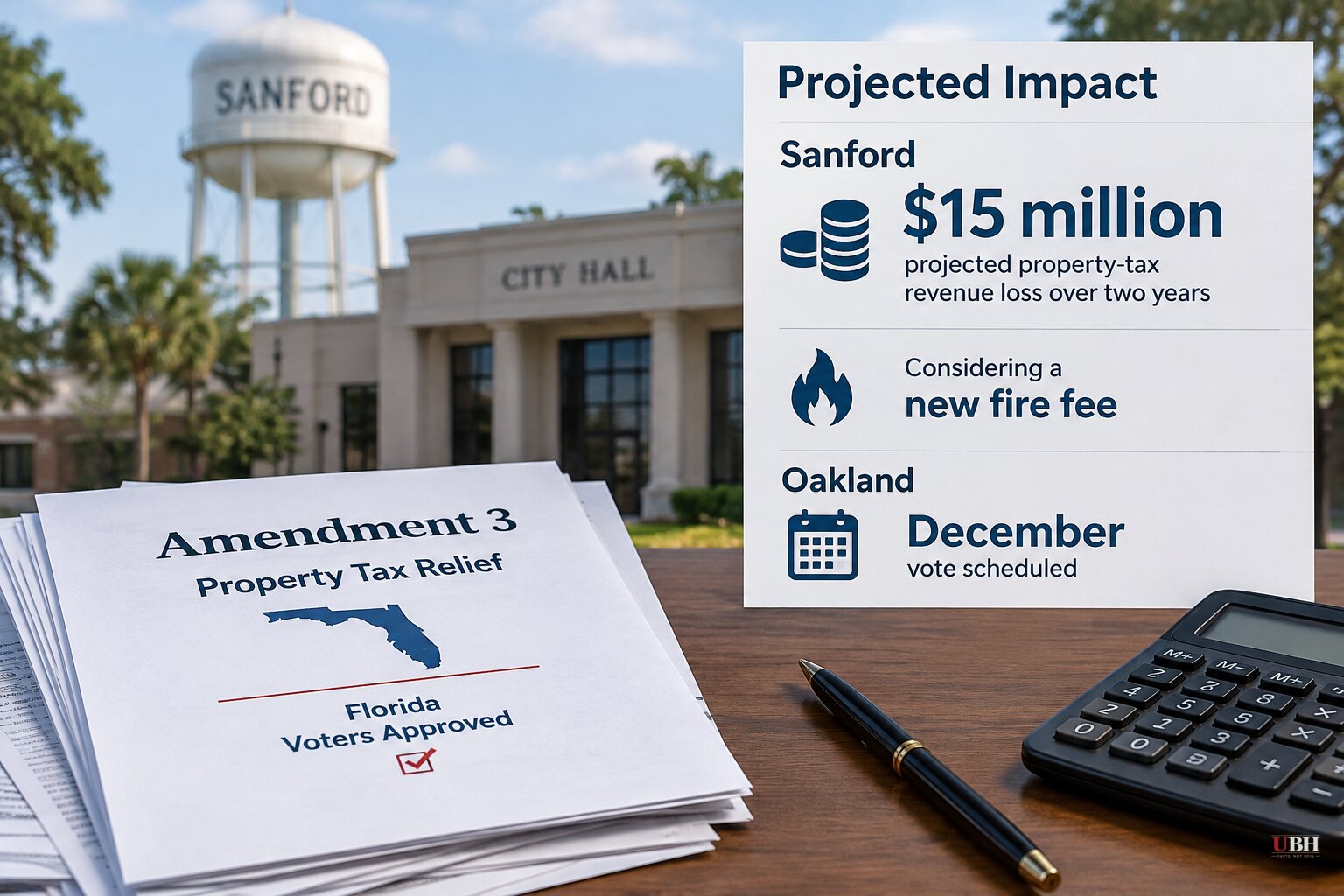
Since Florida voters approved Amendment 3 on Nov. 3, local governments have begun working out how to absorb the lost revenue. The first concrete plans are already on the table, and they include new fees.
The amendment raises the homestead exemption from non-school property taxes. Today the first $50,000 of a homestead's value is exempt. The exemption rises to $150,000 in 2027 and $250,000 in 2028, with inflation adjustments after that. School district levies are separate and not covered. The amendment also places new restrictions on how local governments use property-tax revenue.
Florida TaxWatch estimates the measure could cut local government revenue by $4.9 billion in its first fiscal year and $45.8 billion over five years. An earlier forecast of annual local losses was $11.8 billion. That is a separate estimate covering a different period.
Sanford starts hunting for savings
Sanford, a city northeast of Orlando, expects to lose about $15 million in property-tax revenue over the next two years. The city estimates that is roughly 18% of its budget.
Commissioners discussed several responses at a recent meeting:
- Eliminating travel to Florida League of Cities meetings
- Cutting public arts spending
- Offering early-retirement incentives, similar to those used during the Great Recession
- Adding a fire assessment fee charged to property owners, homeowners and businesses alike
Commissioner Patrick Austin acknowledged the political problem with that last option. "The voters have said we want less fees, and if we come back and go, 'We want to do this fire fee,' we are going to be really, really hated," he said.
The travel and arts cuts are the kind of trimming taxpayers generally want from local government. They will not come close to filling a hole of that size.
Oakland schedules a vote
Oakland, another central Florida town, is preparing a December vote that could pave the way for new fire-protection and stormwater assessments. The town expects to lose about $820,000 in property-tax revenue in fiscal 2028.
That is small in dollars next to Sanford's figure. It is the same pattern: a property tax cut approved by voters, followed by a proposed fee that does not carry the tax label.
The state backfill question
Jeff Brandes, a former Republican state senator and the founder and president of the Florida Policy Project, predicts Florida could eventually raise its statewide sales tax to make up for what cities and counties lose. He compared Amendment 3 to California's Proposition 13, which sharply limited property taxes in 1978 and made local governments more dependent on state funding.
"The bailout comes with a leash," Brandes wrote in a post on X.
Brandes's argument is that when local budgets depend on state checks, local decisions shift toward Tallahassee. No state sales tax increase has been proposed, and the Legislature has not announced a plan to backfill local revenue.
What voters were asking for
The case for the measure starts with why it passed. The vote came in a midterm election driven by frustration over the cost of living, an election that also returned both chambers of Congress to Democratic control. Eligible homeowners will see lower property tax bills under the amendment. That relief is the point of the measure, and voters chose it.
Florida was not alone. In North Carolina, voters approved a constitutional amendment requiring lawmakers to limit increases in property taxes collected by local governments. National Review's John R. Puri wrote that voters in five states approved seven ballot measures to reduce or limit local taxes on property, and that conservatives cheered. He argued that "not all cuts to property taxes are created equal" and that some "may even be worse than the status quo."
Epoch Times commentator Jonathan Miltimore, in a pre-election piece, called property taxes something there is "a lot to hate" about. He still flagged the estimated $45 billion in lost local revenue over five years as a trade-off. Both writers come from the anti-tax camp.
What comes next
The first exemption increase does not take effect until 2027, so most of the budget decisions are still ahead. Oakland's December vote on fire and stormwater assessments is the next scheduled step. Sanford has not adopted a fire fee. Commissioners have only discussed one.
Whether other Florida cities and counties follow with assessments, cuts, or requests for state money will show in their budget cycles. The Legislature, which Brandes expects to be the eventual backstop, has yet to say what it will do.
Sources used for this briefing
7 links from 5 independent newsrooms (syndicated copies of the same report count once)
These are the sources it draws on, linked so you can verify.


