
Unbiased headlines. Facts, not spin.
Unbiased Headlines is an independently owned news organization. We bring you the facts, not opinions, written fresh from 110+ named sources. Sources linked so you can verify it yourself.
 economy
Major Story (7/10)
House China Committee Says Beijing Has Decisively Surpassed US in Most Manufacturing Sectors
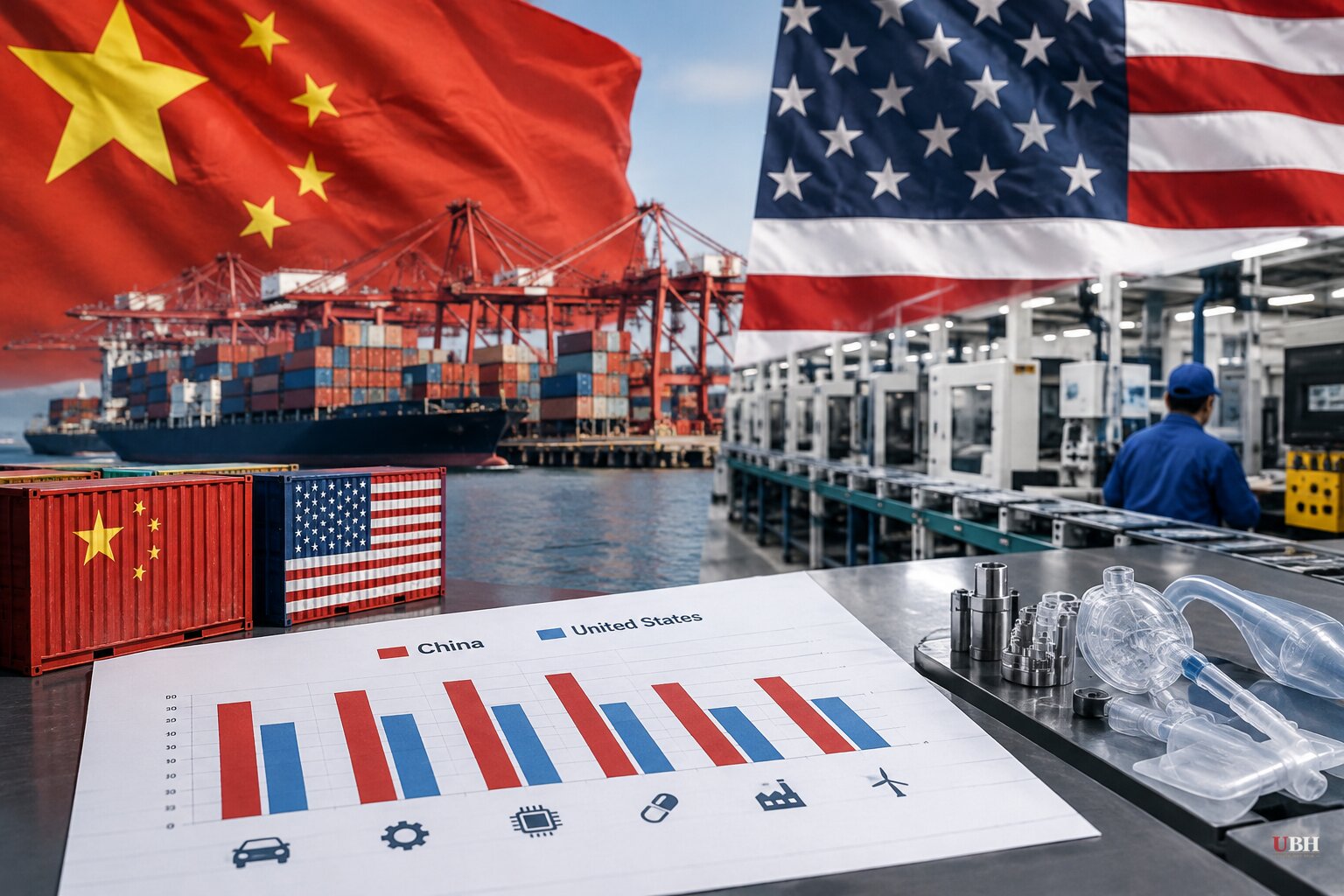
A new report from the House Select Committee on the Chinese Communist Party concludes that China has "decisively surpassed" the United States in most areas of manufacturing. The report is titled Rigging the Game: How China Undermined Western Manufacturing and Helped Hollow Out American Industry.
The committee alleges that Beijing uses state funding, subsidies and state-owned enterprises to dominate industries tied to US national security. It covers biomanufacturing, aerospace, semiconductors and machine tools.
What the committee says
The report traces the strategy to an April 2020 speech by Xi Jinping, who called for strengthening other countries' dependence on Chinese production chains. The committee's summary of the goal: "Abroad, China wants leverage. At home, it wants autarky."
The numbers it cites, mostly from TrendForce:
- Mature-node chips: China held 34% of global capacity in 2024, against Taiwan's 43%. TrendForce projects China reaching roughly 47% by 2027.
- New chip plants: China hosts 57 of the 97 plants scheduled to open worldwide between 2023 and 2025.
- Machine tools: Domestic Chinese firms went from about 2% of China's high-end market in 2013 to more than 30% in 2024.
- Shipbuilding: The committee estimates China has 230 times the civilian shipbuilding capacity of the US. It says commercial and naval yards share workers, steel and dry docks under Beijing's military-civil fusion policy.
The report also points to Shenyang Machine Tool, saying more than 70% of its 2023 revenue came from its state-owned parent and units of China's state aircraft manufacturer. Its argument is that state-owned buyers are propping up domestic suppliers.
Reps. John Moolenaar and Ro Khanna have said China's predatory trade practices have damaged American manufacturing and national security. The committee wants a coordinated, long-term effort with allies to rebuild critical industries.
The report's own caveat
The committee does not claim a clean sweep. State-owned COMAC cut its 2025 C919 delivery target from 75 aircraft to 25, and delivered 15. The jet still relies on Western engines and avionics and lacks US and European certification, which limits where it can be sold.
The report also notes that Chinese state carriers have ordered more than $58 billion worth of Airbus aircraft since 2017, while Boeing has landed no major Chinese order in that period.
Overbuilding with a price tag
China's push has not been smooth for China either. In a report dated Nov. 2, Rhodium Group found that China accounts for more than 45% of world production capacity for basic chemicals and plastic resins, and that its chemical output has grown 18-fold in 25 years.
That capacity now exceeds what Chinese customers can absorb. Prices fell, inventories piled up and profits shrank after China's property market collapse beginning in 2021 cut demand for construction-related chemicals. Rhodium says foreign producers are squeezed twice: they lose sales inside China as local firms replace imports, and they face more Chinese exports elsewhere. So far, the drop in China's chemical imports has hurt them more than the rise in its exports.
Houston-based Westlake Corporation announced in December 2025 that it would shut four chemical production units in Louisiana and Mississippi, affecting about 295 employees. In an SEC filing, Westlake cited global overcapacity and cheap Asian exports. It said three North American units were no longer globally cost-competitive for export markets because of high manufacturing and transportation costs, and it also decided to exit styrene.
Westlake put the charges at roughly $415 million. It said it expected the changes to improve annual operating earnings.
Chinese firms push abroad
The same shift shows up in a market the US once led. Brazil's medical device industry group ABIIS reported on Sept. 22 that in the first half of 2026 Brazil imported $696.5 million of medical devices from China. That was 21% of total imports, ahead of the US at 20% and Germany at 12%.
In 2025, the US led at 17.1%, Germany had 14.9% and China was third at 12.4%. Brazil's total medical device imports in the half reached $3.355 billion, up 8.2% from a year earlier.
Chinese suppliers are moving beyond basic consumables into imaging and high-end equipment. On Oct. 27, United Imaging Chairman Zhang Qiang signed an agreement with Santa Catarina state to invest 535 million reais in a Joinville plant for MRI and oncology radiotherapy equipment. The plant is expected to create 200 to 500 jobs, with first-phase construction scheduled for the second half of 2027.
Washington's answer
On quantum computing, officials say the US is ahead but worry about holding the lead. Deputy Commerce Secretary Paul Dabbar called the American industry "by far the greatest leader in quantum technologies" at the Special Competitive Studies Project's AI + Quantum Summit on Nov. 10. He said the challenge is turning that lead into "brick-and-mortar industrialization and manufacturing dominance."
Dabbar pointed to CHIPS and Science Act grants and letters of intent signed this year with nine companies investing more than $2 billion in quantum technologies. He also said Commerce is willing to use export controls to keep American inventions from being "copied or stolen."
The Commission on U.S. Quantum Primacy released a report the same day. It called research, software and private investment "major strengths" but warned that China's manufacturing and supply-chain production threatens to erode that edge.
The pattern across chemicals, chips, machine tools and medical devices is the same: Beijing keeps building. A September 2025 industrial plan from seven Chinese agencies still targets average annual growth of more than 5% in the petrochemical and chemical industries, despite the glut Rhodium describes.
Whether Congress acts on the committee's call for a long-term allied rebuilding effort remains open. No legislation tied to the report has been announced.
Sources used for this briefing
6 links from 6 independent newsrooms (syndicated copies of the same report count once)
These are the sources it draws on, linked so you can verify.


