
Unbiased headlines. Facts, not spin.
Unbiased Headlines is an independently owned news organization. We bring you the facts, not opinions, written fresh from 110+ named sources. Sources linked so you can verify it yourself.
 health
Low Interest (4/10)
Event date: November 14, 2026 ·
Windward Bio Closes First Nasdaq Day 68% Above IPO Price, Still Without Asthma Flare-Up Data
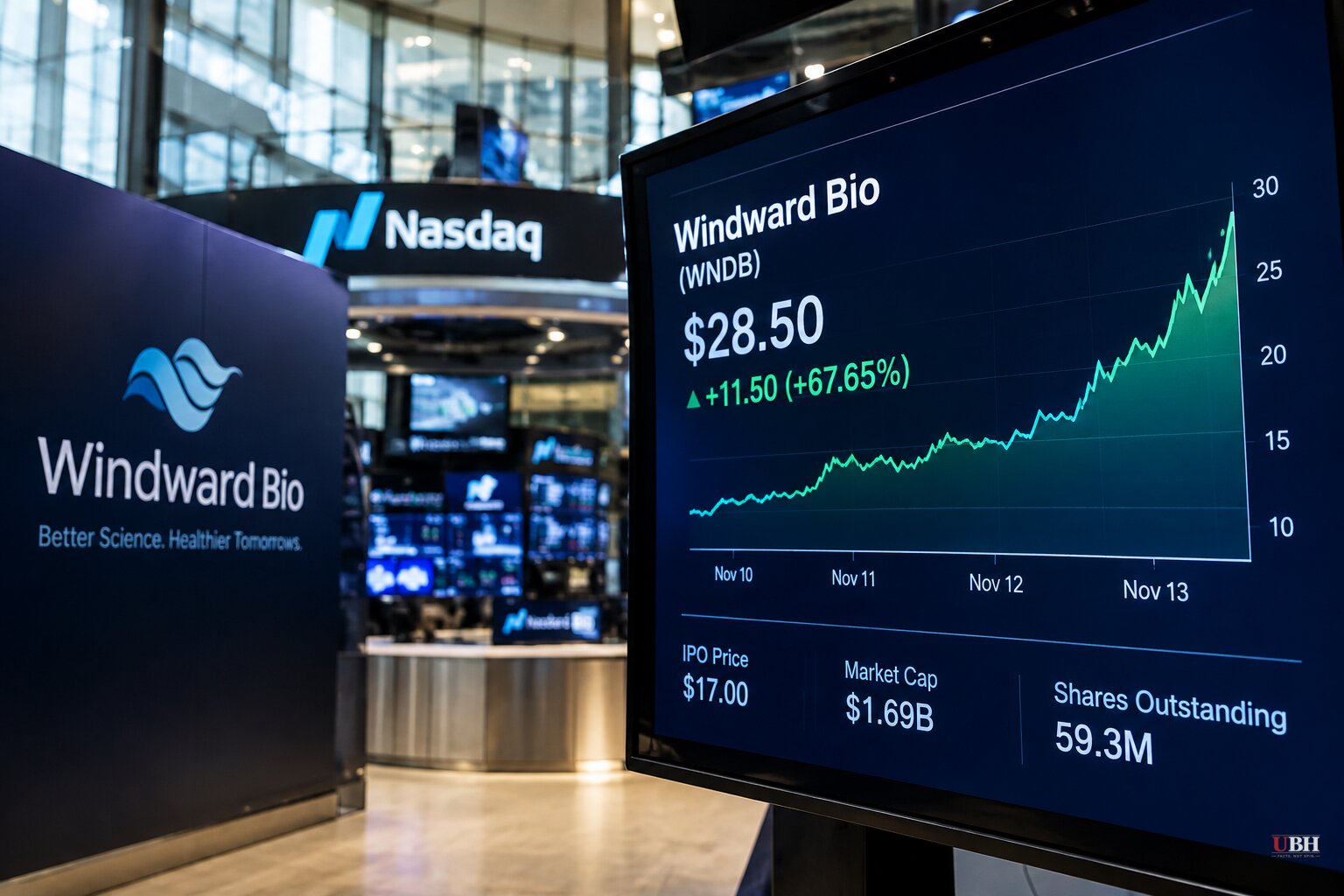
Windward Bio Group AG (Nasdaq: WWB) closed its first day of trading on Friday, Nov. 13 at $28.50 a share. That is 68% above the $17.00 IPO price and gives the company a market value of roughly $1.69 billion, according to Qiming Venture Partners, one of its backers. Bloomberg put the figure at nearly $1.7 billion based on shares outstanding in the filing.
The company has no approved products. It was founded in 2024.
The deal
Windward priced 10,294,117 common shares on Thursday, Nov. 12, all sold by the company, for gross proceeds of about $175 million. Underwriters hold a 30-day option to buy up to 1,544,117 more shares at the IPO price.
Sanofi, through its subsidiary Sanofi Foreign Participations B.V., agreed to a concurrent $50 million private placement at the same price. That covers 1,532,691 common shares plus pre-funded warrants for 1,408,485 shares. Combined gross proceeds come to about $225 million before the underwriters' option.
Both the IPO and the placement are expected to close Monday, Nov. 16, subject to customary conditions. The placement depends on the IPO closing. The IPO does not depend on the placement.
Jefferies, TD Cowen, Piper Sandler and UBS Investment Bank are joint bookrunners.
Windward's Nov. 9 registration statement estimated combined net proceeds of about $203.8 million after discounts, commissions and expenses, assuming the underwriters do not use their option.
Where the money goes
The filing earmarks roughly $217.5 million to $227.5 million to finish the POLARIS-1 and POLARIS-2 asthma trials and the SIRIUS Phase 2 COPD trial for WIN378. That includes research, regulatory, clinical-supply and manufacturing work.
Another $80 million to $85 million is assigned to Phase 2b COPD and Phase 2 atopic dermatitis trials for WIN027, a bispecific antibody targeting TSLP and IL-13. About $5 million to $10 million goes to earlier bispecific programs.
Those allocations add up to more than the net proceeds. Windward says it will combine the money with existing liquidity.
What WIN378 has shown so far
WIN378 blocks thymic stromal lymphopoietin (TSLP), the same upstream airway-inflammation signal targeted by Tezspire, the drug from AstraZeneca and Amgen. Tezspire is dosed every four weeks. Windward is designing WIN378 for twice-yearly dosing.
The Phase 2 asthma portion of POLARIS-1 enrolled 147 patients. Windward reports an observed half-life of up to 75 days. The Phase 3 portion began in September 2026. Phase 2 primary results are scheduled for the first half of 2027, and a confirmatory asthma trial of twice-yearly dosing is expected to start in the same period.
Windward's interim Phase 2 results measured lung function and inflammation markers. It has not reported data on asthma exacerbations, the flare-ups that drive hospitalizations and the main efficacy test for these drugs.
That gap is the sticking point for skeptics of the long-dosing pitch. Tech Times pointed to Upstream Bio's antibody verekitug, which targets the TSLP receptor rather than TSLP itself. It cut annualized asthma exacerbations 56% versus placebo when dosed every 12 weeks. In its two twice-yearly arms, the reduction was 49% and 39%. Verekitug is a different molecule, so the numbers are not a prediction for WIN378. They do show that stretching the interval can cost efficacy.
Qiming's Alexander Sinclair Wilson put the optimistic case in the company's release: "We believe novel, long-acting biologics will reshape the treatment of severe chronic respiratory and skin diseases, and that WIN378 and WIN027 have the potential to expand and meaningfully improve the treatment options available to patients."
Backers and origins
Windward's investors include OrbiMed, Novo Holdings, SR One, Omega Funds and Qiming. Sanofi's venture arm also joined the company's $165 million Series B crossover round in May, according to BioSpace. Post-offering projections show Novo Holdings at nearly 11%, OrbiMed at about 10% and CEO Luca Santarelli at around 8%. Santarelli co-founded Therachon, which Pfizer acquired in 2019.
The lead drug did not originate in Basel. Windward holds exclusive global rights to WIN378, excluding Greater China and certain Asian countries, through a licensing agreement with Kelun-Biotech and Harbour BioMed. It licensed WIN027 separately from Qyuns Therapeutics. Qiming, the Shanghai-based venture firm, said this was its 11th IPO of 2026.
A busy year for biotech listings
BioSpace counts 35 biotech IPOs in 2026, including Parabilis Medicines' $670 million summer offering, the largest public debut in biotech history. Only eight biotechs went public in all of 2025, according to BioSpace's historical data.
What comes next
The offering is set to close Monday, Nov. 16, which will put the proceeds in the company's hands. The 30-day underwriter option runs from pricing. Windward's first look at Phase 2 primary results is slated for the first half of 2027. The first exacerbation data on a twice-yearly regimen will come from the confirmatory asthma trial, which is expected to start in that same period, so any such results are further out.
Sources used for this briefing
7 links from 7 independent newsrooms (syndicated copies of the same report count once)
These are the sources it draws on, linked so you can verify.


