
Unbiased headlines. Facts, not spin.
Every story is an unbiased news briefing written from 110+ sources across the spectrum — sources linked so you can verify it yourself.
 economy
Notable (6/10)
August 3, 2026 at 02:49 PM
economy
Notable (6/10)
August 3, 2026 at 02:49 PM
Wildfire Prediction Markets Draw Fire From Scientists and Senators, For Different Reasons
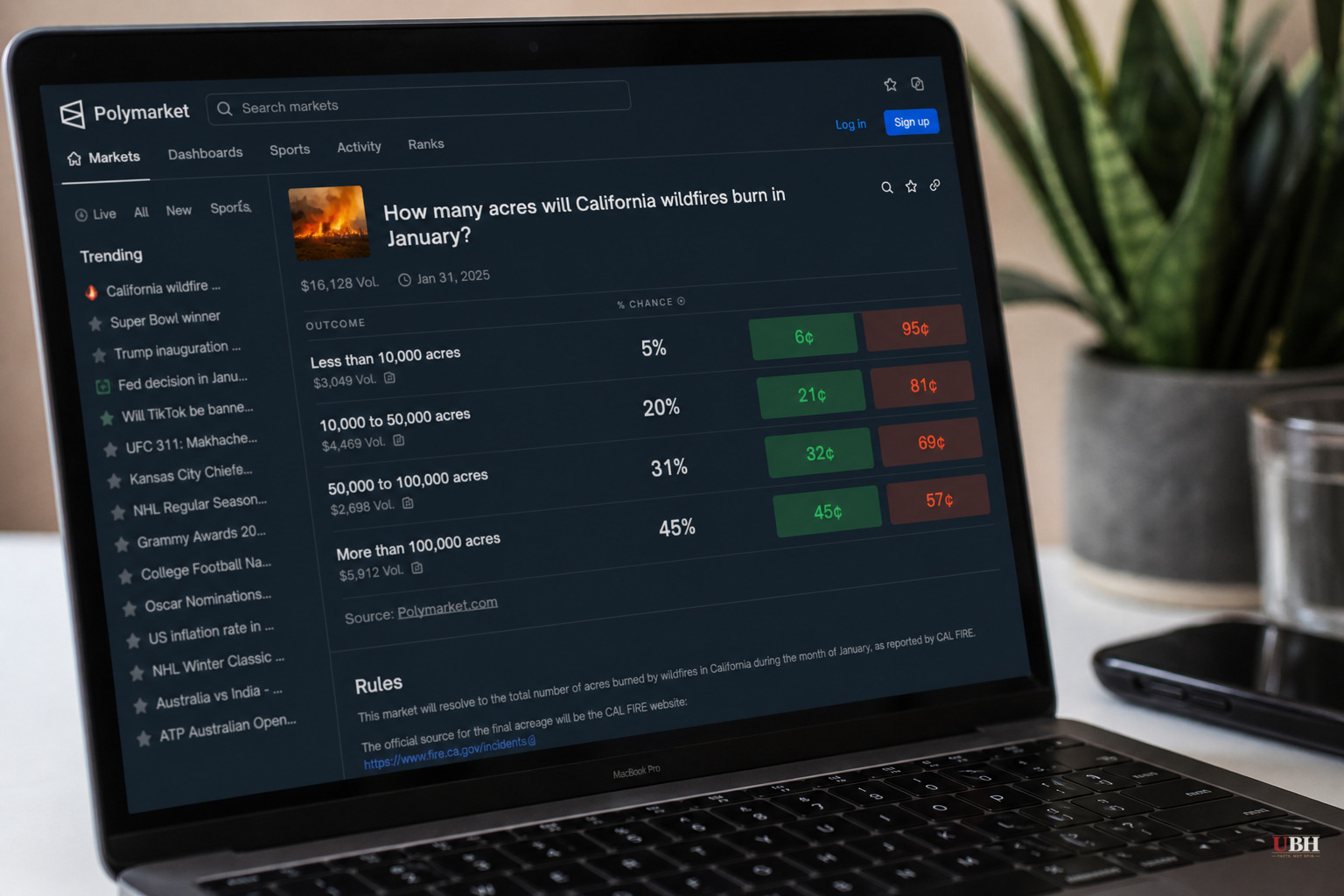
When the Eaton fire tore through Altadena, California, in January 2025, it killed 19 people and destroyed thousands of homes, including the one belonging to the grandfather of climate scientist Kaitlyn Trudeau. While people lost everything, others were placing bets on Polymarket over how many acres would burn, which neighborhoods the flames would reach, and when the fires would be contained, according to CNN.
Trudeau, who works at the nonprofit Climate Central, called it "pretty dystopian." She told CNN that betting markets create a financial incentive layered on top of an already easy crime: starting a fire. "I worry that it encourages people to think about these events like they are video games, not real-world disasters," she said.
Polymarket is the biggest player in a fast-growing, multibillion-dollar prediction market industry where users trade on the outcome of almost anything, from elections to how many times Elon Musk posts on X. Users buy shares priced between $0 and $1 based on the market's collective odds; correct predictions pay out at $1 a share. The company insists this isn't gambling. It says users trade against each other, not against "the house," and prefers the word "trade" over "bet."
Polymarket defended offering wildfire markets, telling CNN that the platform serves as a source of real-time information during disasters. "People turn to the news for commentary and they come to Polymarket for information," a company spokesperson said. "While we are not blind to the risks, removing these markets does not prevent a tragedy but makes the most accurate information less accessible to the people who need it most."
Prediction markets have, in other contexts, produced odds that moved faster and arguably more accurately than traditional polling or punditry. Polymarket's position is that shutting the markets down doesn't stop wildfires or arson, it just blinds the public to information that's already being priced in by traders. No verified evidence in these sources connects any wildfire, including the Eaton fire, to a betting market. The arson-incentive concern is a warning about future risk, not a documented cause of a past fire.
Still, Lauren Ducat, a clinical and forensic psychologist in Australia who studies firesetting, told CNN that people have wagered on weather informally for as long as weather has existed. What's changed is scale. Online platforms make these bets "more pervasive" and open them up to far bigger pools of money and users, she said. That represents a scale problem, since Polymarket is already a multibillion-dollar operation.
While CNN's reporting focuses on the moral hazard of wildfire betting, a different and largely unrelated controversy over prediction markets is playing out in the Senate. It has nothing to do with wildfires.
Senator Mark Kelly of Arizona, Senator Martin Heinrich of New Mexico, and 10 other senators sent a letter to the leaders of the Senate Banking Committee and the Senate Agriculture Committee, warning that prediction markets offering nationwide sports and event wagering are circumventing state and tribal gambling law, according to a release from Kelly's Senate office.
The letter went to Banking Committee Chairman Tim Scott of South Carolina and Ranking Member Elizabeth Warren of Massachusetts, along with Agriculture Committee Chairman John Boozman of Arkansas and Ranking Member Amy Klobuchar of Minnesota.
The senators argue that two pending bills, the Digital Asset Market Clarity Act (the CLARITY Act) and the Digital Commodity Intermediaries Act (DCIA), would make the problem worse. As drafted, the senators wrote, both bills contain exemptions that would let prediction markets and decentralized finance platforms offer what amounts to online casino-style gambling and sports betting nationwide, while sidestepping the tribal-state regulatory system built under the Indian Gaming Regulatory Act of 1988.
That 1988 law, along with the Supreme Court's 2018 ruling in Murphy v. National Collegiate Athletic Association that opened the door to legal sports betting outside Nevada, is the legal foundation tribes rely on for gaming revenue. That revenue funds tribal healthcare, public safety, education, housing, and social services, the senators wrote. Their concern is that if the Commodity Futures Trading Commission gains exclusive federal jurisdiction over these markets without guardrails, it would permanently override protections tribes and states fought for over decades.
Neither of these controversies has produced a regulatory decision yet. No federal agency has moved to ban wildfire-related prediction markets, and no charges or investigations tied to arson-for-profit on these platforms have been announced in these sources. The CLARITY Act and DCIA remain pending legislation; the senators are asking committee leadership to amend the bills, not reporting that any amendment has happened.
Congress has not yet treated these as one problem or two. The wildfire betting issue is about moral hazard and disaster ethics. The tribal sovereignty issue is about federal preemption of gambling law. Both center on the same company and the same regulatory vacuum, and both are waiting on lawmakers who haven't yet acted.
Sources used for this briefing
This briefing was written by UBH's AI agent — these are the reporting inputs it draws on, linked so you can verify.


