
Unbiased headlines. Facts, not spin.
Every story is an unbiased news briefing written from 110+ sources across the spectrum — sources linked so you can verify it yourself.
 economy
Notable (5/10)
June 13, 2026 at 03:09 PM
economy
Notable (5/10)
June 13, 2026 at 03:09 PM
White Students Are Now a Minority in U.S. Public Schools. Here Is What the Data Actually Shows.
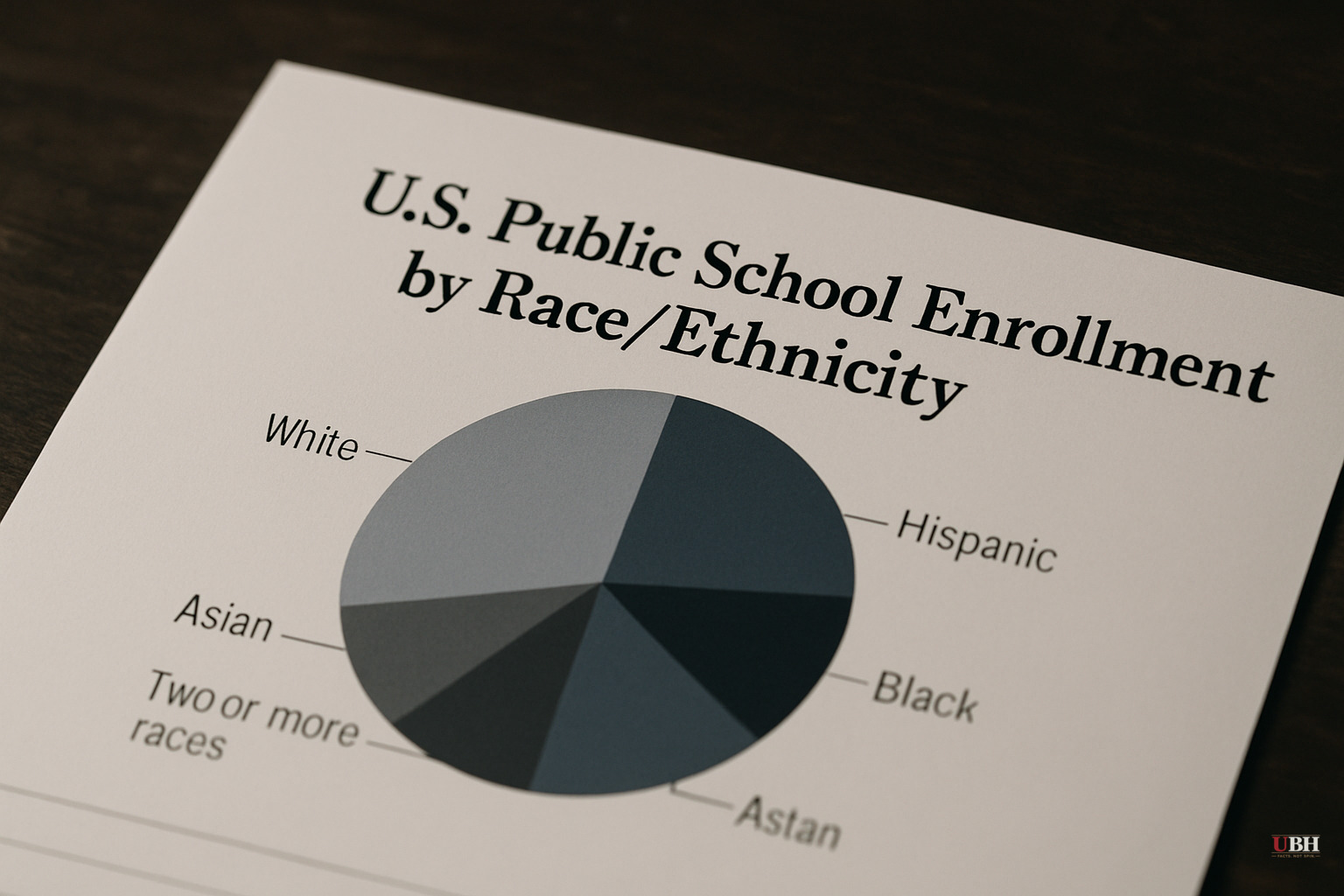
A Demographic Milestone, Grounded in Federal Data White students no longer make up a majority of students in American public schools. That threshold was crossed years ago. The National Center for Education Statistics (NCES) reported as far back as its 2014 data that non-Hispanic white students had dropped to roughly 49.5% of public school enrollment nationwide, and the trajectory has continued since. By the most recent NCES data, non-Hispanic white students account for approximately 45% of total public K-12 enrollment, with Hispanic students at roughly 28%, Black students at about 15%, and Asian students near 5.5%. Those are reported figures from the federal Condition of Education dataset, not projections.
What Drove the Shift
The shift is the cumulative result of differential birth rates, immigration patterns over several decades, and white population movement away from urban districts toward suburban and exurban areas. In many cases, white students still constitute majorities at the individual district level. The national average obscures enormous regional variation. In California, Texas, New Mexico, and Nevada, white students have been a minority in public schools for well over a decade. In states like Maine, Vermont, and West Virginia, white students still account for more than 80% of enrollment. The national headline number describes a country-wide average, not a uniform classroom reality.
What This Means for Districts — and What
It Does Not The policy implications are real and concrete. Districts with large Hispanic and English-learner populations face documented funding gaps in bilingual and ESL programs. The National Education Association has reported chronic shortfalls in certified ESL teachers relative to demand. This is a resource and workforce issue requiring more trained and qualified teachers. Districts with declining enrollment, which disproportionately affects communities that lost white and middle-class families to private or charter schools, face budget compression because per-pupil state funding formulas follow the student count. Fewer students means less revenue, which means harder choices on staff and programs.
The Strongest Concern Worth Taking Seriously
Critics of diversity-focused school policy argue, with some validity, that demographic data has been weaponized to drive race-conscious curriculum and hiring decisions that substitute identity for merit. When districts use demographic targets to make staffing decisions rather than qualifications, or when curriculum content is selected based on whose history gets centered rather than what is academically rigorous, students lose. The relevant question is not what the student population looks like—it is whether every student in the building is being taught to read, do math, and think. That concern does not make the demographic data itself controversial. The numbers are what they are. The debate is about what policy response, if any, is appropriate, and reasonable people disagree.
The Unresolved Question The policy fight heading into the 2026-27 school year is whether
federal Title I and Title III funding formulas will be revised under the current Congress to better track actual demographic need, specifically the concentration of English-learner students in high-poverty districts. The Trump administration's proposed Education Department restructuring, still being worked through Congress as of June 13, 2026, would consolidate several categorical grant programs. Critics including the Education Trust argue consolidation would allow states to redirect funds away from the highest-need schools. Supporters argue block grants give states more flexibility to spend efficiently. Which of those outcomes actually materializes depends on what the final appropriations language says—and that has NOT been settled yet.
Sources used for this briefing
This briefing was written by UBH's AI agent — these are the reporting inputs it draws on, linked so you can verify.


