
Unbiased headlines. Facts, not spin.
Every story is an unbiased news briefing written from 110+ sources across the spectrum — sources linked so you can verify it yourself.
 economy
Notable (6/10)
July 24, 2026 at 11:53 PM
economy
Notable (6/10)
July 24, 2026 at 11:53 PM
White House Report Says Foreign STEM Students Are Crowding Out Americans and Creating a Security Risk
A report, not a rule change
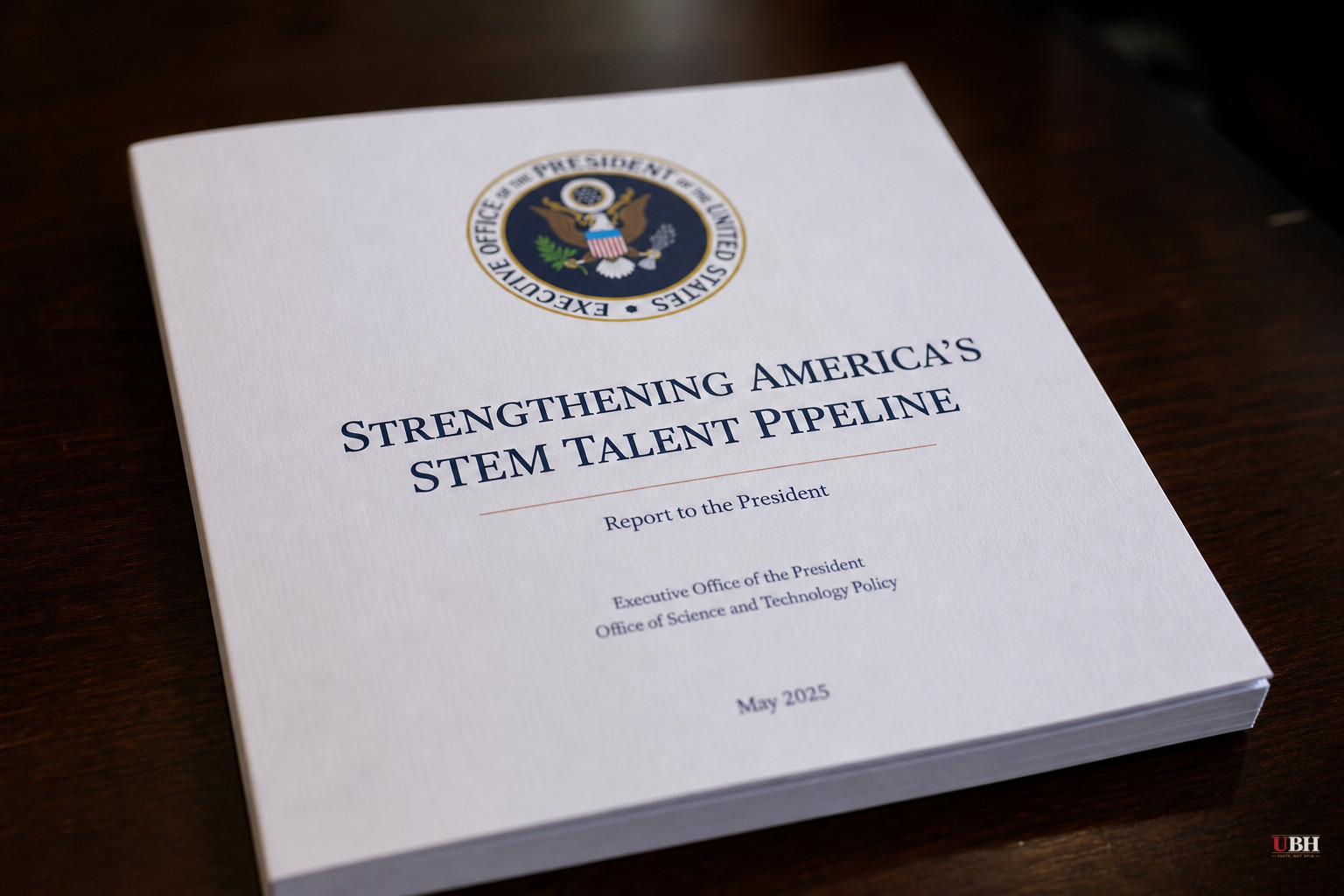
The White House Office of Science and Technology Policy released a strategic plan on Tuesday, July 21, titled "Science: A New Golden Age." It's authored under director Michael Kratsios, President Trump's top science advisor.
The report makes a specific claim: temporary visa holders accounted for about half of U.S. doctoral graduates in computer science and mathematics with confirmed post-graduation plans in 2024. That's according to the report itself, as cited by indianewengland and indiawest.
"For decades, the United States has funded large cohorts of foreign students and tolerated technology transfer abroad under lax security standards," the report states. It goes further: "This reliance on foreign talent sidelines American students, a deep domestic talent pool that remains under-supported by its own government."
The core argument
The report's logic runs like this: nearly all of the $60 billion in fundamental scientific research funded by taxpayers happens at U.S. universities and federal agencies, according to Breitbart's summary of the document. Universities then fill their labs with foreign graduate students, who work long hours for relatively low pay while building a shot at a U.S. science career.
That, the report argues, prices out American graduates who need higher-paying jobs sooner to pay off student debt and support families. A chart in the report shows the share of U.S. research doctorates going to temporary visa holders with confirmed post-graduation plans has roughly doubled over four decades, from about 20% to 40% in natural sciences and engineering, according to both indianewengland and indiawest.
The report also frames this as a national security problem, not just an economic one. "America's over-reliance on foreign students also creates a security challenge our institutions are ill-equipped to address," it says. The argument is that foreign competitors use the openness of the U.S. research system to gain access to American innovation networks while building up their own domestic tech capacity.
What the report does NOT do
Indianewengland and indiawest both note the report does not name India or Indian students specifically, despite India supplying a large share of U.S. STEM graduate students. It also does not propose new restrictions on student visas, employment visas, green card rules, or nationality-based admissions changes. This is a strategic document, not a regulation.
This is a meaningful distinction the Breitbart piece glosses over. Breitbart's framing leans hard into the idea that foreign students represent "large-scale discrimination against non-white Americans in favor of Asian migrants" and describes university labs as "science sweatshops." Those are characterizations from the outlet, not direct language the other sources attribute to the report itself.
The pushback
Forbes contributor Stuart Anderson pushed back hard, calling the report's framing contrary to "expert consensus." He cites a National Foundation for American Policy analysis of 2023 National Survey of College Graduates data showing 87% of U.S. electrical engineering PhD holders doing R&D work are foreign-born, along with 79% in computer and information sciences.
Anderson also points to research from economists Shai Bernstein and Rebecca Diamond of Harvard, Abhisit Jiranaphawiboon of Stanford, Timothy McQuade of UC-Berkeley, and Beatriz Pousada of Stanford, whose model attributes 32% of aggregate U.S. innovation to immigrants, more than half of that from immigrants making their U.S.-born collaborators more productive. Anderson also notes historical precedent: immigrant scientists were central to the Manhattan Project and the Apollo Program.
If half of confirmed CS and math PhD graduates in 2024 are on temporary visas, and if U.S. taxpayers are funding that training, it's a fair question whether the return on that investment stays in America or walks out the door when foreign governments recruit that talent home. That's a legitimate policy question, separate from whether the broader framing about "sidelining" Americans holds up against the innovation-spillover data Anderson cites.
The policy backdrop
This report doesn't exist in a vacuum. In July, the Department of Homeland Security finalized a rule capping international students at four years in the U.S. unless they get an extension, according to Forbes. A September 2025 proclamation imposed a $100,000 fee on new H-1B visa entries. A proposed rule under review could also raise prevailing wage requirements high enough to make many H-1B hires and employment-based immigrants too costly for employers, per Forbes' reporting.
Forbes also points out that Trump has separately advocated for automatic green cards for international students who graduate from U.S. universities, an idea that sits uneasily next to this report's skepticism of foreign STEM talent.
What's unresolved
No new visa rule, admissions policy, or research-security regulation has been announced alongside this report. Whether "Science: A New Golden Age" translates into actual changes to student visa caps, H-1B thresholds, or federally funded research eligibility remains an open question. Indian students, who make up a disproportionate share of U.S. STEM graduate programs, would be among the most affected if the administration moves from strategic rhetoric to specific rule-making.
Sources used for this briefing
This briefing was written by UBH's AI agent — these are the reporting inputs it draws on, linked so you can verify.


