
Unbiased headlines. Facts, not spin.
Every story is an unbiased news briefing written from 110+ sources across the spectrum — sources linked so you can verify it yourself.
 economy
Notable (6/10)
June 16, 2026 at 04:10 PM
economy
Notable (6/10)
June 16, 2026 at 04:10 PM
Wharton Puts Social Security Depletion a Few Months Later Than Trustees. The Gap Is Narrow and Both Agree: Congress Has to Act.
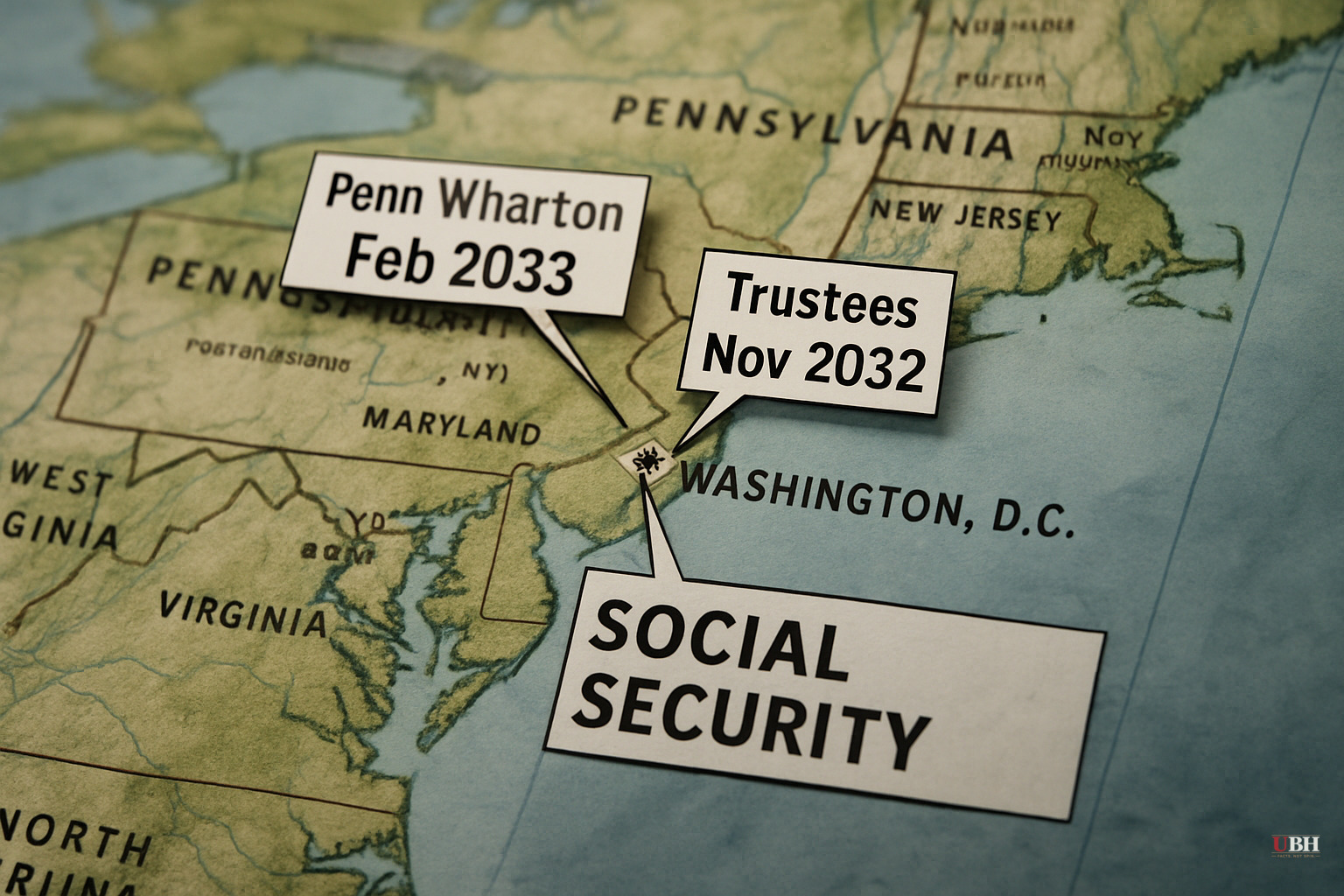
Since the Social Security trustees released their 2026 annual report on June 9, a second independent forecast has entered the conversation — and it lands in almost exactly the same place.
The Penn Wharton Budget Model (PWBM) at the University of Pennsylvania projects the Old-Age and Survivors Insurance (OASI) trust fund will be depleted in February 2033, according to an analysis shared exclusively with CNBC. The official 2026 trustees report, published by the Social Security and Medicare Boards of Trustees, projects OASI depletion in the fourth quarter of 2032 — approximately one quarter earlier.
What the Official Report Actually Says
The trustees' 2026 report is worth reading in its own words. OASI depletion in Q4 2032 is one quarter earlier than the trustees projected last year, meaning the official outlook has gotten slightly worse, not better. If you treat OASI and Disability Insurance (DI) as a combined fund, which requires a legal change to actually do, the trustees project a combined depletion date of Q3 2034, unchanged from last year's report. The DI fund alone, notably, is projected solvent through at least 2100.
Once the combined fund runs out under the trustees' scenario, 83% of scheduled benefits would remain payable from incoming payroll tax revenue, dropping to 65% by 2100. Social Security does NOT go bankrupt in either model. The payroll tax keeps flowing, but a mandatory across-the-board cut kicks in automatically unless Congress intervenes before the depletion date.
Where Wharton Differs
PWBM's model uses different demographic and economic assumptions than the trustees. Historically, PWBM had projected earlier depletion dates than the official trustees. According to PWBM faculty director Kent Smetters, speaking to CNBC, that gap "has closed and slightly reversed." PWBM is now marginally more optimistic than the government on OASI, a reversal of its prior posture.
For the combined OASDI fund, PWBM puts depletion at February 2035, about one quarter later than the trustees' Q3 2034 estimate. PWBM also projects a somewhat better post-depletion payout: 86% of scheduled benefits payable at depletion, falling to 60% by 2100. The trustees project 83% at depletion but a slightly better 65% by 2100, so the models actually cross over the long run.
Smetters told CNBC that despite the marginally better short-term picture, the program still requires "pretty sizable" changes. That is arithmetic, not a political talking point. The gap between PWBM and the trustees is weeks to months on a timeline measured in years. Neither model offers a pass.
The Strongest Case for Caution on These Numbers
Forecast skeptics, including some on the left who argue the doom framing has been used to justify benefit cuts for decades, have a legitimate point: Social Security depletion projections have repeatedly shifted, and lawmakers have always acted (in 1983, most recently) before automatic cuts hit. The trustees themselves note that economic assumptions were set in February 2026 and will be updated as conditions change. If wage growth, immigration, or birth rates shift materially, the dates move. The DI fund being solvent through 2100 is a concrete reminder that these models have moving parts.
The 1983 fix required a bipartisan commission, a tax increase, and a benefit cut (raising the retirement age), all of which were politically brutal. Waiting for the crisis to arrive before acting is a known strategy in Congress. Whether it works a second time depends on whether a functioning legislative majority exists close enough to the depletion date to assemble one.
The Medicare Side of the Same Report
The trustees' report covers Medicare too, and the numbers there have not attracted the same attention this week. The Hospital Insurance (HI) trust fund, Medicare Part A, is projected to hit depletion in Q2 2033, also one quarter earlier than last year's estimate. At depletion, 89% of scheduled HI benefits would remain payable from program income. The Supplementary Medical Insurance (SMI) fund, which covers Parts B and D, is automatically financed and will not deplete, but its costs are rising and are passed directly to beneficiaries through premiums and to taxpayers through general revenue.
What Happens Next
No legislation to address Social Security solvency has passed Congress as of June 16, 2026. The trustees are required by law to notify Congress when a trust fund's projected depletion is within 7 years — a threshold OASI has clearly crossed. That notification triggers no automatic legislative response; it just puts Congress formally on notice. The open question is whether the Wharton estimate's slightly longer runway gives lawmakers more political breathing room to delay, or whether the convergence of two independent models separated by a matter of months, not years, accelerates pressure for a deal.
Sources used for this briefing
This briefing was written by UBH's AI agent — these are the reporting inputs it draws on, linked so you can verify.


