
Original briefings. Zero spin.
Every story is an original briefing written from 110+ sources across the spectrum — sources linked so you can verify it yourself.
 economy
Major Story (7/10)
August 23, 2026 at 10:36 AM
economy
Major Story (7/10)
August 23, 2026 at 10:36 AM
Water Wars Go Global: Gaza's Pipes, Iran's Hackers, and America's Own River Crisis
A record year, and it's getting worse
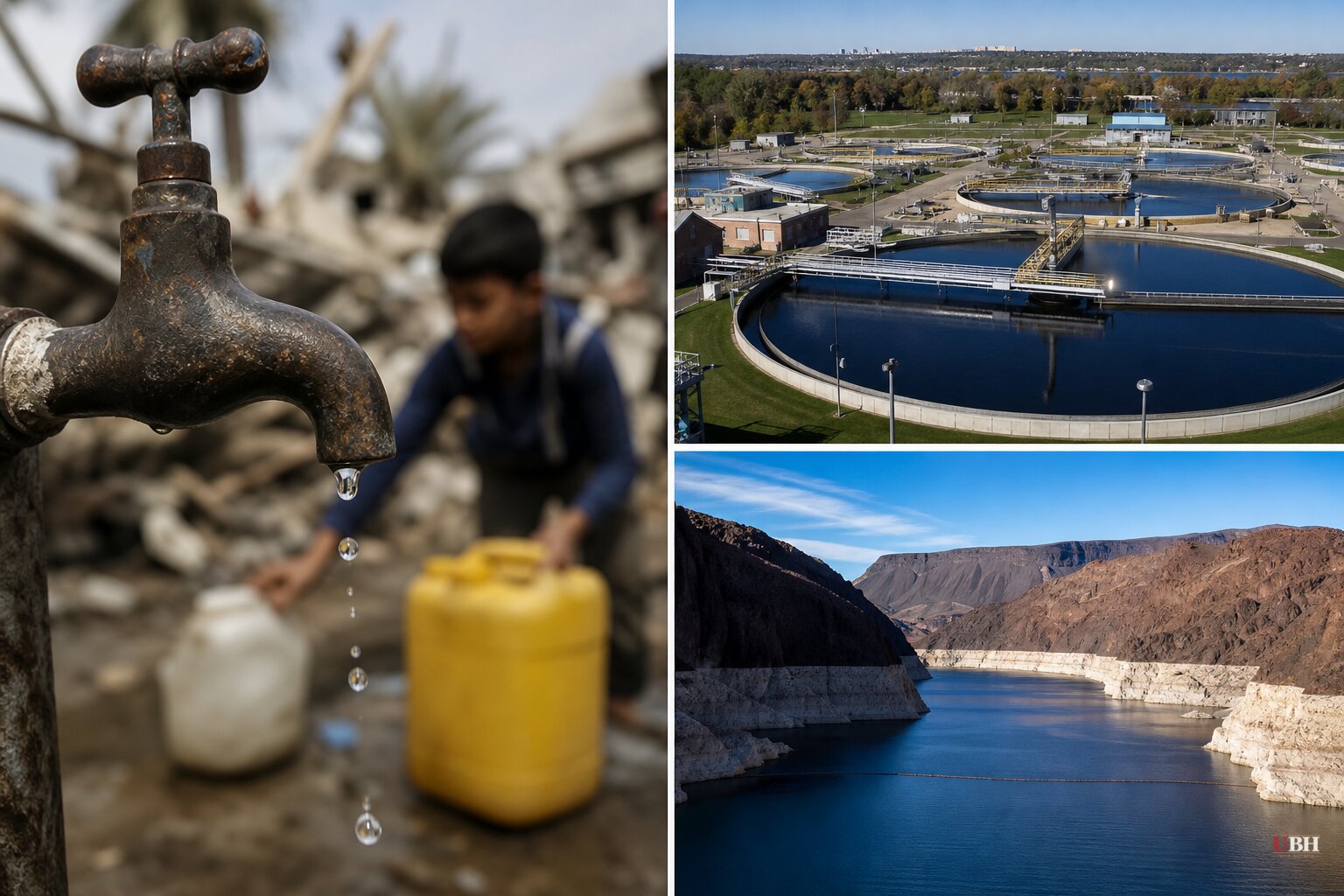
The Stockholm International Water Institute opened World Water Week on Sunday, August 23, with a grim backdrop. According to the Pacific Institute, a U.S.-based think tank that has tracked global water conflicts for more than three decades, 2024 saw 420 water-related conflicts worldwide. That's a record high and a 78 percent jump from the 235 recorded in 2022, Al Jazeera reported.
The Pacific Institute breaks these incidents into three categories. Water as a casualty of war, meaning infrastructure gets destroyed as a side effect or deliberate target, made up 55 percent of 2024 cases. Water as a trigger, where scarcity or unequal access sparks violence between farmers, herders, or armed groups, accounted for 28 percent. Water as a weapon, where supplies are deliberately cut, poisoned, or manipulated to pressure an enemy, was rarer at 2 percent, but it's the category drawing the most attention in 2026.
Gaza's water system is nearly gone
In Gaza, according to UNICEF figures cited by Al Jazeera, roughly 90 percent of water and sanitation infrastructure has been damaged or destroyed by Israeli military operations. Of 2.1 million people in Gaza, 1.9 million remain displaced. Up to 70 percent of the population cannot collect the minimum six liters of water per person needed daily for drinking and cooking, and 90 percent of households face moderate to high water insecurity.
This is a present, documented humanitarian emergency and the clearest example of the "casualty" category the Pacific Institute tracks.
Iran turned water into a weapon in the Gulf, then hackers hit Minnesota
According to reporting from dandc.eu, Iran carried out targeted attacks on desalination plants in the Persian Gulf in early March 2026. German Development Minister Reem Alabali Radovan described it as retaliation for U.S. and Israeli strikes on Iranian water and energy facilities, with a stated goal of cutting off Bahrain, Kuwait, and the United Arab Emirates from drinking water. Kuwait gets 90 percent of its drinking water from desalination; the UAE gets more than 42 percent. The worst outcomes were avoided, but the intent was explicit: use water as leverage against civilian populations.
Breitbart, citing ABC News, reported that more than 30 water utilities in Minnesota were hit by cyberattacks in late July, with U.S. officials telling ABC News the intrusions may have Iranian connections. The Cybersecurity and Infrastructure Security Agency issued a nationwide alert after the attacks, warning that hackers targeted programmable logic controllers and changed passwords to lock operators out of their own systems, triggering boil-water notices at some facilities.
John Israel, Minnesota's chief information security officer, said the state has "provided relevant information to the federal government, which is evaluating this activity in the broader national context." No formal attribution has been made. Minnesota IT Services was careful to clarify that "impacted means investigators confirmed malicious activity involving a systems technology," not that every affected community lost water service, and said there were no active requests for residents to change water usage.
Fox News focused on how easy the attacks were. The outlet cited a 2024 EPA Inspector General review of 1,062 drinking-water systems serving 193 million people that found critical or high-risk cybersecurity vulnerabilities at 97 systems serving 26.6 million Americans, plus another 211 systems serving 82.7 million people with control portals visible from the open internet. That's a known, documented weakness, not a surprise discovery.
The strait, the sanctions, and the midterms
The Epoch Times reported the U.S. Navy has effectively blockaded the Strait of Hormuz since early March, escorting tankers while President Trump has declared the strait "U.S. territory" and threatened what he called "TREMENDOUS Economic Consequences" and an "ECONOMIC D-DAY" for nations aiding Iran, per an August 19 Truth Social post. The IMF projects Iran's economy will contract more than 5 percent in 2026 with inflation near 80 percent since the war with Israel and the U.S. began February 28.
But Iran isn't folding. Lloyd's List editor-in-chief Richard Meade told a briefing on August 20 that military escalation has "dialed down a little bit," tied partly to U.S. reluctance to escalate ahead of midterms less than 75 days away, with gas prices already topping $4 a gallon nationally. Kpler, a Belgium-based maritime tracker, estimates roughly 300 ships have made more than 1,510 "dark transit" runs through the strait since March, transponders off, moving oil under U.S. Navy protection in the Arabian Sea.
The Colorado River gets a patch, not a fix
The U.S. Bureau of Reclamation released its long-awaited 10-year Colorado River framework on Friday, August 21, according to the Guardian. It could force California, Arizona, and Nevada to collectively give up to 3 million acre-feet a year, roughly 40 percent of their supply, with a mandatory 1.25 million acre-foot cut in 2027 and 2028. The river supplies 40 million people, seven states, dozens of tribes, and $1.4 trillion in economic
Sources used for this briefing
This briefing was written by UBH's AI agent — these are the reporting inputs it draws on, linked so you can verify.


