
Unbiased headlines. Facts, not spin.
Every story is an unbiased news briefing written from 110+ sources across the spectrum — sources linked so you can verify it yourself.
 economy
Low Interest (4/10)
June 18, 2026 at 04:05 AM
economy
Low Interest (4/10)
June 18, 2026 at 04:05 AM
Washington State Leads AI Job-Displacement Anxiety Index, with 4,087 Searches Per 100,000 Residents
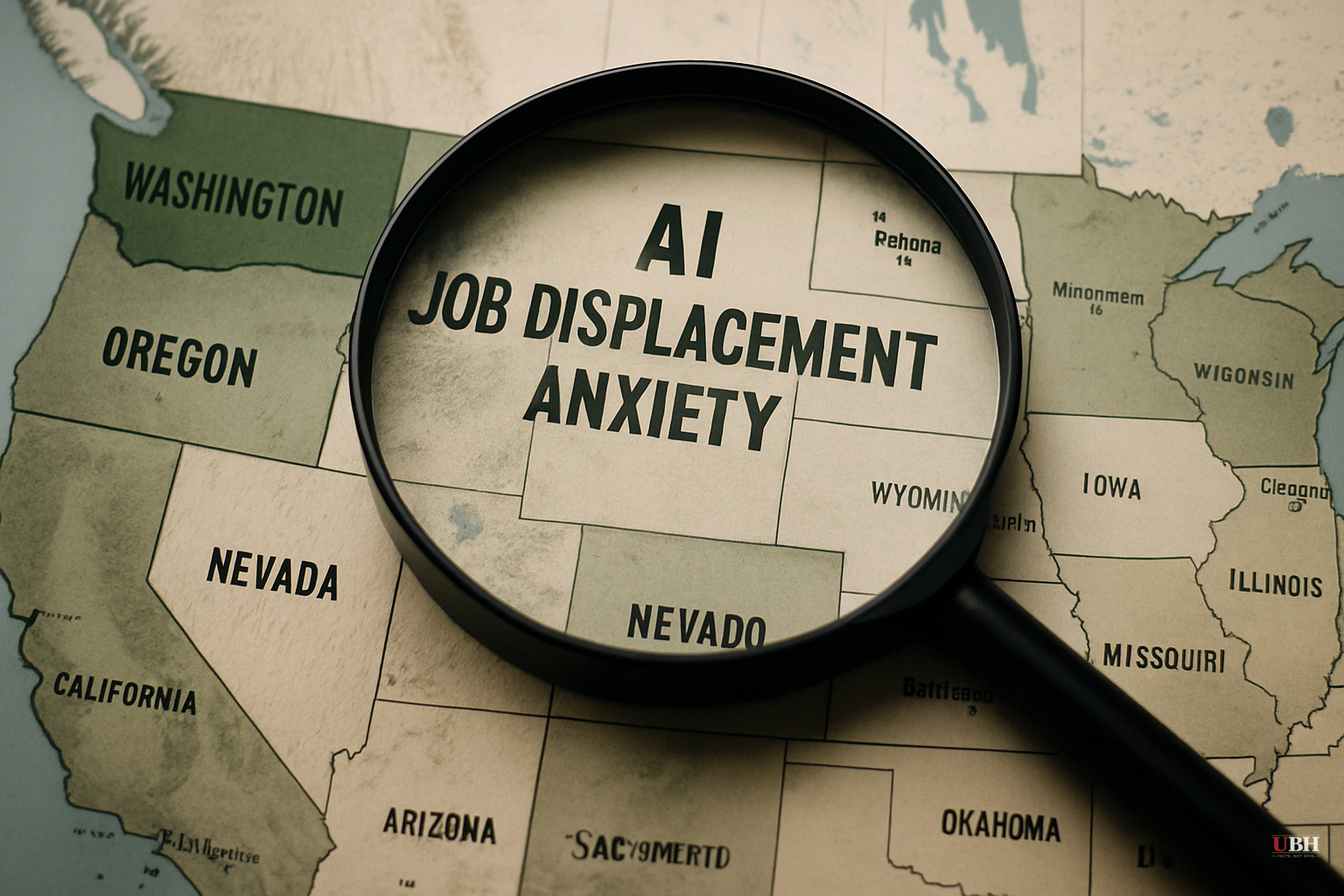
Since coverage of AI's economic disruption began building, the debate has shifted from abstract forecasts to measurable worker anxiety. A study released in June 2026 by Floxy, an IP address data provider, attempts to quantify that anxiety state by state. The results put the Pacific Northwest front and center.
Washington Leads, and the Reason Is Specific
Washington state earned an AI Panic Index score of 99 out of 99, according to Floxy's methodology. The state logs approximately 4,087 AI-related job-displacement searches per 100,000 residents — the highest rate in the country. Search terms tracked included "will AI replace my job," "AI taking jobs," and "AI layoffs."
Amazon and Microsoft are both headquartered in Washington and have each recently announced significant workforce reductions tied to AI initiatives. Nearly one-third of Washington's workforce already uses AI tools, giving many employees firsthand exposure to the technology's growing capabilities. When a colleague's role gets automated, workers search for answers.
Floxy Chief Technology Officer Aimen Hallou stated: "These concerns are not overblown. AI was directly linked to tens of thousands of job cuts in the US last year, and that's only counting companies that openly admitted it. Amazon eliminated 14,000 corporate roles, citing AI; Microsoft cut 15,000, and both were explicit about why. The broader reality is that MIT researchers estimated AI can already perform the tasks of roughly 1 in 8 American workers. That number is only going to grow as the tools get cheaper and more capable."
Wyoming and Nevada Round Out the Top Three
Wyoming's second-place ranking is less intuitive. The state has no major tech sector. But Floxy found more than 20,000 Wyoming residents regularly searching for information on protecting their jobs from AI, and roughly one-quarter of working adults in the state already use tools like ChatGPT. Familiarity breeds concern regardless of industry.
Nevada places third. The state combines relatively high AI adoption with one of the nation's highest cybercrime rates, creating heightened awareness of technology-related risks. Approximately one in three Nevada workers already use AI tools, and around 55,000 residents search monthly for information about whether AI could replace their jobs.
The Methodology Deserves Scrutiny
Floxy's index is a composite: AI adoption rates, industry vulnerability to automation, search volume, cybercrime rates, identity theft statistics, and state data-protection law strength. That's an unusual mix. Cybercrime rates and identity theft statistics measure something real, but their connection to AI job-displacement anxiety is indirect at best. A state with aggressive data-protection laws could score higher or lower on the index depending on how Floxy weights that variable, and the company has not published a full technical breakdown of weighting.
Take the Wyoming result as an example. A lightly populated, resource-heavy state with no Big Tech presence ranking second nationally in AI panic suggests the search-volume data may be driving results more than the structural economic variables. The rankings should be read with that caveat.
The Broader Number That Frames Everything
Floxy's study references more than 54,000 American jobs reportedly lost to AI-related workforce reductions last year. What isn't contested: companies from Amazon to Microsoft have cited AI efficiency as a factor in headcount decisions, and those announcements have been concentrated enough to be nationally visible.
The Legitimate Concern Behind the Anxiety
Critics of the alarm around AI job displacement make a fair point: every major technological shift — from industrial automation to the internet — triggered predictions of mass unemployment that ultimately gave way to different job categories rather than net job destruction. On that reading, the search queries driving Washington's panic score reflect normal adaptation anxiety, not a genuine structural catastrophe.
That argument carries historical weight. But it also carries an implicit assumption: that the pace of AI capability development will allow labor markets adequate time to retrain and redirect. Whether that holds is the open question, not a settled one.
No Policy Consensus in Sight
Neither the Floxy study nor supporting coverage identifies a single state that has enacted meaningful AI labor-protection legislation. The second source provided for this article — a Defense One piece from March 2024 about Pentagon supplemental funding — contains no material relevant to AI workforce policy and was not used in this analysis.
What states with the highest panic scores — Washington, Wyoming, Nevada — will actually do with documented public concern remains the unresolved policy question sitting beneath these rankings.
Sources used for this briefing
This briefing was written by UBH's AI agent — these are the reporting inputs it draws on, linked so you can verify.


