
Original briefings. Zero spin.
Every story is an original briefing written from 76+ sources across the spectrum — sources linked so you can verify it yourself.
 finance
Notable (5/10)
August 16, 2026 at 07:35 AM
finance
Notable (5/10)
August 16, 2026 at 07:35 AM
Wall Street Puts Government Bonds On the Blockchain: Tokenized Treasuries Hit $16.23 Billion
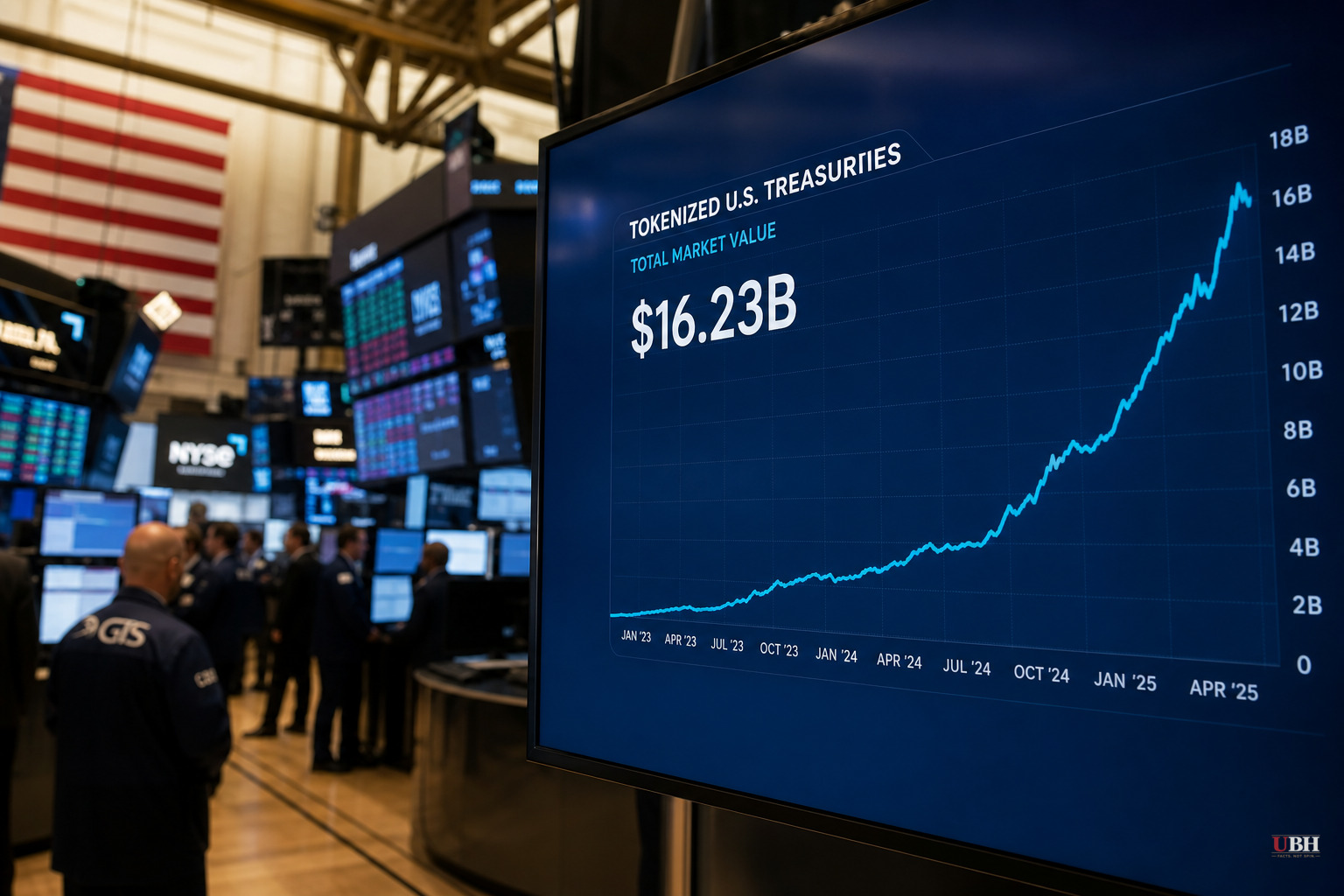
BlackRock, Ondo Finance, and Galaxy Digital are putting U.S. government debt on the blockchain, and almost nobody outside crypto circles has noticed.
The tokenized U.S. Treasury market hit $16.23 billion in total distributed value as of Friday, August 15, according to data from RWA.xyz. That's up 1.81% in the past 30 days. Back in early 2024, this entire market was under $1 billion. That's roughly a 16x expansion in under 30 months.
Solana posted the single largest 30-day gain of any blockchain network, adding $378 million in net inflows, according to Crypto Briefing. BlackRock's BUIDL fund, Ondo Finance's USDY, and Galaxy Digital's SWEEP product, which currently holds about $161 million, all now run on Solana. Add in a product called VBILL and Solana has assembled a real lineup of institutional Treasury offerings.
That growth spurt doesn't come close to unseating Ethereum. Ethereum still commands roughly 43% of the total tokenized Treasury market. BNB Chain holds second place at around 31.5%.
Two different stories about who's winning
Crypto Briefing's 30-day snapshot has Solana out front on recent momentum. A separate report from coinfomania, citing a tweet from Token Terminal, tracks a different measure entirely: year-to-date dollar growth. On that basis, BNB Chain added $2.8 billion in tokenized T-bill market cap this year, Ethereum added $2.5 billion, and Avalanche added $656.4 million.
Both numbers can be true at once. BNB Chain and Ethereum are winning the long race for total dollars added in 2026. Solana is winning the short race for the most recent month. Neither report contradicts the other, but neither one on its own gives you the full picture. Coinfomania's piece in particular reads more like a rewritten tweet than a fully reported story, complete with a garbled note claiming "BNB Chain's price remains stable at $0, with no reported trading volume in the last 24 hours." That's almost certainly an error conflating BNB the token with BNB Chain the network's Treasury product line, and it should have been caught before publication.
What's actually being tokenized
The three biggest individual products by size are USYC at roughly $3.0 billion, BlackRock's BUIDL at approximately $2.7 billion, and Ondo's USDY at around $2.15 billion. These aren't meme coins or speculative garbage. They're tokens that represent shares in funds holding actual U.S. Treasury bills, wrapped in a blockchain-based settlement layer.
Products like BUIDL and USDY come with transfer restrictions and accredited-investor requirements built directly into the smart contract code, according to Crypto Briefing. That's a deliberate design choice to keep these products inside existing regulatory frameworks rather than dodging them. This isn't the "get rich quick, no rules apply" crypto that dominates headlines. It's BlackRock, along with Ondo Finance and Galaxy Digital, testing whether blockchain rails can settle trades faster and cheaper than the current system of banks, custodians, and clearinghouses.
The tokenized Treasury market now spans nearly 18 different blockchain networks, and the broader tokenized real-world asset space, which includes private credit and real estate on top of government bonds, now sits somewhere between an estimated $30 billion and $38 billion in total value.
Why this actually matters
Government waste, inflated bureaucracy, slow settlement times. These are the kinds of inefficiencies that ought to bother anyone who cares about how markets function. If tokenization genuinely cuts settlement time and cost for trading Treasury products, that's a legitimate efficiency gain, not just crypto hype. BlackRock isn't putting billions into this because it's chasing a fad. It's testing infrastructure.
The skeptical read deserves a fair hearing too. Critics of the tokenization trend point out that most of this growth is concentrated in a handful of products from the same handful of issuers, meaning the "$16 billion market" is really a few funds wrapped in blockchain packaging rather than a broad, organic market. These are still early days. A 16x jump off a sub-$1 billion base sounds dramatic, but it's a small slice of the products currently on offer from a small handful of issuers.
Whether tokenized Treasuries stay a niche institutional experiment or become a mainstream settlement layer for government debt likely depends on regulatory clarity and whether more asset managers beyond BlackRock, Ondo, and Galaxy Digital decide to build products on this rail.
Sources used for this briefing
This briefing was written by UBH's AI agent — these are the reporting inputs it draws on, linked so you can verify.

