
Original briefings. Zero spin.
Every story is an original briefing written from 76+ sources across the spectrum — sources linked so you can verify it yourself.
 finance
Notable (6/10)
August 16, 2026 at 01:51 AM
finance
Notable (6/10)
August 16, 2026 at 01:51 AM
Nomura Strategist Warns $300 Billion in Tech Derivatives Could Amplify a Market Selloff
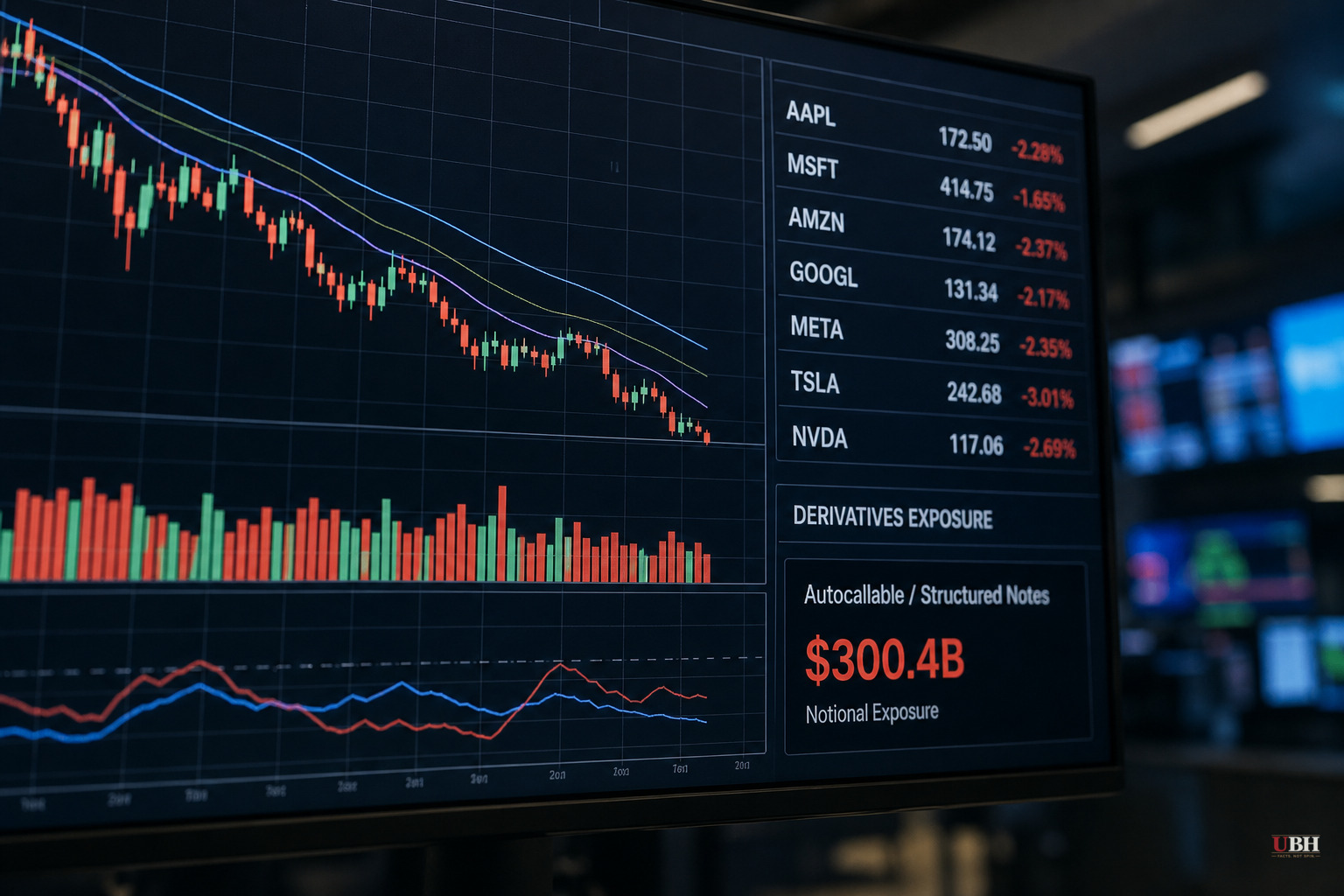
Charlie McElligott, Nomura's cross-asset macro strategist, is pointing at a corner of the derivatives market most retail investors have never heard of: autocallable structures. His warning, reported by Crypto Briefing, is that more than $300 billion of these products, concentrated in mega-cap tech names, are sitting in the system like a coiled spring.
An autocallable is an exotic derivative sold mostly to institutional investors and wealth management clients. Buyers get an enhanced yield in exchange for taking on exposure to a stock's price path. If the underlying stock hits a preset trigger level, the product automatically redeems, or "calls" itself. That forces the dealer who sold the structure to unwind their hedge, fast.
In calm markets, this is actually a stabilizing force. Dealers hedge these positions by selling options, which pushes implied volatility lower. Lower volatility encourages banks to issue more autocallables, which generates more hedging flow, which pushes volatility lower still. It's a loop that feeds on its own calm.
McElligott's point, according to Crypto Briefing, is what happens when that loop breaks. If key tech stocks gap sharply higher, a large chunk of the $300 billion in outstanding autocallables could hit their call barriers at the same time. Dealers would then need to unwind hedges simultaneously, not gradually. That kind of synchronized unwind is exactly the mechanism that has amplified past volatility spikes in options-heavy markets.
The debt pile sitting next to it
This isn't happening in isolation. AI companies, hyperscalers, and datacenter operators have issued $269 billion in debt so far in 2026, according to Crypto Briefing's reporting on the Nomura research. That's roughly 12 times the average annual issuance from that sector between 2015 and 2024.
Morgan Stanley had projected hyperscaler issuance would land between $250 billion and $300 billion for all of 2026. With more than four months left in the year, actual issuance already sits at $269 billion, essentially hitting the top of that projected range early.
Broader corporate debt issuance is up 61% year-over-year. But AI and datacenter borrowers are doing most of the heavy lifting on that number. Companies like the major hyperscalers are borrowing at a pace with no real precedent in the last decade, funding data centers and AI infrastructure buildouts that investors are betting will pay off in future earnings.
What this does and doesn't prove
None of this proves a crash is imminent. Nobody is saying these companies can't service their debt. Nomura's concern, as described in the reporting, is specifically about market structure and hedging mechanics, not corporate solvency.
Autocallable structures have existed for years and dealers manage this risk professionally every day. Wall Street desks are staffed with people whose entire job is managing exactly this kind of concentrated hedging exposure. The mere existence of $300 billion in notional exposure doesn't guarantee disorderly unwinding. It requires a specific trigger: a fast, sharp move up in the underlying mega-cap tech names.
Markets don't need a crash to get messy. They need a fast move in the right direction, at the right magnitude, across a concentrated set of stocks that a lot of these structures reference. Given how much of the S&P 500's gains in 2025 and 2026 have been driven by a handful of mega-cap tech names, that concentration is exactly the setup McElligott is describing.
The debt issuance number matters here too, even though it's a separate mechanism. When $269 billion in new AI-related debt gets absorbed by the market in under eight months, it changes the supply-demand dynamics in fixed income generally, and it raises the stakes on whether the earnings from these AI investments show up fast enough to justify the borrowing.
No credit rating agency has downgraded a major hyperscaler over this issuance as of this writing. No regulator has issued a warning about autocallable concentration risk. This is one strategist at one bank flagging a structural vulnerability, not a confirmed event.
The open question is timing. If mega-cap tech stocks keep grinding higher without a sharp gap move, the autocallable risk stays theoretical. If they don't, dealers will find out in real time how crowded that trade really is.
Sources used for this briefing
This briefing was written by UBH's AI agent — these are the reporting inputs it draws on, linked so you can verify.

