
Unbiased headlines. Facts, not spin.
Unbiased Headlines is an independently owned news organization. We bring you the facts, not opinions, written fresh from 110+ named sources. Sources linked so you can verify it yourself.
 health
Notable (6/10)
Viagra-Class Pill AR1001 Shows 31% Slower Alzheimer's Decline in One Patient Group, Misses in Full Trial
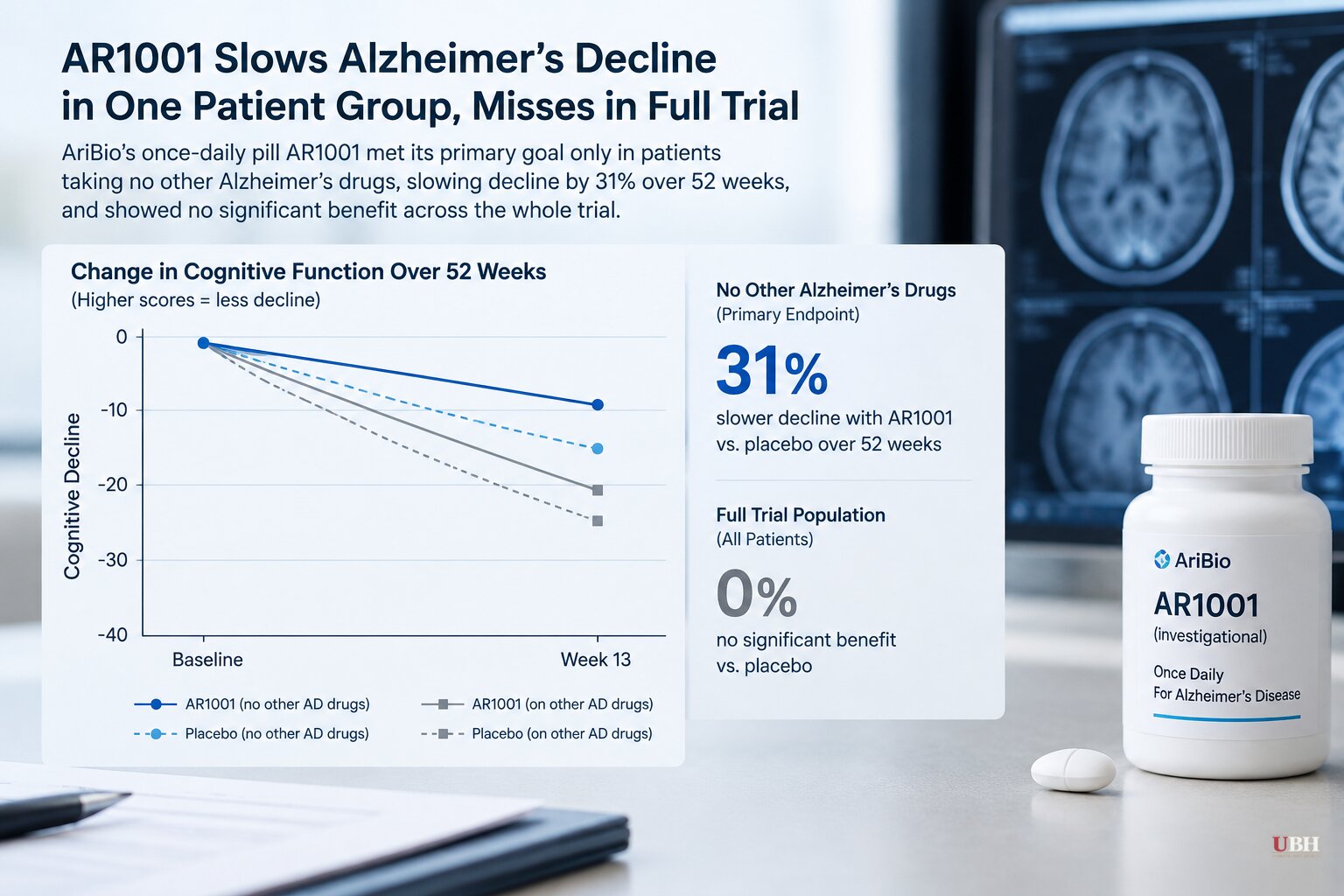
A once-daily pill from the same drug family as Viagra slowed cognitive decline by 31% in one group of early Alzheimer's patients. It did not show a statistically significant benefit across the full trial population.
The drug is AR1001, also known as mirodenafil, made by the South Korean company AriBio. Results from the Phase III POLARIS-AD trial are being presented this week at the Clinical Trials on Alzheimer's Disease conference, which runs Nov. 16 to 19. Sharon Sha, a neurologist who directs the Stanford Center for Memory Disorders and led the trial, presented the data Monday.
What the trial found
The trial ran 52 weeks. The Daily Wire, citing The Washington Post, put enrollment at more than 1,500 people with early Alzheimer's. Researchers tracked decline on the Clinical Dementia Rating-Sum of Boxes (CDR-SB), a scale from 0 to 18 that measures cognitive and functional impairment.
In the prespecified monotherapy group, 604 patients not taking an acetylcholinesterase inhibitor or memantine at baseline, AR1001 beat placebo by 0.44 points (P=0.0266). That works out to the 31% slowing AriBio is reporting.
Across the overall population, the difference was 0.11 points (P=0.4015). That is not statistically significant. Patients who were already on other dementia drugs saw little to no benefit.
Secondary measures leaned toward the drug in both groups. In the monotherapy group, scores on the Mini-Mental State Examination showed a nominally significant improvement. An additional cognitive scale, ADAS-Cog 13, moved 1.16 points in the drug's favor, though not at a statistically significant level.
"POLARIS-AD made its primary efficacy endpoint in the prespecified monotherapy population," Sha said. "The secondary endpoints had trends in favor of AR1001."
Dose, mechanism and side effects
AriBio has tested AR1001 since late 2022 at 30 milligrams a day. That is less than a third of the 100-milligram dose used for erectile dysfunction, where mirodenafil is approved in South Korea.
AR1001 is a phosphodiesterase-5 (PDE5) inhibitor. It relaxes blood vessels to increase blood flow to the brain. In preclinical Alzheimer's models, the drug improved cognitive performance and reduced amyloid and tau burdens.
The most common side effects were diarrhea, falls and dizziness, and AriBio described most as mild to moderate. Adverse events led 5.2% of patients on AR1001 to quit the study, versus 1.7% on placebo. Serious adverse events were nearly identical: 10.0% in the drug group and 9.8% on placebo.
Four patients in the AR1001 group died, from acute myeloid leukemia, stroke, suicide and a ruptured cerebral aneurysm. The placebo group had three deaths in the figures Sha presented.
Where researchers stand
Outside researchers are encouraged but cautious. Richard Oakley, associate director for research and innovation at the Alzheimer's Society in the UK, who was not involved in the trial, called the topline results "an exciting sign that we could have a totally new treatment for early Alzheimer's disease that tackles its causes, not just its symptoms." He noted that, unlike other disease-modifying treatments that have shown benefit in late-stage trials, this one is a daily tablet.
He also said: "We look forward to seeing the full results from this trial and how this drug progresses."
Tara Spires-Jones, a professor of neurodegeneration at the University of Edinburgh, called the results "very promising" and said the drug likely also stimulates pathways in brain cells that support learning and memory. Sheona Scales, director of research at Alzheimer's Research UK, noted that the benefit was significant in people not taking other Alzheimer's medications but "not significant across the overall trial group."
Sha said an oral disease-modifying drug with minimal side effects "would be huge." If the low-dose version is approved, she said, it would be the first pill authorized in the U.S. to slow Alzheimer's.
Not a reason to reach for Viagra
Oakley was direct on that point. "AR1001 is from the same family of medicines as Viagra, but it is being developed specifically for Alzheimer's disease," he said. "People should not take Viagra to try to treat Alzheimer's."
The broader evidence on PDE5 inhibitors is mixed. A 2024 study of 270,000 men in the UK linked erectile dysfunction drugs to a reduced risk of Alzheimer's. That conflicted with data from the NIH DREAM initiative but matched an earlier study of Medicare beneficiaries suggesting sildenafil users were less likely to develop the disease.
What comes next
The results are topline figures from a company-sponsored trial. The full data set has not been published. The overall analysis missed, and the 31% figure comes from a single prespecified subgroup, which regulators will weigh in deciding what the trial proves.
AriBio said it plans to discuss the results with the U.S. Food and Drug Administration, including whether they are sufficient or whether another trial is needed. That answer will determine whether AR1001 faces a new multi-year study or a path toward an application.
Sources used for this briefing
7 links from 7 independent newsrooms (syndicated copies of the same report count once)
These are the sources it draws on, linked so you can verify.


