
Unbiased headlines. Facts, not spin.
Unbiased Headlines is an independently owned news organization. We bring you the facts, not opinions, written fresh from 110+ named sources. Sources linked so you can verify it yourself.
 health
Major Story (7/10)
Event date: November 15, 2026 ·
New Federal Organ Donation Safeguards Take Effect Nov. 18. Separate NRP Rules Due Dec. 6 Draw Ethics Objections
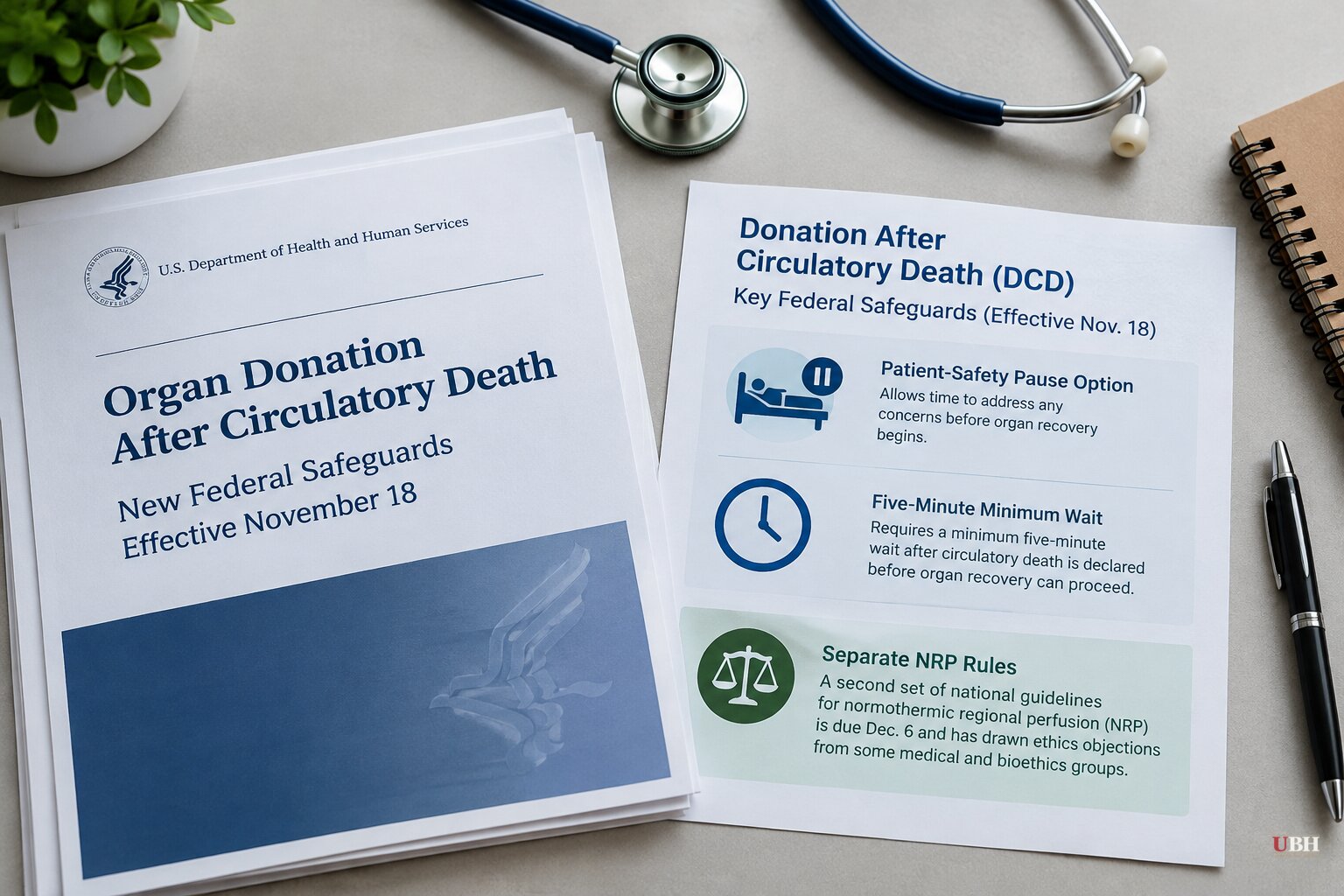
Since the Organ Procurement and Transplantation Network (OPTN) approved new donation-after-circulatory-death rules in August, the federal transplant system has been moving toward a second set of national standards for a more contested procedure. The first rules took effect today, Nov. 18. The second takes effect Dec. 6.
They are two different policies, and they are easy to confuse.
What changed today
The Health Resources and Services Administration (HRSA), part of the Department of Health and Human Services, announced the update after OPTN approved it. It covers donation after circulatory death (DCD), where organs are recovered after the heart and lungs stop. That differs from donation after brain death, where the donor is declared dead based on irreversible loss of brain function.
The changes:
- A formal process to pause donation if patient safety concerns arise.
- Families, medical providers and others involved must be told they can request a pause, and how.
- Procedures for handling and reporting unplanned pauses.
- More detailed records of neurological assessments.
- A minimum five-minute wait after circulation stops and before organ recovery begins.
The American Society of Transplantation said in public comments that it supports honoring requests to pause the process at any point.
Previous cases in which recovery reportedly began before death was confirmed raised questions about safeguards. Dr. Raymond Lynch, director of HRSA's Division of Transplantation, told Fox News Digital that this "does not happen" under the process the new guidelines govern. He said the policies exist "to preserve the sanctity of that decision" and to make sure the technical parts of the operation "pose no risk to the patient."
The NRP guidelines coming Dec. 6
The harder fight is over normothermic regional perfusion, or NRP. It is used after a family has decided to withdraw life support and the patient has been declared dead by circulatory criteria. Doctors attach an external pump minutes later. The pump restores blood flow to the heart, lungs, kidneys, liver and other organs to keep them viable.
On Nov. 6, the OPTN board approved the first phase of the first uniform national guidelines for NRP. Beyond clamping the blood vessels that supply the head, the guidelines call for cutting or venting those vessels. They also recommend against giving donors drugs that could paralyze them and mask movement.
Lynch says venting above the clamp is an added safeguard against blood reaching the brain. He argues NRP, done properly, is ethical and safe. "The hope with NRP is that it increases the supply of organs and it increases the quality of the organs," he said.
The stakes are real. HRSA says more than 109,000 Americans are waiting for a transplant, and about 12 die every day because of the shortage.
Where the objections come from
The push for national standards began with a report from inside the system. Dr. Claire Morgan, a transplant surgeon on the OPTN Patient Affairs Committee, was the first to report to HRSA that blood appeared to be restored to the brain in some NRP cases. "We have seen signs of life in NRP when the brain has been reperfused," she said. "It's extremely disturbing." HRSA then told OPTN to investigate and respond.
Morgan now says the policy offers little or no added protection. Critics told NPR that most surgeons already both clamp and vent. Morgan also opposed putting the first phase in place on an emergency basis before the public could comment.
Dr. Lainie Friedman Ross, a University of Rochester bioethicist, objects to the procedure itself. "In order to be dead by circulatory criteria it means we're not going to attempt to reestablish circulation. But that's exactly what they do in NRP," she said. "I think it violates the dead donor rule. It's taking organs from people who are no longer dead."
The dead donor rule holds that surgeons may take vital organs only after a patient is dead by brain or circulatory criteria. Ross also told NPR that letting procurement teams approach families before they decide on withdrawing life-sustaining care could leave them feeling pressured or distrustful of doctors' motives.
Dr. Matthew DeCamp, a University of Colorado bioethicist, called the policy "the cart before the horse" and said "the fundamental issues around NRP still remain unresolved."
What comes next
The NRP guidelines are labeled the first phase. HRSA and OPTN have not said in the material at hand when later phases will be released. Whether the public gets a comment period on them is also open, since Morgan's complaint is that the first phase was adopted on an emergency basis without one.
The NRP rules are set to take effect Dec. 6.
Sources used for this briefing
7 links from 5 independent newsrooms (syndicated copies of the same report count once)
These are the sources it draws on, linked so you can verify.


