
Original briefings. Zero spin.
Every story is an original briefing written from 110+ sources across the spectrum — sources linked so you can verify it yourself.
 economy
Major Story (8/10)
Event date: August 26, 2026
economy
Major Story (8/10)
Event date: August 26, 2026
Venezuela's Assembly Approves Trump's Oil Deal, Pentagon Stake Signing Set for Wednesday in Caracas
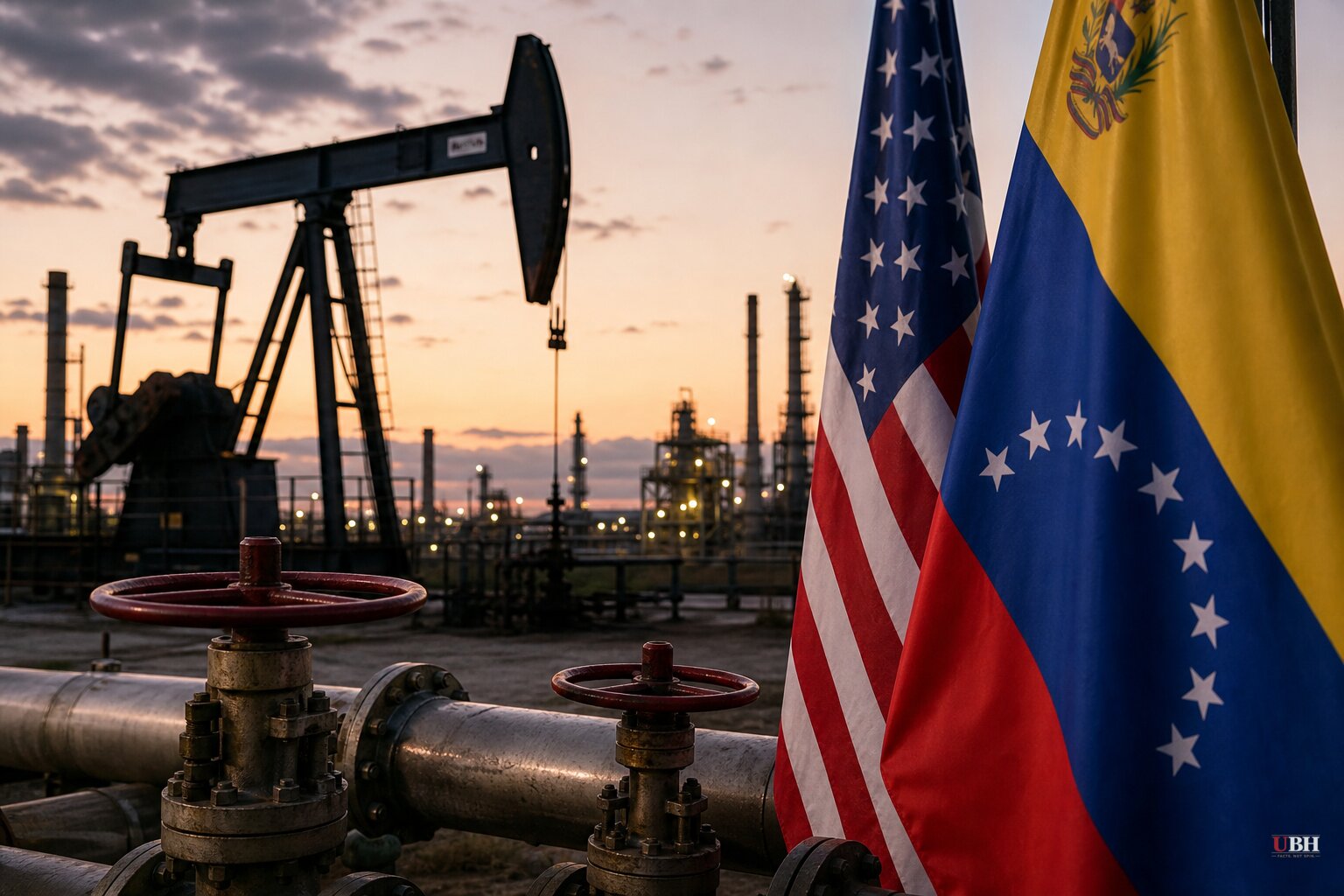
Since President Trump announced last Friday that the US had struck what he called "THE BIGGEST OIL DEAL IN WORLD HISTORY," Venezuela's National Assembly voted Tuesday, September 1 to formally back the agreement, and Energy Secretary Chris Wright landed in Caracas that same night for a signing scheduled for Wednesday, September 2, according to Channel NewsAsia.
The deal gives the US Department of Defense a 35% stake in North American Blue Energy Partners, a joint US-Venezuelan company that now holds 100-year leases on 17 Venezuelan oil fields, according to Democracy Now! and reporting from The Wall Street Journal cited by Reason. The White House says the Pentagon will also hold veto power over appointments to the company's board.
Trump has claimed the arrangement gives the US control of more than 65 billion barrels of proven oil reserves. Channel NewsAsia's US officials described it more narrowly, saying the deal covers roughly one-fifth of Venezuela's total reserves. The White House has described Venezuela as the country with the world's largest proven oil reserves, according to the Guardian.
What the Vote Actually Was
Venezuela's National Assembly, which Channel NewsAsia describes as government-dominated, approved the pact Tuesday in a show-of-hands vote. Some opposition lawmakers abstained. Opposition lawmaker Luis Emilio Rondón said, "We need and are obliged to know what is written in the fine print," arguing lawmakers hadn't seen the full written terms before voting.
Assembly chief Jorge Rodríguez defended the deal, asking, "Who benefits from this oil if it stays underground?" Venezuela's Defense Minister Gustavo González López called it "prosperity and well-being for the country," insisting it amounted to "a decision to choose peace" rather than "subordination."
Interim President Delcy Rodríguez, installed by the Trump administration on January 5, two days after US special forces captured Nicolás Maduro in a Caracas raid, claims the deal will generate more than $209 billion in revenue that could fund healthcare and education, according to The Guardian. "The benefits are endless," she said in a televised address.
The National Security Case
Secretary of State Marco Rubio, in a Spanish-language interview cited by Channel NewsAsia, said the "vast majority" of the 17 oil fields had been "in Chinese and Russian hands" before the deal, and that the Defense Department now holds a "special account" to take possession of a percentage of the assets produced. The White House has framed this as purging "foreign malign influence" from Venezuela and securing "energy dominance for the next century."
Wright, denying the deal amounts to the US commandeering Venezuelan oil, told CNBC "absolutely not" when asked if the US was engaged in "heavy-handed" tactics. He called it "an absolutely historic transformation" and "President Trump's grand plan to replace conflict with commerce." Trump has also argued the deal, which he says will cost US taxpayers nothing, could help lower gasoline prices that have spiked amid the war with Iran, according to Channel NewsAsia. Chevron is expected to announce a major expansion of its own Venezuela operations the same day as the signing.
That rationale, countering Chinese and Russian influence in America's hemisphere while addressing a real oil-price problem tied to the Iran conflict, provides a legitimate national security argument.
The Cronyism and Constitutionality Problem
But the deal has drawn criticism that cuts across the political spectrum. The Wall Street Journal's editorial board, hardly a left-wing outlet, wrote that the arrangement with an unelected interim president "looks less like a normal commercial transaction than it does the famous scene of US businessmen meeting with the Cuban strongman in The Godfather Part II," pointing to Venezuelan tycoon Alejandro Betancourt as the deal's central private beneficiary.
Reason's Eric Boehm called it "the American nationalization of Venezuelan oil" and noted the federal government now has veto power over a foreign oil company's board, on top of stakes it already holds in roughly two dozen American companies. A government that claims to oppose socialism abroad is now directly co-owning and controlling a foreign energy company, the exact kind of state corporatism free-market conservatives normally condemn.
Venezuelan economist Francisco Rodríguez, a former head of Venezuela's Congressional Budget Office now at the University of Denver, told Democracy Now! the deal "appears to violate the Venezuelan Constitution" and called the process "extremely shady." He argued no Venezuelan government would have signed it "unless this country had been subject to an invasion, and unless its authorities had been held at gunpoint," describing it as "gunpoint diplomacy." Rep. Ro Khanna (D-Calif.) made a similar argument on X, calling it a return to "the era of gunboat diplomacy where might makes right."
Elliott Abrams, a former special representative to Venezuela and now a senior fellow at the Council on Foreign Relations, raised a separate concern in a Washington Post opinion piece: polls show opposition leader María Corina Machado would defeat Rodríguez decisively in an open election, following a rightward political wave in Argentina, Chile and Colombia. His argument is that locking in a 100-year deal with an unelected government forecloses that democratic path rather than advancing it.
Whether the deal violates Venezuela's constitution is a legal question neither side has settled in court, and there is no ruling on it in these sources. The signing is set for Wednesday in Caracas, and the terms opposition lawmakers say they still haven't fully seen will become binding for a century.
Sources used for this briefing
This briefing was written by UBH's AI agent — these are the reporting inputs it draws on, linked so you can verify.


