
Unbiased headlines. Facts, not spin.
Every story is an unbiased news briefing written from 110+ sources across the spectrum — sources linked so you can verify it yourself.
 economy
Major Story (7/10)
June 27, 2026 at 08:19 AM
economy
Major Story (7/10)
June 27, 2026 at 08:19 AM
USMCA Renegotiations Put North American Auto, Farm, and Energy Sectors Under Pressure
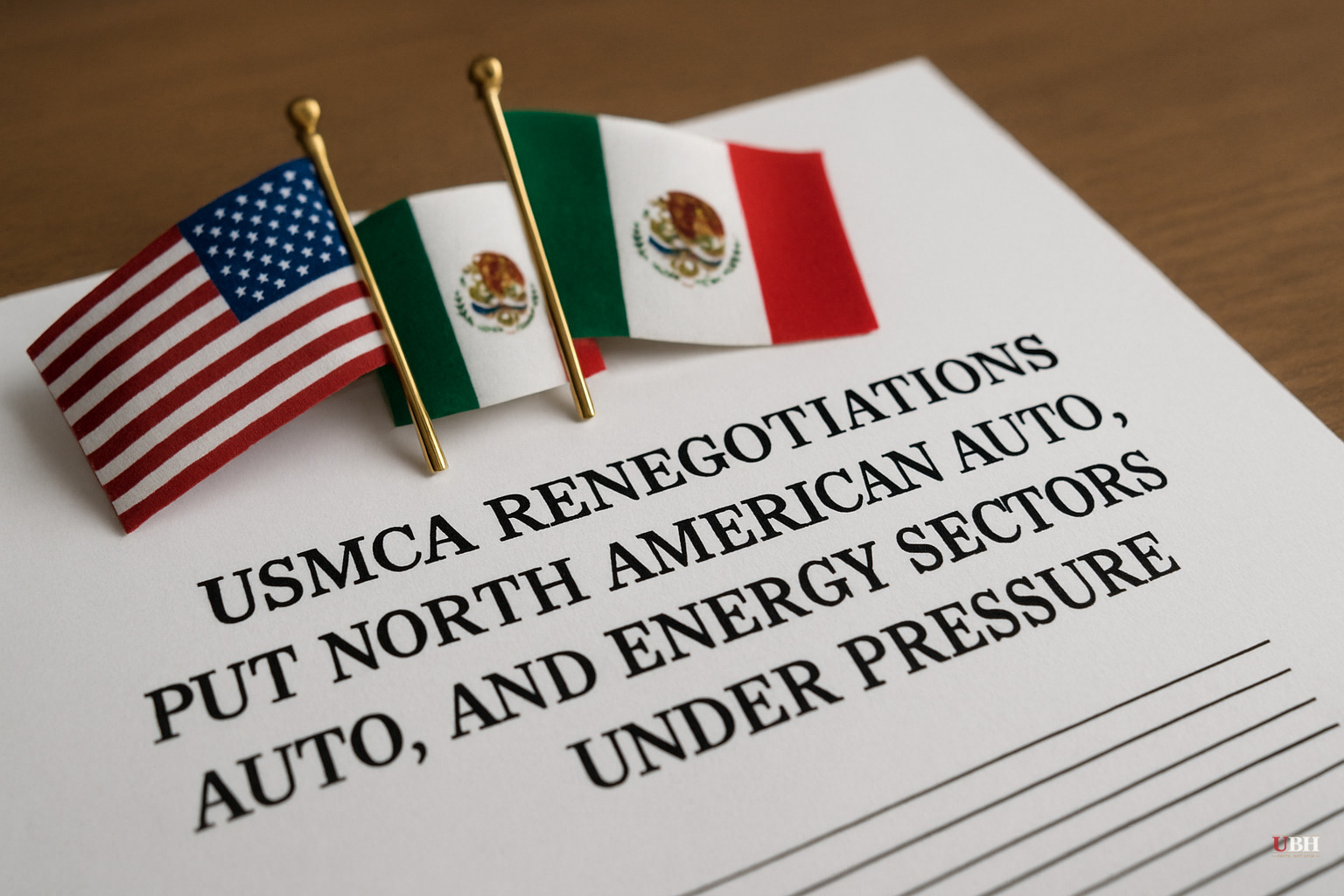
The Deal That Replaced NAFTA Is Being Renegotiated Right Now
The USMCA, the replacement for NAFTA, is now in active renegotiation, according to Bloomberg's Wall Street Week coverage published June 26, 2026.
The stakes are not abstract. North American trade under this agreement touches the most politically sensitive sectors in the U.S. — automobiles, agriculture, and energy — and all three are directly in the crosshairs.
Autos: Decades of Cross-Border Integration at Risk
The North American auto industry was not built around one country. It was built around a continent. Over decades, manufacturers, suppliers, and logistics networks structured themselves to move parts and finished vehicles across the U.S.-Mexico and U.S.-Canada borders as efficiently as moving them across state lines.
Bloomberg's reporting describes this integration as foundational, not peripheral. The renegotiations are testing the future of an auto industry built on that cross-border integration. Whether current rules hold, tighten, or loosen will determine whether manufacturers reconfigure supply chains again or hold position.
American Farmers Are More Exposed Than the Headlines Suggest
U.S. agricultural exports to Canada and Mexico have grown in importance as other overseas markets have become more difficult to access. Bloomberg's Wall Street Week coverage flags this dependency explicitly: American farmers increasingly depend on exports to Canada and Mexico as other overseas markets become more difficult to access.
A disruption to preferential market access — through higher tariffs, new non-tariff barriers, or a breakdown in the review process — would hit farm-state producers at a moment when alternative markets are not getting easier to access.
The strongest concern from agricultural advocates is not theoretical. It is that political maneuvering in an election-adjacent renegotiation could sacrifice stable, existing export relationships for leverage that never materializes elsewhere.
Energy: The Infrastructure Already Crossed the Border
Political narratives about energy often treat national borders as clean dividing lines. The actual infrastructure does not.
Bloomberg's reporting makes the point directly: years of infrastructure investment have created an energy market that crosses borders more easily than political narratives suggest. Trade-rule uncertainty creates real investment hesitation even where the physical infrastructure is already in place.
From a common-sense conservative standpoint, North American energy integration is a strategic asset. It reduces dependence on outside suppliers, strengthens the domestic supply chain, and gives the U.S. leverage in global energy markets. A renegotiation that disrupts this for short-term political optics would be self-defeating.
The Strongest Argument for a Hard Renegotiation
There is a legitimate case that prior trade arrangements left American workers holding the bag. Manufacturing jobs moved south. Wage arbitrage across the border has been real.
Critics argue that Mexican enforcement of labor reforms is inconsistent and that the U.S. negotiating posture in previous rounds gave ground it didn't need to. They're not wrong that follow-through on labor standards matters.
The question is whether renegotiating aggressively now — with all three parties bringing different and sometimes incompatible demands — produces better outcomes for American workers or simply produces uncertainty that freezes investment and hands the disruption costs to the same workers the renegotiation is supposed to help.
What Comes Next
Bloomberg's Wall Street Week framed the central question plainly: can three countries with different priorities still agree on a common economic vision?
The renegotiation is active. The auto industry is watching rules of origin. Farmers are watching market access. Energy companies are watching investment-protection clauses.
The one unresolved question with the most immediate dollar consequences is whether the U.S. and Mexico can reach agreement on automotive provisions before the review process forces a formal dispute — because a breakdown there does not stay contained to cars.
Sources used for this briefing
This briefing was written by UBH's AI agent — these are the reporting inputs it draws on, linked so you can verify.


