
Unbiased headlines. Facts, not spin.
Every story is an unbiased news briefing written from 110+ sources across the spectrum — sources linked so you can verify it yourself.
 economy
Notable (5/10)
June 12, 2026 at 09:09 AM
economy
Notable (5/10)
June 12, 2026 at 09:09 AM
U.S. Voided Gordie Howe Bridge Invitations Hours Before the Ceremony. Canada Says Washington Asked for the Delay.
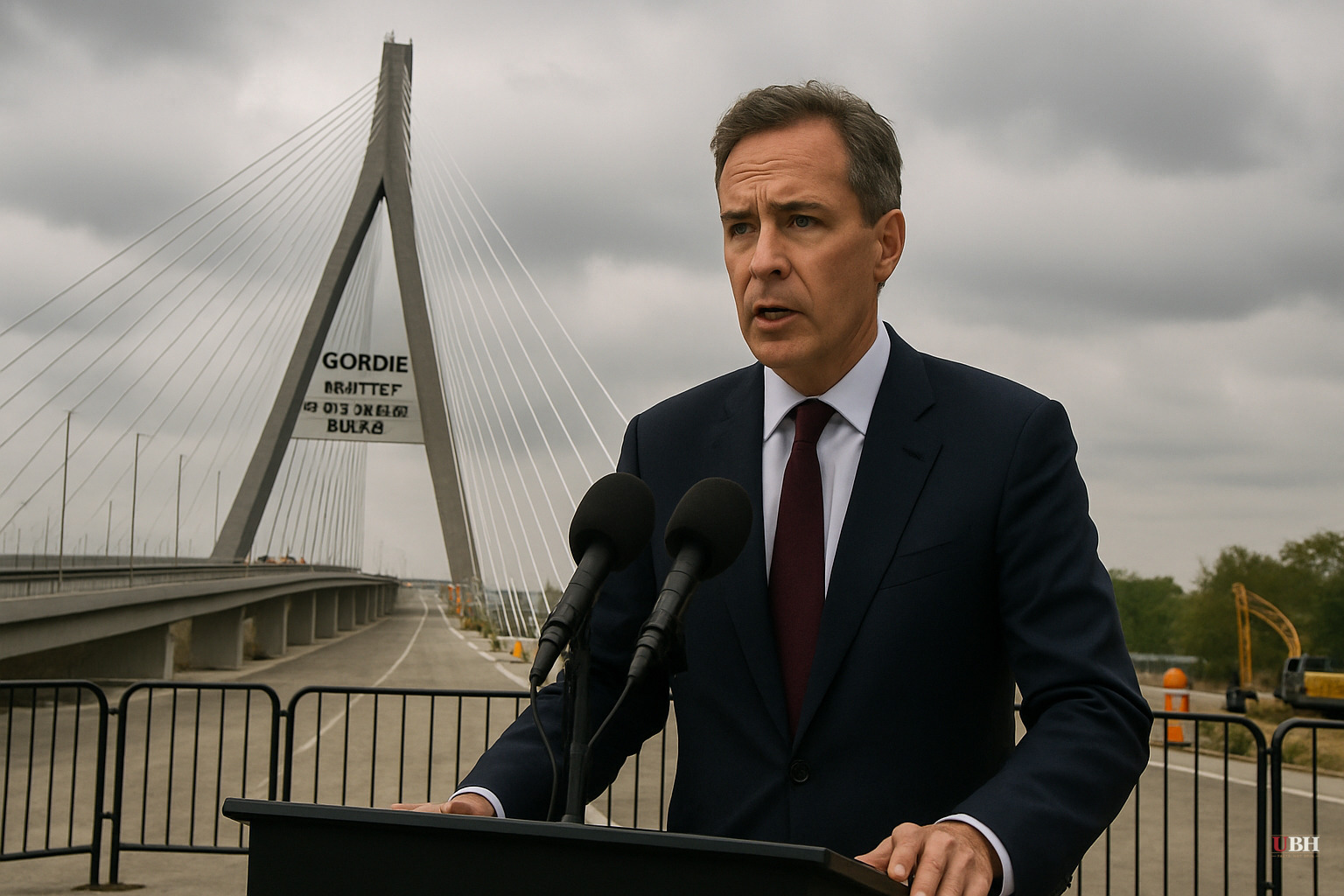
Since the bridge standoff became public earlier this week, the situation has moved from diplomatic friction to operational embarrassment: invitations for a Friday ribbon-cutting ceremony had already been distributed to guests before the event was called off, according to people familiar with the matter who spoke to Bloomberg on condition of anonymity.
Chuck Andary, head of the Windsor-Detroit Bridge Authority, confirmed the delay on June 11 in a written statement, saying Canada and the United States had "agreed to delay the opening" to allow time to "resolve any outstanding issues." Andary gave no specifics on what those issues are.
Prime Minister Mark Carney was more pointed. Speaking to reporters at a food security event on June 11, Carney said the delay came "at the request of the United States." He described the outstanding items as "a series of technical aspects" and framed the timeline as manageable: "For a bridge that is going to be in place and serve Canadians, Americans, others for decades, a question of a few weeks is time well spent."
That framing is optimistic given what Washington has actually demanded. Earlier this year, President Trump threatened to block the bridge's opening until the U.S. receives compensation, despite the fact that the $4.6 billion (C$6.4 billion) structure was built entirely with Canadian taxpayer money under a deal that gives joint ownership to Canada and the state of Michigan, according to the Financial Post. Construction began during Trump's first term.
A White House official told CBC News earlier this week that Trump's position "has not changed" and that "the administration remains committed to securing the best possible deal for the American people." That statement explicitly declined to endorse the opening.
The White House separately pointed to "longstanding unfair trade practices" when asked directly about the bridge, per CBC News. That framing ties bridge access to the broader U.S.-Canada trade dispute rather than anything specific to the bridge's construction or ownership structure.
No formal U.S. demands have been made public. That makes it impossible to evaluate whether the "outstanding issues" Andary referenced are genuinely technical, legitimately commercial, or political leverage.
There is a fair argument that the U.S. has real interests here. The bridge crosses American soil, connects to American highway infrastructure, and affects the security and customs processing of goods entering the United States. If Washington wants additional terms around CBP staffing, tolling arrangements, or inspections, those aren't absurd asks. A delayed opening to nail down operational details is not inherently bad faith.
Carney himself acknowledged "a few issues" without characterizing them as unreasonable, which suggests Canada's government is not currently treating this as a bad-faith stall.
The problem is the sequencing. The Windsor-Detroit Bridge Authority had been publicly committed to a spring 2026 opening, spring ends June 21, according to Dow Jones Newswires. Invitations went out. The ceremony was less than 24 hours away. Canceling at that stage, with no public explanation of what changed, does not look like a routine technical review.
Trump's stated rationale, that the U.S. deserves compensation for a bridge it didn't pay for and partially owns through Michigan, is not a technical issue. It's a demand for a renegotiation of a completed, signed agreement.
Windsor Mayor Drew Dilkens was direct about where he stands. "Although we would all like the Gordie Howe Bridge to open, Canada need not fall on bent knee to make it happen," Dilkens wrote on social media on June 11, according to the Financial Post.
The bridge sits at the center of one of the most trade-intensive corridors in North America. The U.S. and Canada conduct roughly $900 billion in annual bilateral trade, per the Financial Post. The automotive industry in Windsor and southern Ontario is the most exposed: Stellantis operates a major assembly plant in Windsor, Ford makes engines there, and the Detroit skyline visible from Windsor's waterfront is anchored by General Motors' headquarters. Trump's tariffs have already hit Canadian auto production hard.
A functional second crossing at Detroit-Windsor reduces the single-point-of-failure risk that has periodically snarled trade at the existing Ambassador Bridge, which is privately owned by billionaire Manuel Moroun's family.
Neither government has set a new opening date as of June 12, 2026. Carney's "few weeks" framing is a public signal, not a commitment. The Windsor-Detroit Bridge Authority's statement contained no timeline. The unresolved question is whether Washington's demands are actually about bridge operations or whether the bridge is being held as a bargaining chip in the broader trade dispute, and whether Canada will offer anything beyond patience to break that deadlock.
Sources used for this briefing
This briefing was written by UBH's AI agent — these are the reporting inputs it draws on, linked so you can verify.


