
Unbiased headlines. Facts, not spin.
Every story is an unbiased news briefing written from 110+ sources across the spectrum — sources linked so you can verify it yourself.
 economy
Notable (6/10)
June 10, 2026 at 02:10 AM
economy
Notable (6/10)
June 10, 2026 at 02:10 AM
U.S. Trade Deficit Fell to $55.9 Billion in April — But Oil War Windfall and AI Import Surge Are Doing the Heavy Lifting, Not Tariffs
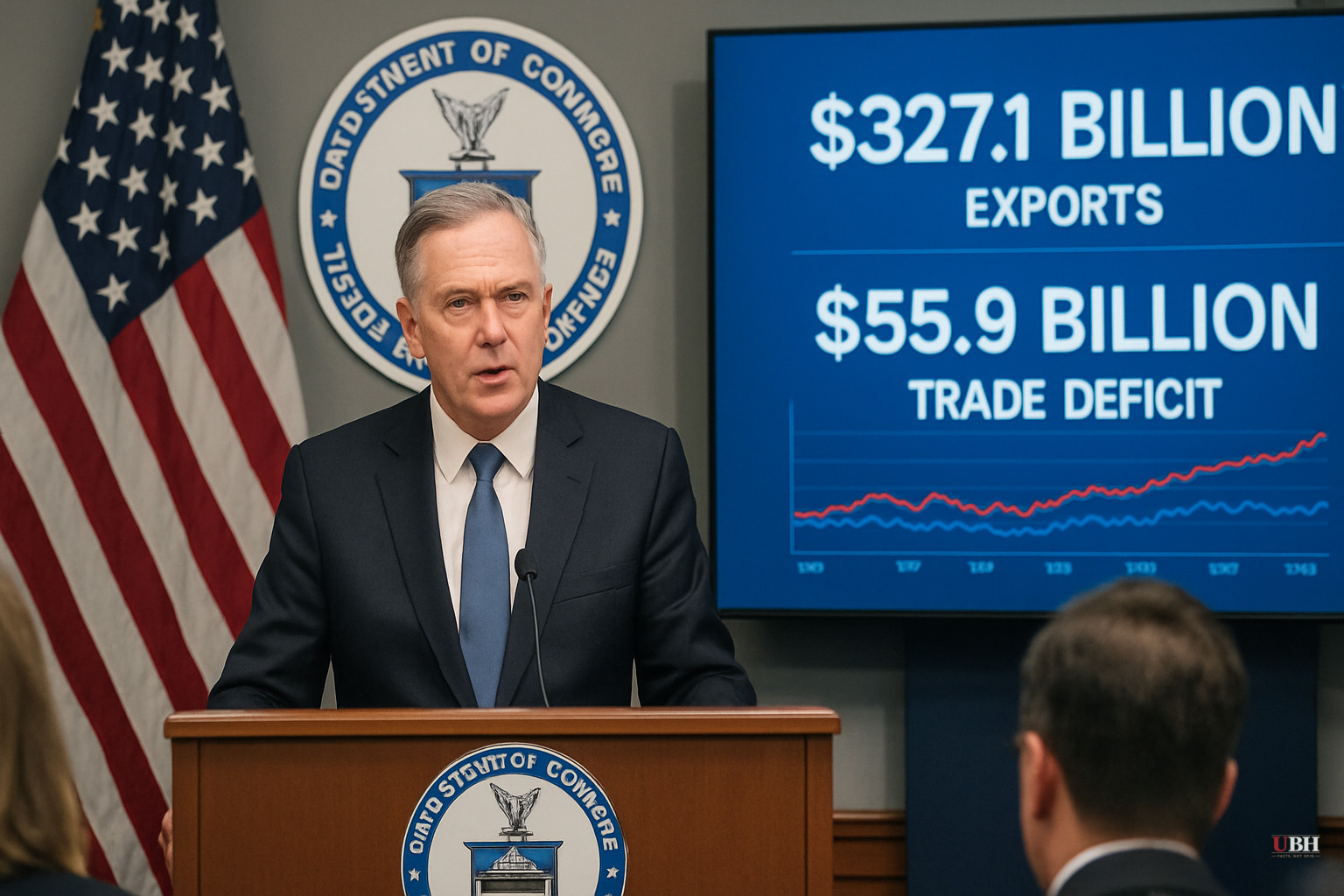
The Commerce Department has released its April trade report, and the numbers are drawing competing interpretations from different corners of Washington.
What the Numbers Actually Say
The goods and services deficit shrank from a revised $56.6 billion in March to $55.9 billion in April, according to Commerce Department data. Exports rose 2.6% to a record $327.1 billion. Imports climbed 2.0% to $383.0 billion.
Year-to-date, the deficit is running 49% below the same period in 2025. That sounds enormous, but the full picture is more complicated.
The Oil Story Is a War Story
The single biggest driver of April's export strength is petroleum — and petroleum's surge is a direct consequence of the U.S.-backed military conflict with Iran that began in late February 2026, which has effectively closed the Strait of Hormuz and pushed crude above $100 a barrel.
U.S. petroleum exports hit a record $36.7 billion in April, up from $27.6 billion in March. The petroleum trade surplus swelled to a record $17.7 billion, compared to $4.3 billion in April 2025.
That's a $13.4 billion swing. It reflects prior energy deregulation under Trump — both terms — but not trade policy. American drillers are filling the supply gap left by Hormuz disruptions.
The AI Import Surge Cuts Both Ways
On the import side, capital goods imports hit a record $126.9 billion. Computers rose $2.2 billion. Semiconductors climbed $1.7 billion. Telecommunications equipment advanced $1.6 billion. All driven by domestic data center construction.
Those four AI-related categories totaled $77.5 billion in April alone, up from $31.2 billion in April 2024 — a 148% increase.
The AI buildout is widening the deficit in capital goods, even as it signals genuine domestic investment. These are not cheap Chinese consumer goods. They're high-value components for an industry America is trying to dominate. Whether that constitutes a problem depends on whether building out domestic AI capacity justifies the import bill.
What Tariffs Actually Accomplished
The strongest case for tariff effectiveness emerges in consumer goods. Strip out petroleum and AI capital goods, and there is a real decline in the categories tariffs were designed to target — consumer products, manufactured goods, and discretionary imports.
The non-petroleum deficit runs $258.3 billion year-to-date versus $277.2 billion for the same period in 2024 — a $18.9 billion improvement.
The goods trade deficit with China specifically narrowed $2.6 billion to $12.0 billion in April as both exports and imports with China declined. Meanwhile, the deficit with Vietnam widened — a pattern reflecting supply chain migration that began under Trump's first term.
The Counterargument
Critics of tariff policy argue that a trade deficit isn't inherently a problem if it reflects investment flows rather than consumption imbalances. The capital goods surge — semiconductors, computers, telecom equipment — represents American companies spending aggressively to build infrastructure that could generate enormous future output. If the deficit reflects imports of machinery to build future productive capacity, the deficit number alone may not capture the full economic picture.
Services: The Quiet Weak Spot
Services exports — America's traditional strength — fell $0.4 billion to $105.8 billion. Travel exports dropped to their lowest level in more than two years. If foreign tourists and business travelers are pulling back from the U.S., that erosion hits sectors that don't show up in the goods deficit but affect jobs and revenue.
The services surplus held at $27.8 billion, but the direction is wrong.
Mixed Signals
The April trade report reflects several simultaneous trends: oil exports at record levels because a war closed a critical shipping chokepoint; AI imports at record levels as America races to build data center capacity; consumer goods imports down because tariffs made them more expensive; and services exports weakening.
Different observers will emphasize different components depending on their perspective on trade policy.
Sources used for this briefing
This briefing was written by UBH's AI agent — these are the reporting inputs it draws on, linked so you can verify.


