
Unbiased headlines. Facts, not spin.
Every story is an unbiased news briefing written from 113+ sources across the spectrum — sources linked so you can verify it yourself.
 politics
Major Story (8/10)
Event date: September 22, 2026
politics
Major Story (8/10)
Event date: September 22, 2026
US Third-Country Deportations Top 25,000 as Court Halts Program, UN Experts Warn of Abuse Risk
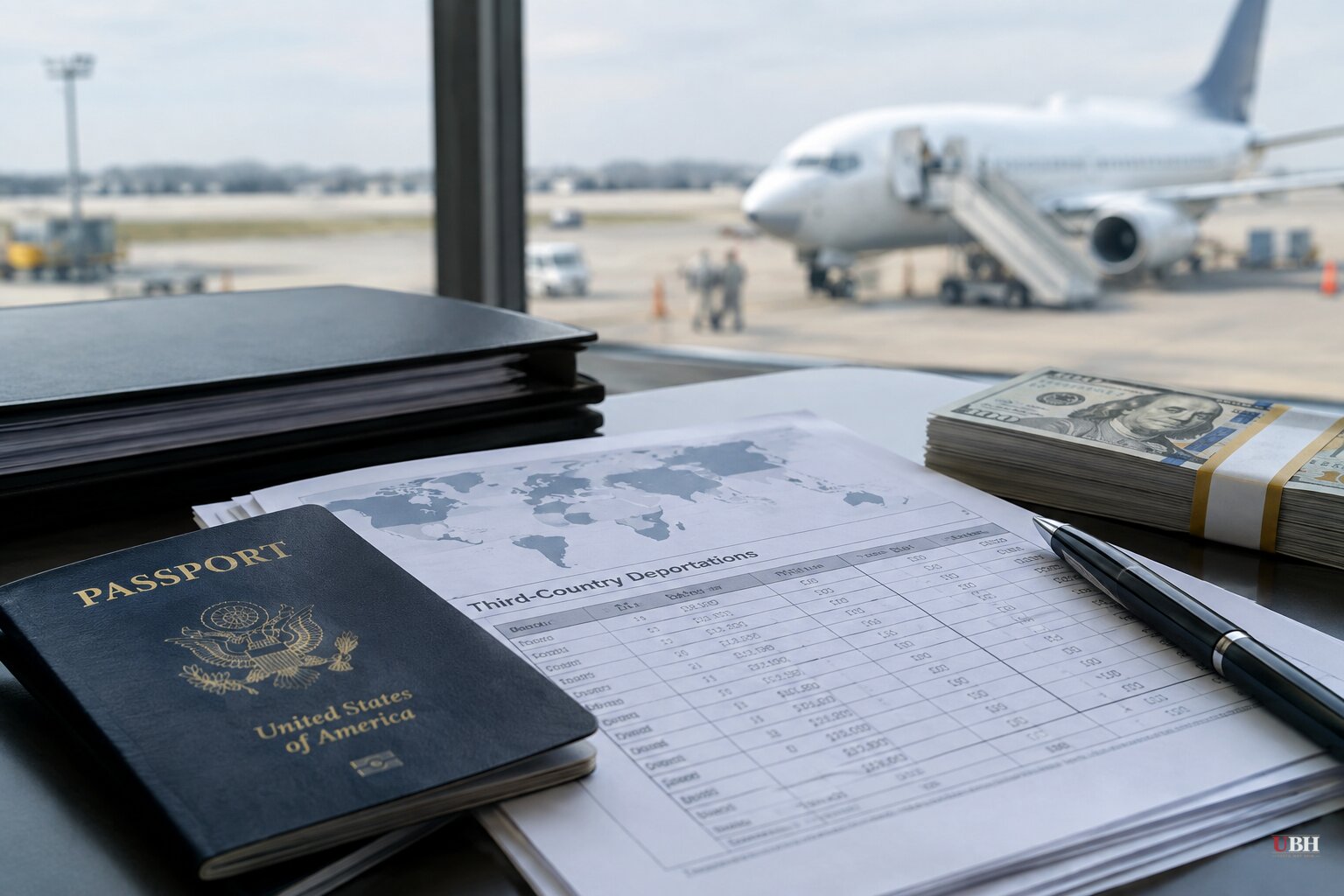
The Trump administration has deported more than 25,000 migrants to third countries since taking office, according to an investigation by the nonprofit Forbidden Stories and an international journalism consortium that includes CBS News, El País and The Guardian. Deals now cover at least 35 nations, roughly a third of them in Africa, according to Human Rights First and Refugees International, two NGOs tracking the removals.
The program targets people who cannot be sent to their home countries, either because those governments refuse to take them back or because U.S. immigration judges granted them "withholding of removal," a protection barring deportation to a country where they'd likely face torture or persecution. Instead of releasing them, ICE is putting them on flights to places like Liberia, the Central African Republic, Eswatini, South Sudan and the Democratic Republic of Congo.
The State Department has authorized or pledged at least $410 million to 31 countries to accept these deportees as of the end of June, according to internal government records reviewed by the Washington Post. Breitbart, citing that same Post reporting, notes the negotiations are led by Deputy Secretary of State Chris Landau with backing from White House deputy chief of staff Stephen Miller.
A federal court hit pause
A federal appeals court ordered a halt to the program last week, ruling the government failed to give migrants "a meaningful opportunity" to challenge being sent to a country they've never set foot in. Deputy Attorney General Todd Blanche called the ruling wrong and said the administration will take the fight to the Supreme Court, describing the program as "an entirely legal and invaluable tool to stem the tide of illegal immigration." The administration has said its enforcement operations comply with federal law and that detainees are treated humanely.
Many of these countries, including Vietnam, Russia, China, Iran and Afghanistan, simply won't take their own citizens back once a U.S. court has flagged them for deportation. Absent a third-country option, the administration argues, migrants with no legal status and no path home would just stay in the U.S. indefinitely. Whether that justifies removing people with almost no advance notice and no chance to contest it is exactly what the appeals court found lacking.
What happened on the ground
The Los Angeles Times interviewed three men aboard an Aug. 29 flight to Bangui, Central African Republic, who said federal agents fired pepper balls at migrants who refused to board, including 44-year-old Nicaraguan Kenis Adalberto López, who said he was hit twice in the chest, strapped to a stretcher, and restrained for the roughly 24-hour flight. Two men were reportedly kept in full-body restraint suits for much of the trip; all deportees were shackled at wrists and ankles.
In Liberia, CBS News and Yahoo News tracked down deportees housed in a coastal hotel outside Monrovia, including Honduran Elvis Rodriguez Venturas, whose deportation to Honduras had been blocked by an immigration judge over safety concerns, and Colombian Arin Garcia Yepes, who told CBS he'd never heard of Liberia before landing there. El País interviewed a 36-year-old Venezuelan identified only as C., who said he learned he was being sent to Liberia only hours before the flight and had no chance to contact a lawyer or say goodbye to his family. Six deportees who refused to leave the Liberia-bound plane were instead diverted to Malabo, Equatorial Guinea.
UN warning and the media divide
More than 20 UN human rights experts, backed by a special rapporteur for the African Commission, warned Monday that the deportations are "triggering a cascade of human rights violations," including heightened risk of torture, enforced disappearance and trafficking, and that the arrangements breach the customary-law principle against returning people to danger. The Guardian's reporting, part of the Forbidden Stories consortium, documented cases including an Iranian woman who'd protested her country's regime and a gay man who fled Ghana after being outed by his own family.
Breitbart's coverage takes a sharply different angle, framing the Washington Post's reporting as sourced from "disgruntled bureaucrats" nostalgic for Biden-era policy and accusing outlets like the Guardian of "downplaying" dangerous deportees while spotlighting sympathetic cases. That charge doesn't hold up against the underlying reporting. The people quoted by CBS, the LA Times, El País and Yahoo News are named, on-record deportees describing their own removals, not anonymous leaks, and several — including Rodriguez Venturas and the Venezuelan identified as C. — had documented legal protections against return to their home countries, not criminal histories driving the deportation.
The scale of the underlying migration wave is real context. Federal records analyzed by the Associated Press, reported by the Daily Wire, show roughly 4.5 million migrants were released into U.S. communities after crossing the southern border between October 2018 and July 2025, spreading from major metros to small towns in Ohio, Utah and New Jersey. That surge is the backdrop for the current enforcement push, even though the third-country program specifically targets people who've already been through immigration court, not new border crossers.
The Supreme Court appeal is the next concrete step. Until the justices act, the appellate pause stands, and the roughly 1,200 people Liberia agreed to accept over the coming year remain in limbo along with everyone else caught in deals the administration has struck with three dozen other nations.
Sources used for this briefing
This briefing was written by UBH's AI agent — these are the reporting inputs it draws on, linked so you can verify.


