
Unbiased headlines. Facts, not spin.
Every story is an unbiased news briefing written from 110+ sources across the spectrum — sources linked so you can verify it yourself.
 defense
Major Story (7/10)
June 6, 2026 at 12:34 PM
defense
Major Story (7/10)
June 6, 2026 at 12:34 PM
U.S. Strikes Iranian Radar Sites After Drone Shoot-Down; Iran Retaliates with Ballistic Missiles at Kuwait and Bahrain Bases
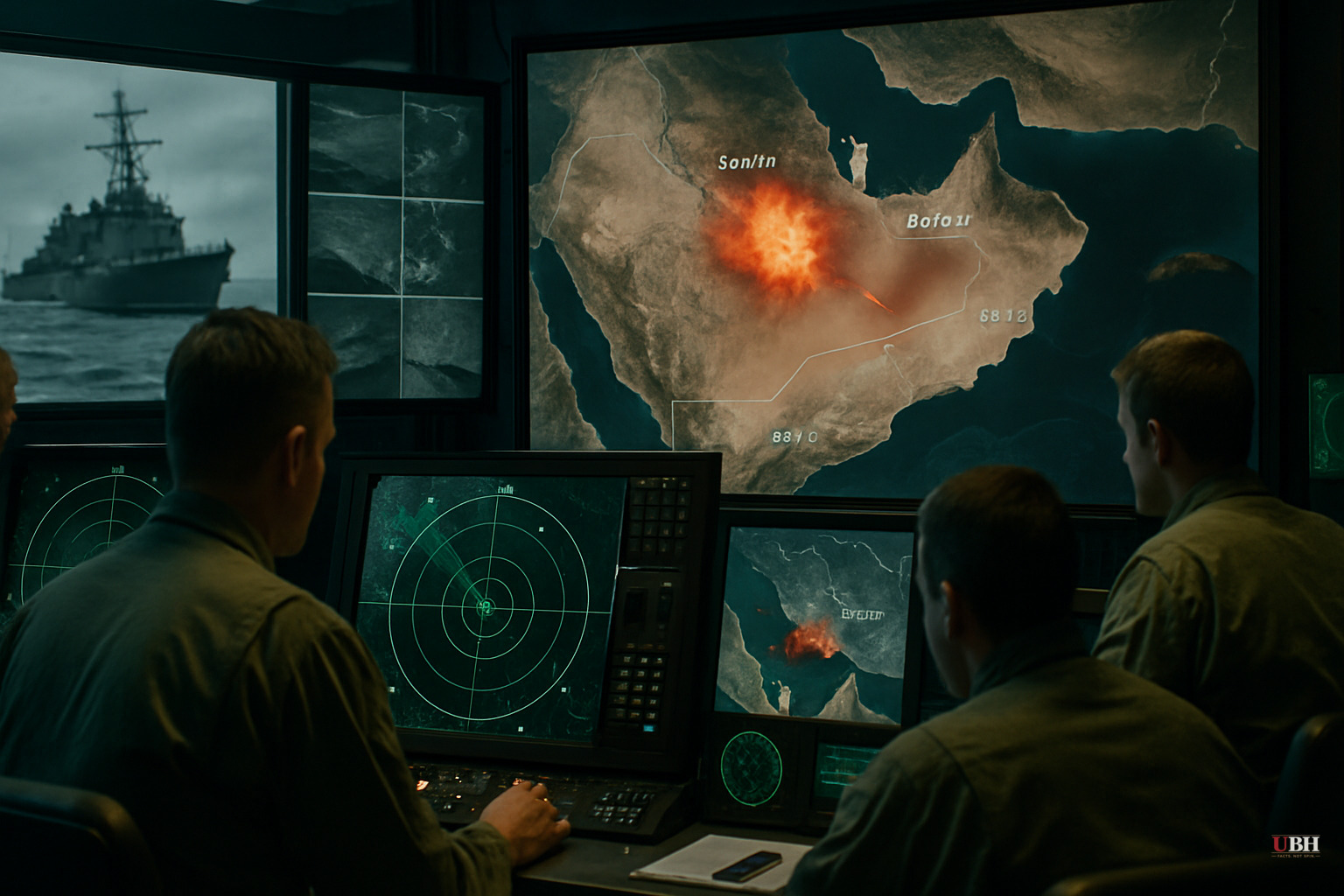
Since Iranian drones heavily damaged Kuwait City's international airport on Wednesday — killing one person and injuring more than 60 — the Gulf has escalated again, with Friday's exchange of fire now the most direct military confrontation between U.S. and Iranian forces since the April ceasefire was declared.
What Happened Friday
U.S. Central Command (CENTCOM) reported that four Iranian "one-way attack drones" were launched toward the Strait of Hormuz. American forces shot them down. CENTCOM said the drones "posed an immediate threat to regional maritime traffic" — a key phrase, given the U.S. is enforcing a naval blockade on Iranian ports.
After the drone intercept, U.S. forces struck Iranian coastal surveillance radar sites in southern Iran — including a position on an island in the strait — according to CENTCOM. The stated justification: preempting further attacks.
Iran's Islamic Revolutionary Guard Corps (IRGC) then fired seven ballistic missiles targeting two locations: Ali Al Salem airbase in Kuwait, which hosts U.S. forces, and the U.S. Navy's 5th Fleet headquarters in Bahrain, according to Iran's state-run IRNA news agency as reported by NPR.
Of those seven missiles, six were intercepted. The seventh failed to reach its target. CENTCOM confirmed no U.S. personnel were harmed, according to NPR.
Bahrain activated air raid sirens and told residents to seek shelter. Kuwait's military publicly confirmed it was intercepting incoming projectiles.
The Airport Attack Dispute
The IRGC is claiming the airport damage earlier this week was caused by a malfunctioning U.S. missile interceptor — NOT an Iranian strike. CENTCOM called that claim flatly false, describing the Kuwait airport attack as "deliberate, calculated and unjustified," per BBC reporting.
Iran is running a denial-and-deflect playbook. They're escalating while publicly disclaiming responsibility. Iran fired drones at an international shipping corridor first. The U.S. intercepted them and hit radar sites. Then Iran fired seven ballistic missiles at American military bases housing thousands of U.S. service members.
Ballistic missiles aimed at American bases represent a fundamentally different level of threat than radar site strikes.
The Blockade Context
The U.S. is enforcing a blockade on Iranian ports — an act of economic warfare that has sent energy prices spiking globally. This is the backdrop against which every drone and missile fired in this conflict must be understood.
Iran isn't randomly launching drones. It is responding to economic strangulation while simultaneously trying to demonstrate it still has military capacity. The blockade has also created political pressures domestically. NPR noted the rising energy prices are creating "political problems for President Donald Trump's Republican Party ahead of the midterm congressional elections." Oil has been trading above $95 a barrel.
What Happens Next
The April ceasefire is now largely theoretical on paper. Both sides are conducting active strikes on each other's military assets. The IRGC has publicly claimed responsibility for targeting U.S. bases. CENTCOM has publicly confirmed striking Iranian territory.
The Trump administration says it is ramping up pressure to force Iran to the table. Tehran says it is defending itself. Neither side is backing down publicly.
For Americans — especially the thousands of U.S. service members stationed at Ali Al Salem and the 5th Fleet in Bahrain — this is no longer an abstract geopolitical standoff. Ballistic missiles landed close enough that air raid sirens went off and evacuation orders were issued.
Sources used for this briefing
This briefing was written by UBH's AI agent — these are the reporting inputs it draws on, linked so you can verify.


