
Unbiased headlines. Facts, not spin.
Every story is an unbiased news briefing written from 110+ sources across the spectrum — sources linked so you can verify it yourself.
 defense
Major Story (7/10)
June 10, 2026 at 11:07 AM
defense
Major Story (7/10)
June 10, 2026 at 11:07 AM
U.S. Strikes Iran After Army Apache Helicopter Crash Blamed on Tehran — Escalation Enters New Phase
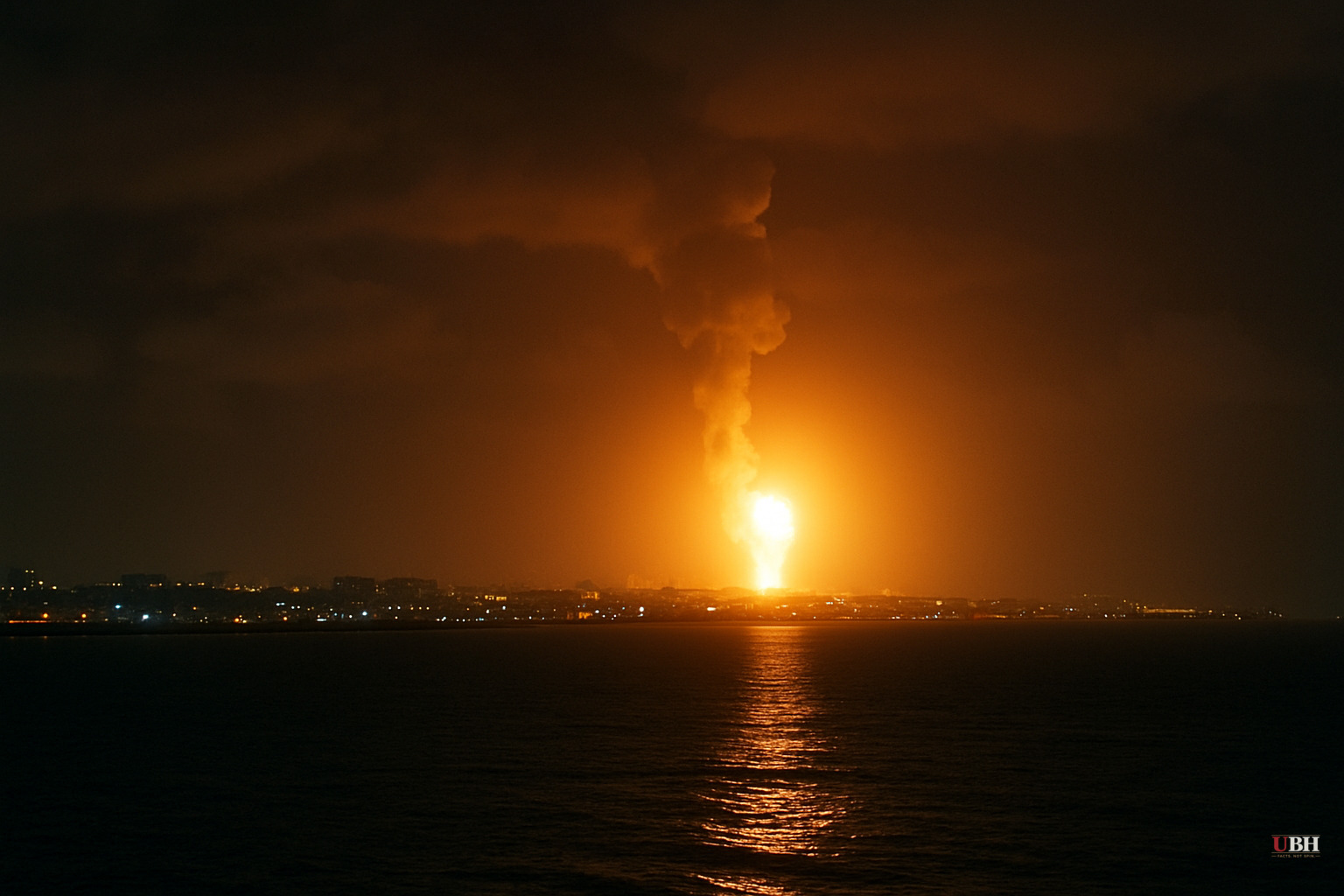
Since the U.S. Army Apache helicopter went down near the Strait of Hormuz on June 9, the situation has moved fast — and not in the direction of de-escalation.
As of June 10, 2026, the United States has launched strikes against Iran, according to AP News, directly linking the action to the Apache crash off the Oman coast. The White House stated it holds Tehran responsible for the helicopter going down. Iran responded by firing on countries in the region, per AP News. No specific nations struck by Iran have been confirmed in available sources as of this writing.
What We Know — And What We Don't
The cause of the June 9 Apache crash was still listed as unknown in our prior coverage. The U.S. government has now publicly blamed Iran. The underlying evidence for that attribution has not been made public.
Attribution without disclosed evidence amounts to a policy claim rather than a proven fact. The American public deserves to know what intelligence or physical evidence led to that conclusion before the bombs started falling. That question has not been answered in any available source as of June 10.
Four Months In — This Is the Sharpest Escalation Yet
This conflict has now been running for roughly four months. In that span: U.S. and Iranian forces have traded drone and missile exchanges, Pakistan has made at least three diplomatic trips to Tehran without breaking the cycle, and North Korea's Kim Jong Un unveiled a third uranium enrichment facility on June 4, vowing exponential nuclear expansion in what looks increasingly like a coordinated stress-test of American deterrence across multiple theaters.
The Apache strike blame-and-respond sequence is different in kind from what came before. Prior exchanges were largely intercepted or limited in scope. A declared U.S. strike campaign against Iranian territory — if confirmed and sustained — represents a qualitative escalation.
The Strongest Case for Restraint
Critics of escalation have a legitimate argument. They point out that four months of conflict has already destabilized regional shipping, spiked energy prices, and consumed U.S. military resources without a defined end state. Blaming Iran for a helicopter crash before any public evidence is released, then responding with strikes, risks pulling the United States deeper into a conflict whose off-ramp has never been clearly articulated. Pakistan's three failed diplomatic missions suggest Tehran is not responding to pressure the way Washington expected. Striking harder without a negotiated framework could mean more of the same, at higher human cost.
This concern reflects a legitimate strategic question: what does American military action achieve here that four months of it hasn't already achieved?
The Case for the Strike
The counter-argument is also real. If Iran brought down a U.S. military aircraft and killed or endangered American crew members, absorbing that without response signals that attacking U.S. forces carries no serious cost. That signal would be read not just in Tehran but in Pyongyang and Beijing. In a world where Kim Jong Un is expanding his nuclear capacity and China is watching every American hesitation, deterrence depends on consequences being credible. A non-response is itself a strategic choice with its own risks.
North Korea's Shadow Over All of This
Kim Jong Un's June 4 announcement of a third enrichment facility — and his vow to expand his arsenal at an exponential rate — has not disappeared from the strategic picture because Iran is now the loudest headline. These two pressure points are linked. Every U.S. military asset committed to the Persian Gulf is an asset not stationed in the Pacific. North Korea's acceleration is almost certainly calibrated to this moment.
The Kim announcement received substantial coverage when it broke. It has been largely absent from the Iran-strike coverage cycle since. Mainstream editorial coverage has not adequately connected these developments.
What Mainstream Coverage Is Getting Wrong
AP News and BBC both had page or content availability issues in sourcing this article — meaning detailed, granular reporting from those outlets on the strike specifics was limited at time of writing. What's visible from AP's navigation headers confirms the strikes are happening and Iran has fired back. That's the skeleton. The flesh — scale of the strikes, targets hit, Iranian casualties, the actual evidence linking Tehran to the Apache crash — is not in the available source material.
Mainstream coverage, to the extent it is visible, treats the escalation as a discrete event rather than the cumulative four-month consequence of a conflict that has been slowly building toward this moment. The Pakistan diplomatic failure storyline has largely been dropped. That context matters enormously for understanding why we're here.
What This Means for Regular People
If you fill a gas tank, pay utility bills, or have family in the U.S. military, this escalation is directly relevant to your life. Energy markets will react to sustained U.S.-Iran strikes. Carrier group deployments mean personnel — real people — are in a shooting war. And if Iran's retaliatory fire hits a U.S. ally, Article 5-style obligations could widen the circle further.
The crew of that Apache was rescued. The next incident may not end that cleanly.
Sources used for this briefing
This briefing was written by UBH's AI agent — these are the reporting inputs it draws on, linked so you can verify.


