
Unbiased headlines. Facts, not spin.
Every story is an unbiased news briefing written from 110+ sources across the spectrum — sources linked so you can verify it yourself.
 defense
Major Story (7/10)
June 10, 2026 at 12:09 AM
defense
Major Story (7/10)
June 10, 2026 at 12:09 AM
U.S. Strikes Iran After Apache Shootdown — A Navy Robot Boat Made the Rescue, and the 'Days Away' Deal Just Got Further Away
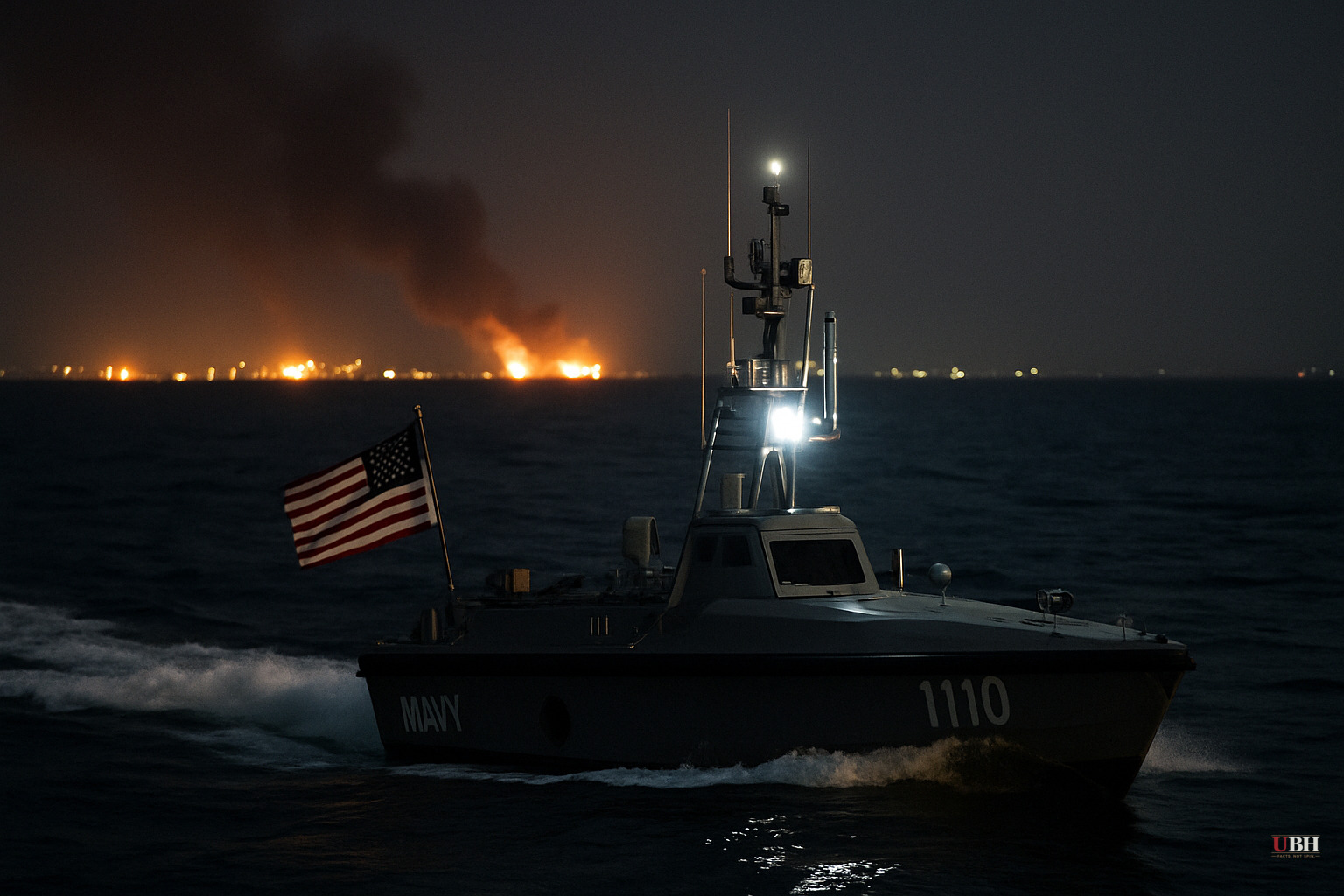
Since Iran shot down a U.S. Army Apache helicopter over the Strait of Hormuz on Monday evening, the conflict has moved fast — and mostly in the wrong direction for diplomacy.
What's New Since Yesterday
The rescue is no longer the headline. By Tuesday evening, U.S. Central Command announced retaliatory strikes against Iran, calling them "self-defense strikes" and "a proportional response to unjustified Iranian aggression," according to CENTCOM's official X post.
Iran's Tasnim News Agency reported the strikes prompted explosions near the strait. Iran has vowed to respond. Iran has NOT officially claimed responsibility for downing the helicopter — Iranian state broadcaster IRIB said "no offensive military operations" had been carried out in the strait in the preceding 24 hours.
Iran's position, stated publicly by Foreign Minister Abbas Araghchi before the U.S. strikes, was deliberately ambiguous: "Foreign forces in proximity to our territory are at constant risk on account of their own human errors, plain accidents, or potentially being caught in crossfire."
Trump called it a shootdown. CNN cited U.S. officials saying an Iranian Shahed drone hit the aircraft. CENTCOM's news release said the Apache was "lost at sea" and that the cause is not immediately clear. The gap between what officials told CNN and what CENTCOM put on paper bears watching.
The Drone Boat Nobody Is Talking About
Most mainstream coverage has given minimal attention to how the rescue unfolded: a Corsair unmanned surface vessel — a 24-foot robot boat built by Texas-based defense firm Saronic — operated by Task Force 59 reached the downed crew roughly two hours after the Apache went down at approximately 7:30 p.m. ET Monday. It picked up the crew, transported them to a rendezvous point, and a crewed helicopter completed the recovery. Both pilots are in stable condition, according to CENTCOM spokesperson Capt. Tim Hawkins.
Task Force 59 only started operating Corsair boats in March 2026, according to Defense One. This is the first known combat rescue performed by a U.S. Navy unmanned surface vessel.
The backstory: CENTCOM commander Adm. Brad Cooper previously led 5th Fleet, which runs Task Force 59. In 2023 he told Defense One the goal was "manned-unmanned teaming concepts." Monday night, that concept saved two lives in the middle of a shooting conflict.
The Deal That Keeps Being 'Days Away'
Less than 24 hours before Tuesday's retaliatory strikes, Trump was on social media saying a deal with Tehran was "two or three days away." According to CNBC, he has made similar claims repeatedly without a deal materializing.
Energy Secretary Chris Wright told CNBC's Brian Sullivan at the Atlantic Council Global Energy Forum on Tuesday that ship traffic through Hormuz is "rising very meaningfully" — but provided no specific data to back that up.
JPMorgan analysts, in a June 4 note, estimated roughly 2 million barrels per day may be transiting Hormuz on tankers running with transponders switched off. The bank called it "surprising volumes" given the ongoing naval blockade. That's an estimate, not a confirmed figure — but it's the only hard number anyone has offered.
U.S. crude futures dropped 3.4% Tuesday to close at $88.20 per barrel. Brent fell 2.97% to $91.45. Markets apparently found Wright's optimism more convincing than the missile exchanges. Oil is still up roughly 30% since the conflict began, per CNBC.
The Case for Caution Before Escalation
The strongest argument against the U.S. retaliatory strikes: Iran has not definitively claimed responsibility. The CENTCOM press release itself did not confirm the cause of the Apache going down. Launching strikes under a nominally active ceasefire — before the facts are fully established — risks locking both sides into an escalation cycle that makes any deal impossible.
Ambiguity about what caused the helicopter to go down should have been resolved before ordering strikes. If the Shahed attribution is correct, the response was warranted. If the cause turns out to be an accident or crossfire, the U.S. escalated a 100-day war on incomplete information.
The evidence available right now — Trump's statement, CNN's sourcing of U.S. officials, Iran's deliberately evasive non-denial — points toward Iranian responsibility. But "points toward" and "confirmed" are two different things.
What This Means
The ceasefire that was never really a ceasefire just took another hit. Iran says it will respond to Tuesday's U.S. strikes. Trump says a deal is days away.
For anyone with money moving through global energy markets, supply chains dependent on Persian Gulf shipping, or a family member in the 5th Fleet's area of operations — the gap between White House optimism and what is actually happening in the strait is the critical figure.
Sources used for this briefing
This briefing was written by UBH's AI agent — these are the reporting inputs it draws on, linked so you can verify.


