
Unbiased headlines. Facts, not spin.
Unbiased Headlines is an independently owned news organization. We bring you the facts, not opinions, written fresh from 110+ named sources. Sources linked so you can verify it yourself.
 health
Major Story (8/10)
U.S. Measles Elimination Review Opens in Washington as Local Health Departments Count Eight 2026 Deaths to CDC's Four
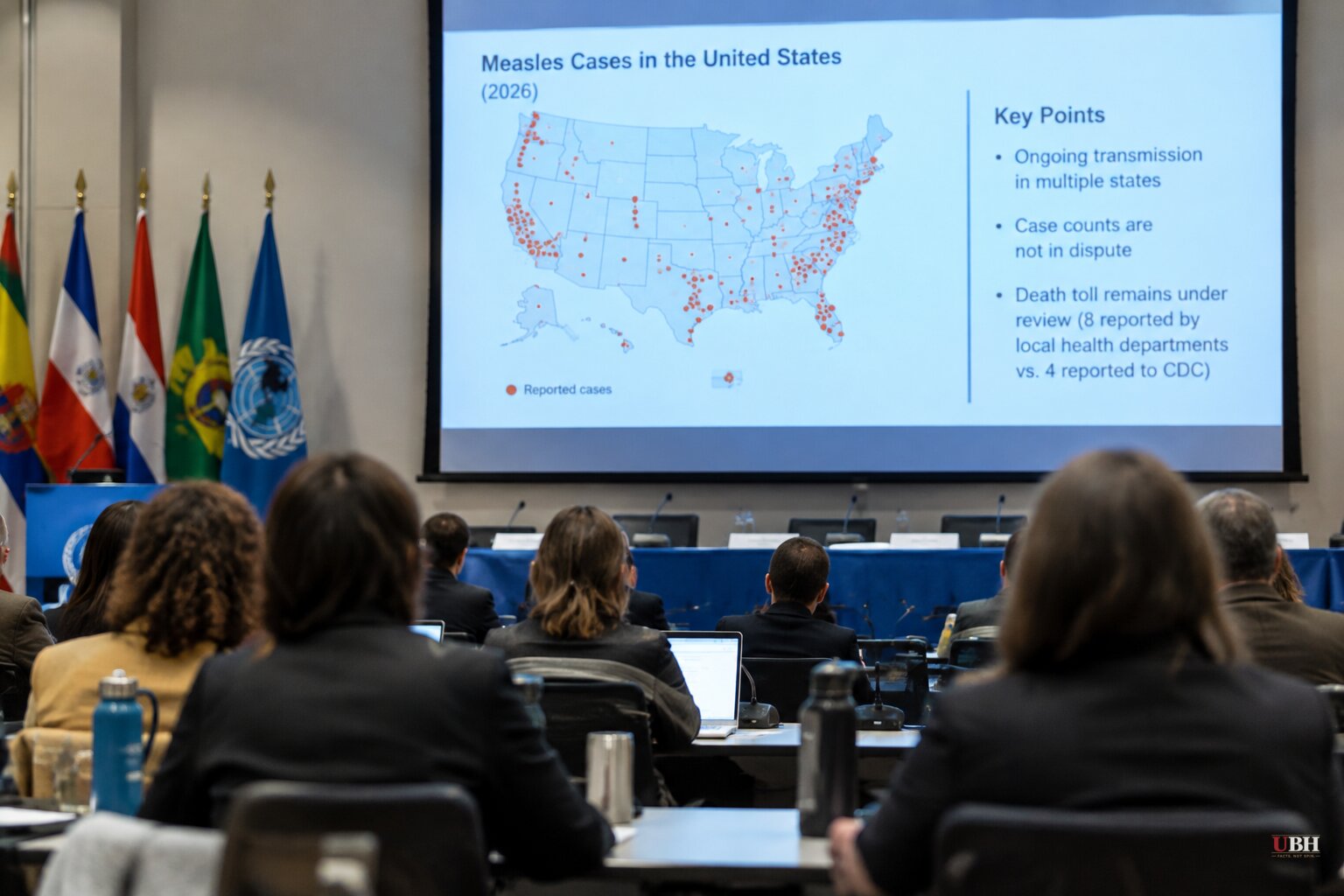
Since measles outbreaks began in West Texas in January 2025, the U.S. has gone from 285 cases in 2024 to 2,289 in 2025 and 5,182 so far in 2026. Today, Nov. 10, a Pan American Health Organization commission began its review of whether that adds up to the loss of the country's elimination status.
The Measles and Rubella Elimination Regional Monitoring and Re-Verification Commission is holding its sixth annual meeting in Washington, D.C., from Nov. 10 to 13. It is an independent technical body of infectious disease experts that reports directly to PAHO. No ruling has been announced.
The test the commission applies
A country loses elimination status if transmission is re-established and continues uninterrupted for at least 12 months. Imported cases and short-lived outbreaks do not count. The U.S. earned the status in 2000, when the CDC recorded 85 cases.
At the commission's November 2025 meeting, Canada was found to have endemic measles again. The U.S. was classified that same day as "sustained with major concerns," a category that also covered Mexico, Honduras and Venezuela.
A review of U.S. status was originally set for April 2026. The CDC asked for more time to determine whether cases were spreading domestically or being imported, KFF reported.
That question is still the crux. ABC News reported that it is unclear whether the Texas cases confirmed in January 2025 are linked to outbreaks in other states. If they are, the U.S. has had a year of continuous transmission. CIDRAP News reported that the status may hinge on genomic sequencing data.
The numbers
The CDC's latest update, posted Nov. 6, counts 5,182 confirmed cases as of Nov. 5. Of those, 5,164 were reported by 47 jurisdictions, and 18 were among international visitors. The agency says there have been 43 new outbreaks in 2026.
Of the 2026 cases, 4,993, or 96%, are outbreak-associated. Of those, 3,608 come from outbreaks that started this year and 1,385 from outbreaks that started in 2025. That overlap is the kind of carryover the commission will weigh.
The death count depends on who is counting. Local health departments have reported eight deaths connected to this year's outbreaks, according to Scientific American. The CDC has recorded four. Three more people died in 2025, CIDRAP reported, which gives the 11 deaths confirmed over nearly two years that ABC News cited. Scary Mommy reported that three states announced measles-related deaths last week, including an infant in Wisconsin.
CIDRAP News also reported that cases could pass 7,000 by the end of the year. That is a projection, not a count.
What the experts are saying
Jennifer Nuzzo, director of Brown University's Pandemic Center, described the pattern to CIDRAP as "popcorn: outbreak, outbreak, outbreak, outbreak. All over the country." Outbreaks grow, shrink and move somewhere else, she said. In her view, that is what perpetual transmission looks like.
Michael Osterholm, director of the Center for Infectious Disease Research and Policy at the University of Minnesota, said a ruling would only recognize what has been true for months. "When a semi hits your car at 60 miles an hour at an intersection, you don't need more assessments showing you've had an accident," he told Scientific American.
Paul Offit of Children's Hospital of Philadelphia called the status "an enormous accomplishment" and said losing it would be "at best... a call to arms." Elizabeth Jacobs, professor emeritus at the University of Arizona, said she "literally cannot believe this is happening in the United States."
There would be no formal penalty. Scientific American reported that losing the status carries no formal consequences. Nuzzo called it "a loss of standing... a loss of stature."
Vaccination and who gets blamed
Scary Mommy reported that experts blame falling vaccination rates, and within that the Trump administration, specifically HHS Secretary Robert F. Kennedy Jr. Staffing and funding cuts at public health agencies, and the absence of a Senate-confirmed CDC director for a full year during the outbreak, were also cited as contributing factors. Those are the critics' claims. None of the sources contain a response from HHS.
The vaccination data itself is not contested. Scary Mommy, citing CDC figures, reported kindergarten vaccine exemptions at 4.2% in the 2025-2026 school year, the highest on record, with 39 states below the 95% coverage level needed to prevent outbreaks. Both the CDC and the American Academy of Pediatrics recommend a first MMR dose at 12 to 15 months and a second at 4 to 6 years.
The epidemiologists who spoke to CIDRAP agreed on one point: the trend can be reversed by raising vaccination rates.
What comes next
The commission meets through Friday, Nov. 13. CIDRAP's epidemiologists said PAHO will almost certainly find measles endemic in the U.S. Whether the commission agrees that the 2025 Texas outbreak and the 2026 outbreaks form one unbroken chain of transmission is the open question.
The CDC has not said publicly what its sequencing shows.
Sources used for this briefing
6 links from 6 independent newsrooms (syndicated copies of the same report count once)
These are the sources it draws on, linked so you can verify.


