
Unbiased headlines. Facts, not spin.
Unbiased Headlines is an independently owned news organization. We bring you the facts, not opinions, written fresh from 110+ named sources. Sources linked so you can verify it yourself.
 health
Notable (6/10)
Event date: November 4, 2026 ·
Rural America Has 71 Doctors Per 100,000 People, Half the Urban Rate, as Remote Care and AI Expand
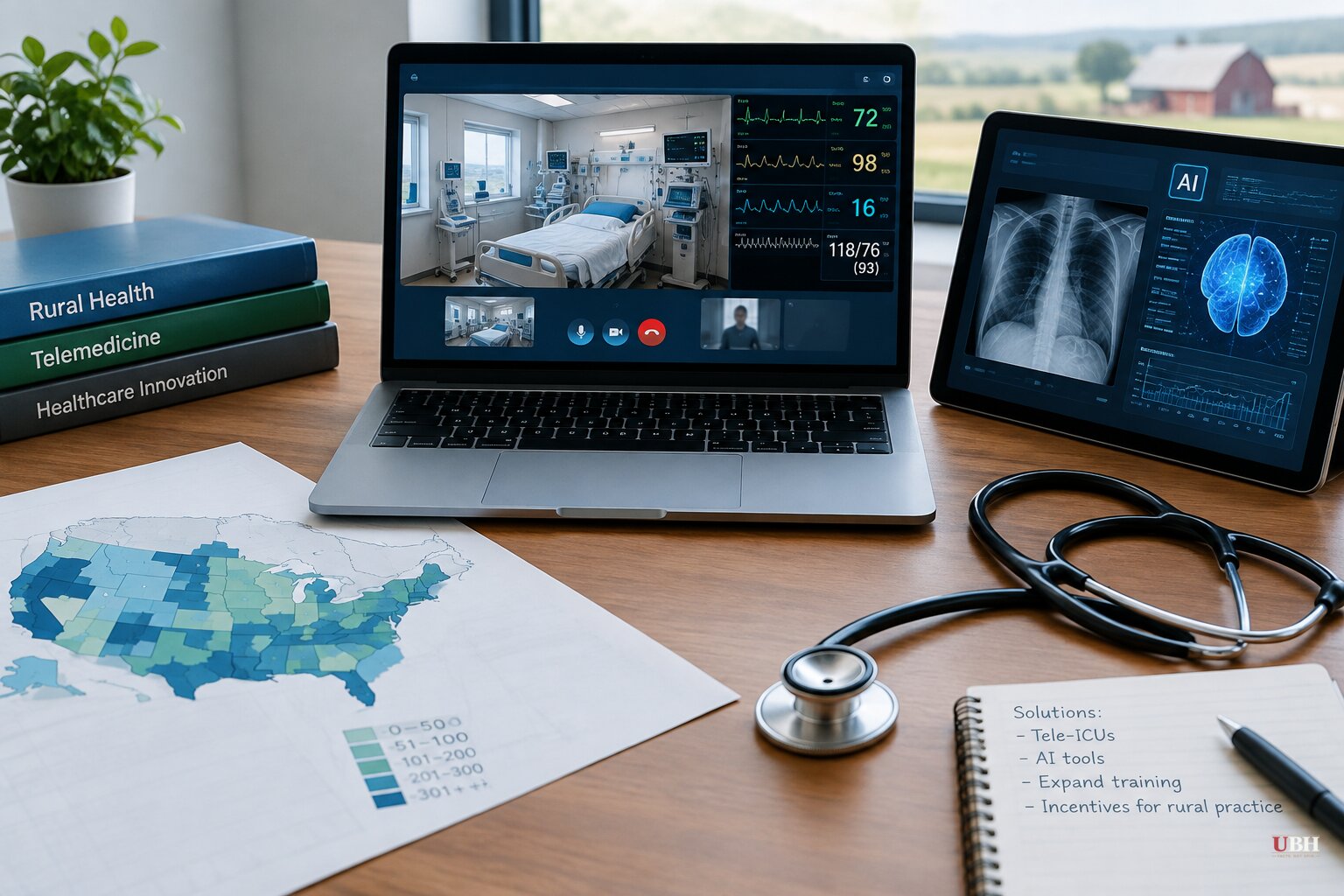
The physician shortage is not a forecast anymore. It is the baseline hospitals and small practices are building around.
Six years after projecting that the U.S. would be about 94,000 physicians short by 2025, the workforce planning firm 3Dhealth rechecked its math. The prediction held, according to its update, "94,000 Short and Counting."
The rural gap
The geography is lopsided. 3Dhealth found rural America has roughly 71 office-based physicians per 100,000 residents. Urban areas have about 144.
By 2040, the firm projects rural communities will account for more than 60% of the national physician deficit while holding about 14% of the population. Rural doctors also tend to be older and carry workloads 1.3 to 1.5 times the national median, so each retirement is harder to replace.
The states with the biggest gaps include Texas, Florida and Georgia. In Plains states such as North Dakota, South Dakota and Nebraska, shortages top 28% of demand.
3Dhealth CEO Ron Flower said specialty gaps land on primary care doctors, who end up managing patients longer while waiting on referrals. Independent physicians in small and mid-sized practices, especially rural ones, are "feeling that pinch the most," he said.
Flower is not predicting collapse. "I think there's a lot of opportunity here that's kind of lost in the doom and gloom of one of these reports," he said. His advice to independent practices: compete for physicians and advanced practice providers on autonomy, partner with local hospitals, plan four to five years ahead for succession, and use advanced practice providers at the top of their license.
Technology as the stopgap
On November 3, Mayo Clinic Platform rolled out an AI clinical decision support tool for its clinicians. It includes 35 specialty-specific chat assistants and 22 clinical calculators built into the medical record.
Around the same time, at The Economist's AI in Health Summit, healthcare leaders floated the idea that 20 to 30 percent of clinical interactions could eventually be handled by patient-facing AI, with doctors overseeing it from a distance. That is an idea under discussion, not a policy or a rollout.
Smaller practices are being pitched something humbler. A vendor-style commentary argues the first AI hire should be at the front desk, where practices are bleeding staff. The Medical Group Management Association's 2026 survey found a majority of practices naming staffing as their biggest challenge this year. The commentary cites front-office turnover of around 40 percent a year, a figure it does not tie to a named study, and a Staffing For Doctors report finding that 41 percent of practices seeking hiring help wanted a front desk receptionist.
The commentary's pitch is commercial. It argues that missed calls mean lost patients, and that an AI phone answerer fixes that. The turnover problem is real enough. The sales argument is the seller's own.
The tele-ICU death
The sharpest critique of the efficiency push comes from a Daily Wire opinion essay about the 2024 death of Conor Hylton, a 26-year-old dental student, at a Connecticut hospital.
According to the essay, Hylton was admitted with severe gastrointestinal symptoms, moved to the ICU as he worsened, and had a history of alcohol abuse and withdrawal seizures. The essay says the intensivist overseeing his care was working from Yale's tele-ICU hub 15 minutes away. It says that doctor had to ask another physician in the hospital to place a breathing tube, and that the procedure was reportedly delayed because the physician had trouble reaching the ICU. The essay also says Hylton's father was at the bedside when the intensivist pronounced his son dead by video.
The essay's author argues this staffing model is deliberate. "Remote ICU programs like Yale's enable hospitals to scale physician availability, allowing them to manage more patients than a traditional ICU while saving money," the piece says. It describes a "revenue-extraction motive" running through American healthcare and argues that time with patients is the first thing cut.
That is one writer's account and argument. The essay does not cite a regulatory finding or court ruling on the death.
The essay also acknowledges the other side. Proponents of remote specialist care, it says, note that it lets patients stay in especially remote places and avoid expensive and unhelpful transfers. That is the case for tele-ICU in a country where, per 3Dhealth, rural counties have half the physicians of cities. The essay's counterpoint is that Hylton did not die in a rural area. He died in a hospital 15 minutes from a full-service ICU.
What hospitals say they are doing
The American Medical Association has profiled nine health systems it says are succeeding at recruiting and keeping physicians, through mentorship, well-being programs and leadership changes aimed at cutting administrative burden. All nine belong to the AMA's own Health System Member Program, which the AMA promotes in the same piece.
The AMA says the goal is environments where physicians "feel valued, supported, and inspired to stay." The profiles describe programs, not measured outcomes in the excerpt, and they do not address how many patients a doctor is asked to cover.
What comes next
The dispute comes down to one question: whether technology and remote oversight extend a thin physician workforce or simply stretch it thinner. Mayo's AI rollout is aimed at clinicians in the room. The Economist summit's 20 to 30 percent figure is about doctors supervising from a distance.
The 3Dhealth numbers set the clock. If its 2040 projection holds, more than 60% of the physician deficit will sit in communities that hold about 14% of the people.
Hospitals will keep making staffing choices in the meantime. The Hylton case shows where one of those choices can end up.
Sources used for this briefing
4 links from 4 independent newsrooms (syndicated copies of the same report count once)
These are the sources it draws on, linked so you can verify.


