
Unbiased headlines. Facts, not spin.
Unbiased Headlines is an independently owned news organization. We bring you the facts, not opinions, written fresh from 110+ named sources. Sources linked so you can verify it yourself.
 health
Notable (5/10)
J&J's Caplyta Beats Placebo in Second Phase 3 Bipolar Mania Trial, FDA Filing Planned
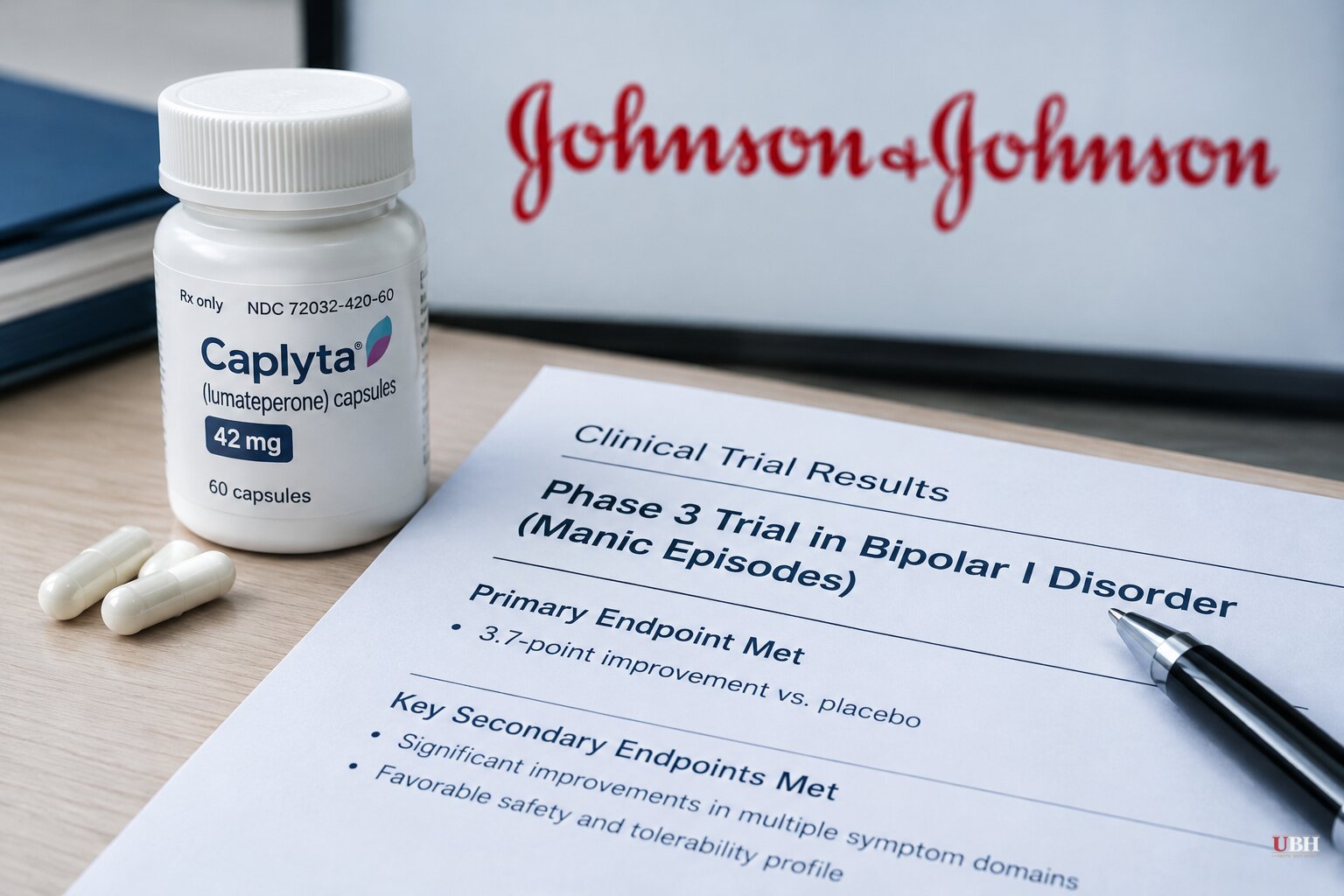
Johnson & Johnson (NYSE: JNJ) said today, Nov. 10, that Study 452, its second pivotal Phase 3 trial of Caplyta (lumateperone) in acute bipolar mania, hit its primary and key secondary endpoints. The company plans to take the combined data to the FDA.
Caplyta is not currently approved for manic episodes associated with bipolar I disorder. A positive FDA decision would add that use to a label that already covers several psychiatric conditions.
What the trial showed
Study 452 was a global, randomized, double-blind trial of once-daily 42 mg Caplyta versus placebo over three weeks. It enrolled adults with manic episodes from bipolar I disorder, with or without mixed features. The study included 351 patients.
On the primary endpoint, patients on Caplyta had a 3.7-point greater reduction in Young Mania Rating Scale (YMRS) total score than placebo at week 3. The effect size was -0.43 and the result was statistically significant (P<.0001). The 95% confidence interval ran from -5.61 to -1.86.
Significant separation from placebo showed up as early as day 3 and held from week 1 onward, according to Roger S. McIntyre, MD, of the University of Toronto, who presented the data.
The key secondary endpoint was also met. On the Clinical Global Impression-Severity (CGI-S) scale, Caplyta beat placebo by 0.4 points (P=.0003).
Response rates were reported too. 43.9% of Caplyta patients had at least a 50% improvement from baseline on the YMRS, compared with 23.7% on placebo (P<.0001). McIntyre said that translates to a number needed to treat of 5.
Safety
J&J said the safety profile matched what was seen in earlier studies, with low discontinuation rates. The most common treatment-related adverse events, at a rate of at least 5% and at least twice the placebo rate, were dizziness, dry mouth and somnolence or sedation.
McIntyre said treatment-emergent adverse events were low and that discontinuations due to side effects were similar to placebo.
How it compares to the first trial
Study 452 follows Study 451, which J&J reported Sept. 21, 2026. That trial showed a 4.8-point YMRS advantage over placebo, per Fierce Pharma's reading of the data. The new result is a smaller gap, 3.7 points, but still clears the statistical bar. McIntyre described the new findings as replicating and reinforcing the earlier trial, which was identically designed.
Both trials compared Caplyta against placebo. Neither, as described in J&J's announcement or the published summaries, pitted it against an existing mania treatment.
McIntyre acknowledged that other options exist. "Notwithstanding options available for the treatment of bipolar mania with and without mixed features in adults, there remains a need for treatments that are rapidly efficacious with meaningful improvements for what effectively is a medical emergency," he said.
The results were a late-breaking presentation at the Neuroscience Education Institute Fall Congress, held Nov. 5-8 in Colorado Springs.
What Caplyta is approved for today
The FDA has already cleared Caplyta for schizophrenia in adults. It is also approved for depressive episodes associated with bipolar I or II disorder, as monotherapy or alongside lithium or valproate. A third approved use is adjunctive therapy with antidepressants for major depressive disorder.
The mechanism of action is unknown. The drug's efficacy may be mediated by a combination of antagonist activity at serotonin 5-HT2A receptors and partial agonist activity at dopamine D2 receptors.
The company's pitch
Jane Tiller, J&J's Vice President and Global Head of Development for Neuroscience, said the "consistent, positive results across two pivotal Phase 3 studies in acute mania associated with bipolar I disorder support its potential to help stabilize symptoms for patients during some of the most difficult moments of their illness."
J&J says bipolar disorder affects an estimated 36 million people worldwide. The company says manic episodes can escalate quickly and often require hospitalization.
Michael Thase, MD, of the University of Pennsylvania, said in an earlier statement from the drugmaker that mania is among the most dangerous and worrisome phases of bipolar disorder.
What comes next
J&J says the two studies together support a planned U.S. regulatory submission to expand the Caplyta label. The company has not given a filing date. FDA review of any submission would follow.
Sources used for this briefing
6 links from 6 independent newsrooms (syndicated copies of the same report count once)
These are the sources it draws on, linked so you can verify.


