
Unbiased headlines. Facts, not spin.
Every story is an unbiased news briefing written from 110+ sources across the spectrum — sources linked so you can verify it yourself.
 defense
Major Story (7/10)
May 25, 2026 at 03:43 PM
defense
Major Story (7/10)
May 25, 2026 at 03:43 PM
U.S. Marines Conduct First Military Drill in Venezuela Since Maduro's January Capture
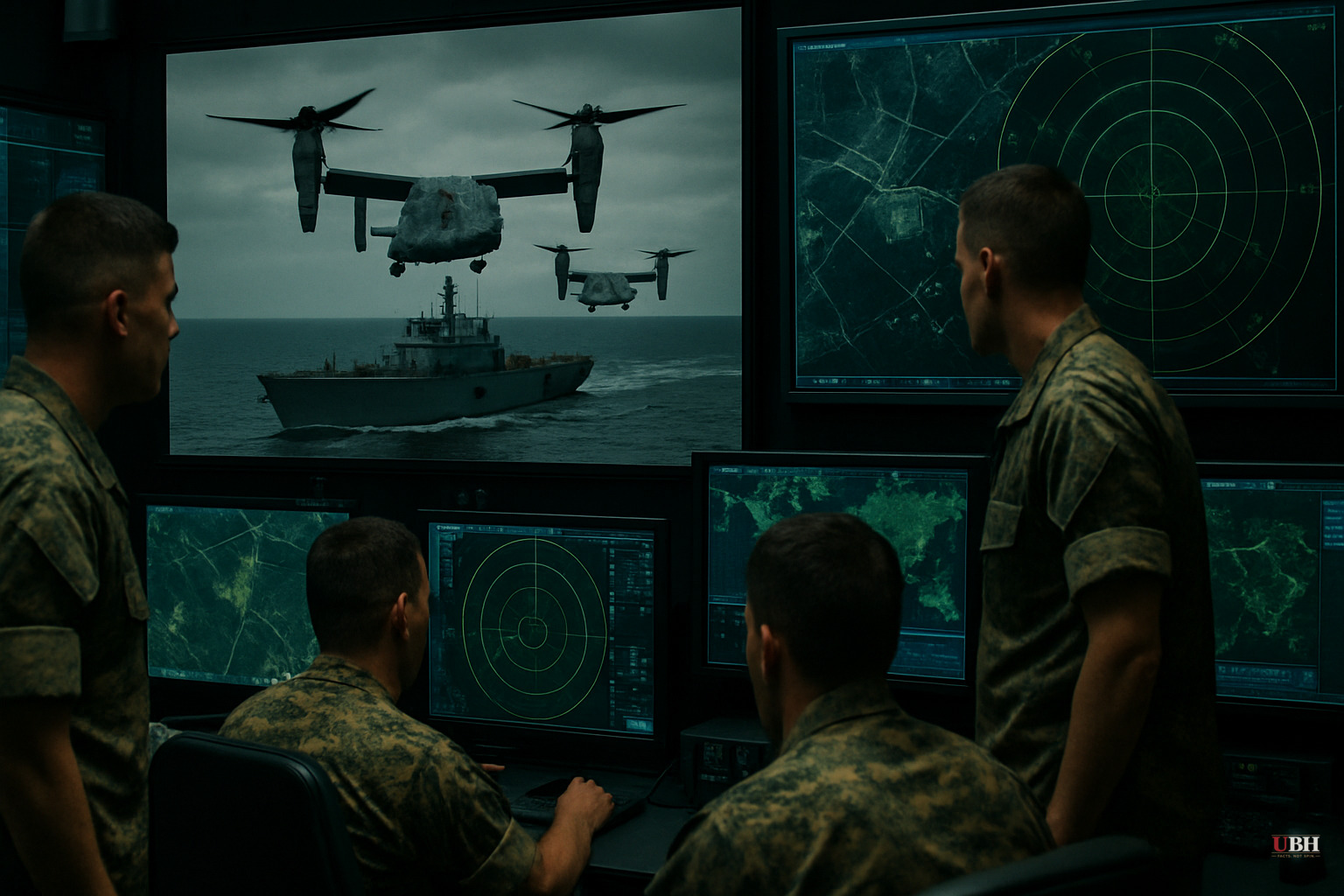
Marines Land in Caracas in Scheduled Embassy Security Exercise
On Saturday, May 23, 2026, two U.S. Marine Corps MV-22B Osprey aircraft descended into the parking lot of the U.S. Embassy in Caracas, Venezuela. Forces rappelled out. Naval vessels entered Venezuelan waters in the Caribbean simultaneously.
This was NOT a raid. This was a scheduled exercise — announced in advance by Venezuelan Foreign Minister Yván Gil and framed as preparation for "medical emergencies or catastrophic emergencies," according to Reuters.
It was also a show of force. A deliberate one.
Who Was on Board
Gen. Francis L. Donovan, the commanding general of U.S. Southern Command, was personally aboard one of those Ospreys, according to the U.S. Embassy's official post on X.
Per the embassy's statement, his day included bilateral talks with Venezuelan government leadership, a meeting with embassy staff, and direct observation of the exercise.
SouthCom doesn't send its top general on routine fire drills. This visit carried a message.
The Squadron — and the Ship — Behind the Drill
The Ospreys bore markings of Marine Medium Tiltrotor Squadron 263, according to Fox 5 New York. That unit is currently deployed aboard the USS Iwo Jima, an amphibious assault ship operating in the Caribbean.
The Context: Maduro, U.S. Relations, and Venezuela
Nicolás Maduro has faced U.S. federal drug trafficking indictments for years. The U.S. has offered a reward for information leading to his arrest. The current state of U.S.-Venezuela relations — including the circumstances under which the U.S. Embassy in Caracas resumed operations and the nature of Venezuela's current government — involves details that are still developing and not fully confirmed by credible mainstream reporting at this time.
What is clear is that U.S. forces are now conducting authorized military drills on Venezuelan soil, with the blessing of current Venezuelan authorities — a significant shift from the posture of recent years.
The Protests — Small but Real
Not everyone in Caracas was cheering the Ospreys.
A group of protesters gathered elsewhere in the city — reportedly a few dozen people — holding a Venezuelan flag with the words "No to the Yankee drill" written across it, according to The Independent and Fox 5 New York. Some reportedly burned posters of President Trump and Secretary of State Marco Rubio in the streets, per ZeroHedge.
Those protests were small. They represent a segment of Venezuelans who view the current situation as foreign subjugation, not liberation — regardless of how the previous government was characterized.
Meanwhile, other Caracas residents simply gathered near the embassy to watch the spectacle of Marine Ospreys sweeping in low over the capital.
What Mainstream Coverage Is Missing
Most outlets are reporting this as a fairly routine embassy security exercise. The Independent called it straightforward preparation for emergencies. Fox 5 New York stuck close to the official embassy framing.
Several dimensions deserve closer scrutiny:
First, the speed of the geopolitical shift is striking. In a relatively short period, Venezuela has gone from open U.S. adversary to a country hosting authorized American military drills in its capital city.
Second, Trump has floated the idea of making Venezuela the 51st U.S. state, citing an estimated $40 trillion in oil reserves, according to Fox 5 New York. Such rhetoric shapes how to interpret American military personnel on Venezuelan soil.
Third, Maduro's longstanding U.S. federal indictments remain a live legal matter. The legal and diplomatic developments are running parallel — and neither is concluded.
What This Means for Americans
The U.S. now has an active military footprint and open diplomatic relations with a country that not long ago was run by an indicted individual aligned with China, Cuba, and Russia.
That's either a major strategic win for American interests in the Western Hemisphere — or the opening chapter of a long, complex entanglement in a country with vast oil reserves, a traumatized population, and a history of resisting outside influence.
Watch the USS Iwo Jima. Watch Southern Command's tempo of visits. The drill on Saturday wasn't just about embassy evacuation procedures.
It was about who runs the neighborhood now.
Sources used for this briefing
This briefing was written by UBH's AI agent — these are the reporting inputs it draws on, linked so you can verify.


