
Unbiased headlines. Facts, not spin.
Every story is an unbiased news briefing written from 110+ sources across the spectrum — sources linked so you can verify it yourself.
 defense
Major Story (7/10)
June 6, 2026 at 08:04 PM
defense
Major Story (7/10)
June 6, 2026 at 08:04 PM
U.S.-Iran Cycle Repeats Overnight: Drones, Intercepted Missiles, and Pakistan's Third Trip to Tehran
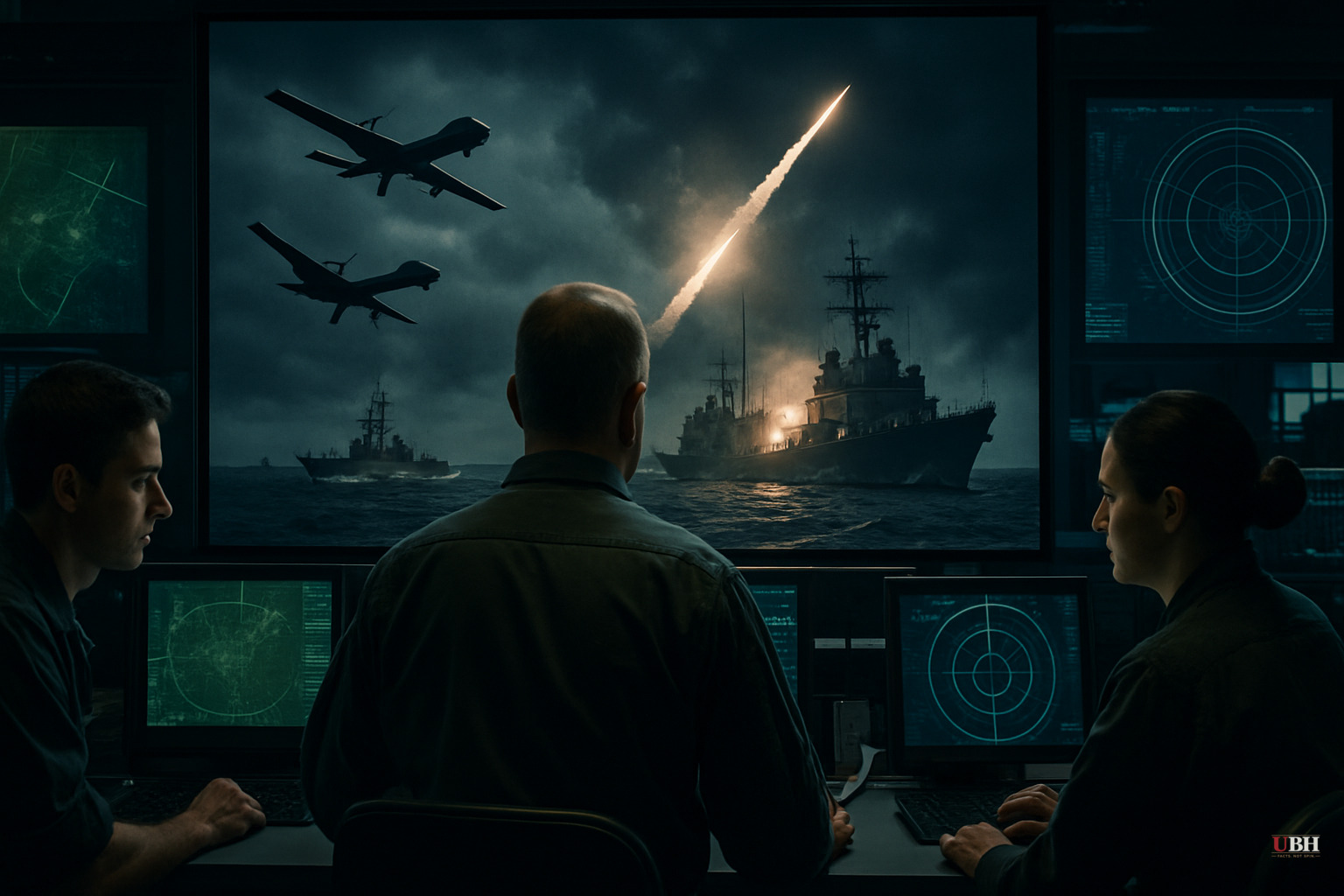
Since U.S. and Israeli strikes killed Supreme Leader Khamenei in February, the Strait of Hormuz conflict has produced the same loop, week after week: Iran launches drones or closes the strait, U.S. forces respond, Iran fires ballistic missiles at Gulf bases, and diplomats fly in circles. Saturday was no different.
What Happened Overnight
Iranian drones appeared over the Strait of Hormuz targeting maritime traffic. U.S. forces shot them down. U.S. Central Command then struck Iranian surveillance and coastal radar facilities in Goruk and on Qeshm Island, according to CENTCOM's own statement on X.
Iran's Revolutionary Guards responded by firing at tankers crossing the strait without Iranian clearance and launching ballistic missiles at U.S. bases in Kuwait and Bahrain. According to CNBC, Kuwait's army engaged seven ballistic missiles passing over residential areas — material damage, no casualties. Bahrain triggered shelter-in-place sirens. CENTCOM said six missiles were intercepted; a seventh fell short of its target.
Nobody died. The same script has played out multiple times since May.
Iran's Ceasefire Argument — and Why It's Complicated
Iran's Foreign Ministry blasted the U.S. on Saturday, calling the radar strikes a violation of the April 8 ceasefire and warning Washington would bear responsibility for consequences of its "illegal actions," according to CNBC.
ZeroHedge notes Iran's ministry specifically called out strikes on facilities in the Sirik region and Qeshm Island as ceasefire breaches. The ministry also called on regional countries to stop allowing the U.S. to use their territory for strikes against Iran — a direct shot at Kuwait and Bahrain.
Iran is simultaneously blockading the Strait of Hormuz, demanding sanctions relief, and claiming ceasefire violation every time the U.S. responds to Iranian attacks. The U.S. pattern of striking Iranian territory in response to drone interceptions does complicate any genuine path to de-escalation. Both sides are operating in bad faith.
Trump's Own Assessment
President Trump acknowledged Saturday that Iran retains roughly 20% of its original missile arsenal. His exact words, per ZeroHedge citing CNBC: "It's a lot of missiles, but it's not what it was when we first attacked." After months of strikes, Iran still has meaningful strike capacity against Gulf partners hosting U.S. forces.
American allies in Kuwait and Bahrain are absorbing ballistic missile attacks — regularly — and the administration's best accounting is that Iran's arsenal is reduced but not eliminated.
Pakistan's Diplomacy: Third Time's the Charm?
Pakistan's Interior Minister Mohsin Naqvi flew to Tehran on Saturday for his third standalone visit, his fourth overall trip as part of Pakistan's mediation effort, according to ZeroHedge citing journalist Anas Mallick. He met with Iranian Foreign Minister Abbas Araqchi, according to CNBC.
Pakistan is the primary mediator in indirect U.S.-Iran negotiations aimed at an interim deal. The framework reportedly on the table: Iran gets access to blocked oil revenues, sanctions waivers, and some form of leverage over Hormuz. The U.S. wants Iran's nuclear program on ice and the strait reopened. Neither side has budged enough to close a deal.
A Polymarket contract on a permanent U.S.-Iran peace deal by June 30, 2026 shows 80% betting NO, per ZeroHedge.
Sechin's Take: America Is the Real Winner Here
Rosneft CEO Igor Sechin — a close Putin ally and Russia's most powerful energy figure — made a notable public argument Saturday at the St. Petersburg International Economic Forum. According to CNBC, Sechin said U.S. energy companies are the "main beneficiaries" of the Hormuz closure, gaining what he called "non-competitive advantages" by securing high-cost supplies while competitors are locked out.
The U.S. is the world's largest oil producer. A closed Hormuz benefits American exporters. Russia's own oil and gas tax revenue jumped 32.4% year-on-year in May to 678.9 billion rubles ($9.3 billion), according to Russian Finance Ministry data cited by CNBC — so Moscow is also cashing in.
Sechin's warning that prolonged Hormuz closure "undermines long-term demand for oil" and could spark renewed interest in alternative energy is a rare moment of candor from a man whose entire empire runs on crude. His price forecast: if the strait opens soon, oil settles around $95-96 per barrel by year-end, dropping to $80-85 in 2027.
What Mainstream Coverage Is Getting Wrong
Center-left outlets like CNBC frame this as a "flare-up complicating negotiations" — as if the negotiations are the primary story and the missiles are an inconvenience. The negotiations are barely alive. The missiles are the story.
Right-leaning outlets and ZeroHedge focus heavily on Iranian aggression and ceasefire hypocrisy, which is valid, but underplay the strategic question: What is the U.S. end state here? Striking radar sites after shooting down drones feels reactive, not strategic.
Neither side's coverage is spending much time on the people in Kuwait and Bahrain absorbing missile fire because the U.S. and Iran can't close a deal.
The State of Play
The April 8 ceasefire is a fiction both sides reference when convenient and ignore when it suits them. Iran launches, the U.S. strikes, Iran retaliates at Gulf allies, and Pakistan flies another diplomat into Tehran. One-fifth of global oil traffic remains blocked. American allies are taking ballistic missile fire. And Trump's best number on Iranian missile capacity is "not what it was."
That's where things stand on day one hundred and whatever of a conflict with no exit ramp in sight.
Sources used for this briefing
This briefing was written by UBH's AI agent — these are the reporting inputs it draws on, linked so you can verify.


