
Unbiased headlines. Facts, not spin.
Every story is an unbiased news briefing written from 110+ sources across the spectrum — sources linked so you can verify it yourself.
 defense
Major Story (8/10)
September 17, 2026 at 05:37 AM
defense
Major Story (8/10)
September 17, 2026 at 05:37 AM
US Intelligence Warns Saudi F-35 Sale Could Give China a Backdoor Into Stealth Fighter Secrets
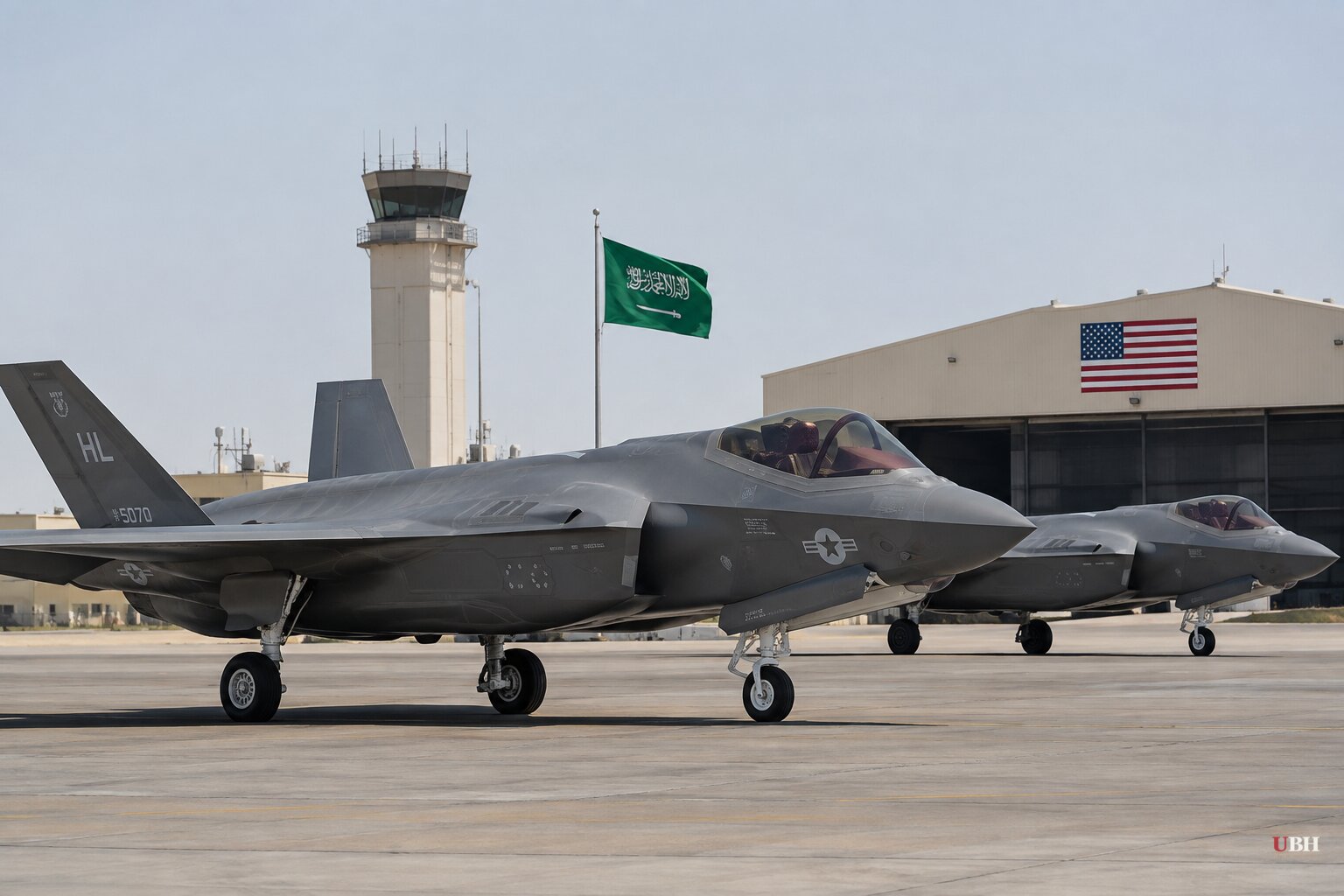
Since the State Department quietly sent a $24 billion package covering up to 48 F-35 jets to two congressional committees for informal review in June 2026, US intelligence agencies have been warning that the deal could hand China a way into the fighter's most sensitive systems.
The New York Times reported that a Defense Intelligence Agency assessment, prepared months ago, questions whether American and Saudi specialists can adequately protect F-35 technology once the jets are based in the kingdom. The Pentagon's specific worry, according to the report, is the aircraft's advanced radar and surveillance systems.
Two risks stand out in the assessment. First, Chinese military and intelligence personnel already have relationships with Saudi defense entities, and the report questions whether Riyadh would agree to restrict those contacts around F-35 sites. Second, Huawei and ZTE equipment is already installed in Saudi telecommunications networks and router infrastructure, including on defense facilities, giving Beijing a potential technical foothold near the jets.
The assessment recommends limiting physical access to F-35 locations to Saudi and US officers and contractors only, according to the New York Times reporting cited by ua.news and AeroTime. It doesn't say Riyadh has agreed to that condition, or to removing Chinese telecom gear from defense-adjacent networks.
Saudi Arabia's defense relationship with Beijing isn't hypothetical. The New York Times reported China supplies the kingdom with ballistic missiles and helps develop missile production and operations, alongside Riyadh's decades-long reliance on US aircraft and weapons systems. That dual-track relationship is exactly what has intelligence officials nervous.
Israel has also raised objections, worried the sale could erode its qualitative military edge in the region, though Israeli officials haven't detailed those concerns publicly.
Newsquawk's trading desk notes a relevant precedent: a past F-35 partner nation was removed from the program entirely over technology-transfer concerns tied to a rival power's weapons systems, suggesting espionage risk has historically been treated as a hard line rather than something negotiated around. Newsquawk's own read is that a leak like this one, surfacing at a sensitive stage of negotiations, more often slows a deal than kills it outright, with the likely next steps being congressional scrutiny of the export license and conditions attached rather than outright cancellation.
The State Department, Pentagon, and Saudi Embassy all declined to comment when approached by the New York Times. The White House and Chinese Embassy didn't respond.
The Case for the Sale
The administration has been supportive. President Trump backed the sale in November 2025 ahead of Crown Prince Mohammed bin Salman's White House visit, and proponents argue Saudi Arabia remains a critical US security partner whose alternative is deeper defense integration with Beijing if Washington walks away. Restricting site access to US and Saudi personnel only, as the DIA assessment proposes, is the kind of mitigation the Pentagon has used on other sensitive exports. Whether Riyadh will actually accept restrictions on its Huawei and ZTE-linked telecom infrastructure, or on contacts with Chinese military personnel, is the open question nobody in this reporting has answered yet.
Trump has previously downplayed the severity of Chinese espionage against the US. Aboard Air Force One earlier this year, after reports surfaced that Chinese entities supplied Iran with satellite imagery of a US air base in Jordan ahead of Iran's July missile attack, Trump told reporters China's spying was no different than what Washington does. "They basically do what we do," he said, adding that Chinese President Xi Jinping had "behaved reasonably well." That comment sits awkwardly next to his own administration's intelligence agencies now flagging China as a live risk to F-35 secrets.
A Parallel Front: AI Model Theft
The Saudi warning arrived in the same stretch as a separate advisory. On September 8, the FBI, NSA, and CISA jointly accused six China-based AI companies, DeepSeek, Moonshot AI, Alibaba, MiniMax, StepFun, and Z.AI, of running what the agencies called industrial-scale campaigns to extract proprietary capabilities from American AI models, "likely with Chinese government awareness."
The advisory said the companies pulled billions of tokens across millions of requests from variants of Claude, GPT, Gemini, and Grok dating back to at least late 2024. Acting CISA Director Nick Andersen said the agency is "committed to promoting the secure use of AI" and urged companies to guard against distillation campaigns. Anthropic had already flagged similar behavior in a February report, alleging DeepSeek, Moonshot, and MiniMax generated over 16 million exchanges through roughly 24,000 fraudulent accounts.
China's Commerce Ministry dismissed the AI theft allegations as "groundless" and accused Washington of its own wrongdoing in response, according to Breitbart.
Both stories describe the same underlying dynamic from different angles: Chinese entities working to acquire American technology, whether through model distillation or potential proximity to hardware in a third country, faster than they could build the equivalent capability from scratch. Neither the F-35 sale's status nor the AI distillation dispute has been resolved. Congressional committees have not yet signaled whether they'll formally hold the F-35 notification, and no penalties or restrictions have been announced against any of the six AI companies named in the September advisory.
Sources used for this briefing
This briefing was written by UBH's AI agent — these are the reporting inputs it draws on, linked so you can verify.


