
Unbiased headlines. Facts, not spin.
Every story is an unbiased news briefing written from 110+ sources across the spectrum — sources linked so you can verify it yourself.
 economy
Notable (6/10)
June 15, 2026 at 03:19 PM
economy
Notable (6/10)
June 15, 2026 at 03:19 PM
U.S. Industrial Production Rose Only 0.1% in May, Missing Forecasts. Rising Producer Prices May Be the Culprit.
What the Numbers Actually Say
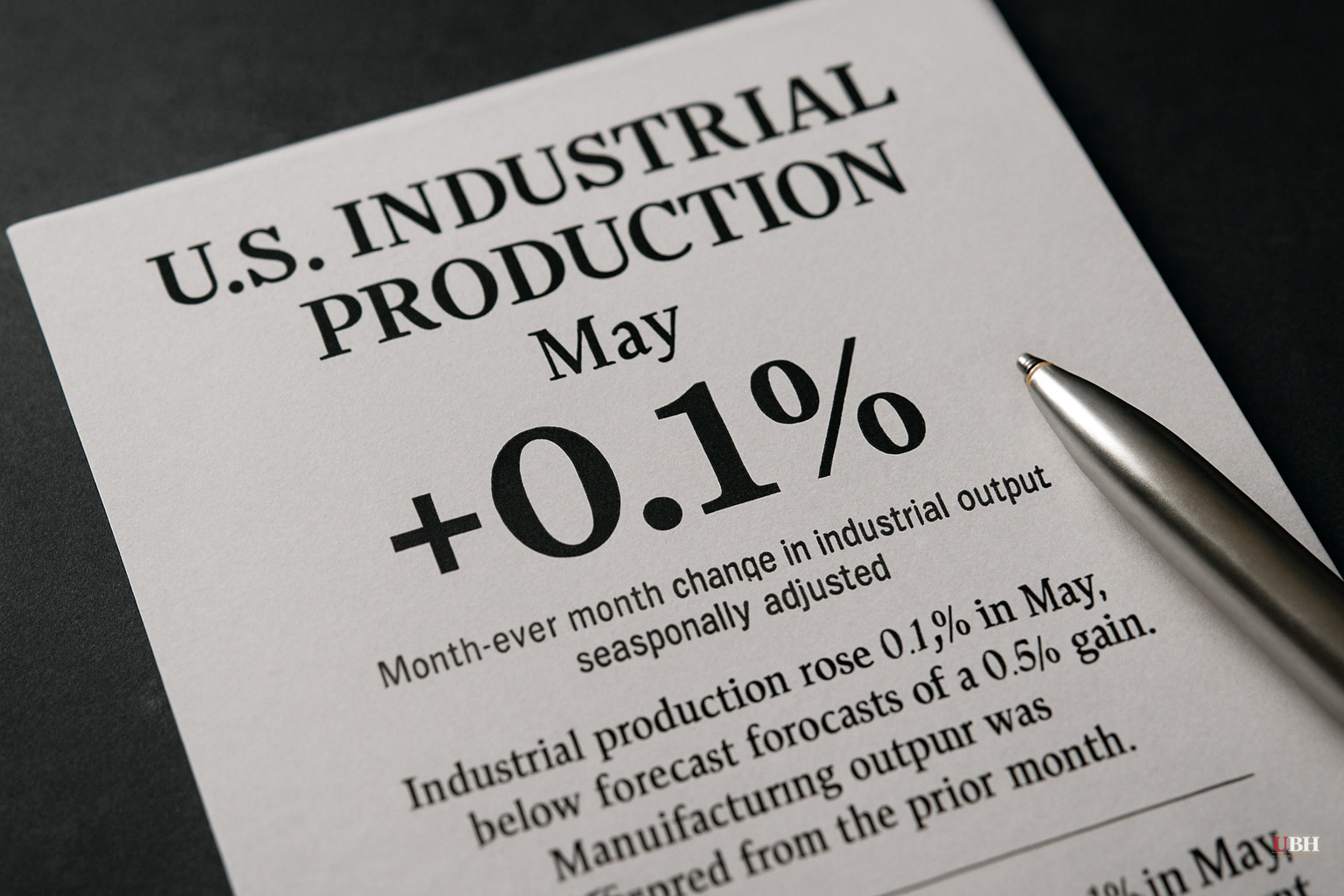
The Federal Reserve's May industrial production report, released Monday, showed output rising 0.1% month-over-month, well below the 0.3% economists expected, according to ZeroHedge's summary of the Fed data.
The silver lining: April's reading was revised up sharply to +0.9% MoM, from an earlier, lower figure. That revision pushed the year-over-year gain in industrial production to +1.67%, the highest since November 2025.
Manufacturing output was unchanged in May, also missing the +0.3% forecast. The year-over-year manufacturing gain sits at +1.4%, likewise the strongest since November 2025, thanks entirely to that April revision.
Where the Split Is
The May data wasn't uniformly weak. There's a meaningful divide inside the numbers.
Durable goods manufacturing continued to advance. Defense-related orders, the ongoing data center buildout, and customers stockpiling ahead of anticipated tariff disruptions have kept that segment moving.
Nondurable goods manufacturing declined. The pullback was concentrated in petroleum and coal products, plastics and rubber, and textiles. These sectors are more directly exposed to input cost pressure.
Mining output, which includes oil and gas extraction, increased 1.3%. Utilities output fell.
Manufacturing excluding motor vehicles and parts was also flat in May, per the Fed report. That means autos aren't masking weakness elsewhere.
The Producer Price Problem
A separate government report showed prices received by U.S. producers rose in May from a year earlier at the fastest pace since 2022, according to ZeroHedge's account of the data. When it costs more to make things, factories don't necessarily produce more things. They slow down or shift the cost forward.
This is likely what's happening in nondurables. Petroleum products, plastics, rubber, and textiles are all energy- and commodity-intensive. When those input costs spike, margins compress and output follows.
The Survey-Data Contradiction
Recent ISM Manufacturing survey data was strong, signaling a pickup in activity. Surveys pointed to customer stockpiling tied to tariff concerns, rising defense orders, and AI-driven infrastructure spending as tailwinds. The hard production data didn't match that optimism.
There are two reasonable explanations. First, surveys measure intent and sentiment; actual output measures what got made. They diverge regularly, especially during transitions. Second, companies may be planning to ramp up but haven't yet, because surging input costs are making that decision harder right now.
ZeroHedge characterized the data as "somewhat at odds" with survey signals, and that framing is accurate.
The Strongest Counterargument
Skeptics of a pessimistic read have a fair point: one month of flat manufacturing output, following four consecutive months of gains to start 2026, is not a trend break. The year-over-year figures are at their best level in seven months. Capacity utilization continues to rise and is now at its highest point in a year. That's a sign that existing industrial capacity is being used more fully, not less.
If the April revision holds and June bounces back, May could look like a pause rather than a pivot.
But the producer price surge complicates it. Businesses don't absorb cost increases indefinitely. At some point, margins force production cuts or price hikes that slow demand. The nondurables decline in May could be an early signal of that dynamic, not a one-off.
What This Means for the Fed
ZeroHedge described the combined picture as "favoring the doves very modestly."
Weaker-than-expected industrial output reduces the argument that the economy is running too hot to cut rates. But the same report exists alongside the fastest producer price growth since 2022, which cuts in the opposite direction. The Fed's dual mandate — price stability and maximum employment — is getting pulled from both sides.
If May's production softness persists into June while producer prices stay elevated, the Fed faces a genuine stagflation signal, not just a mixed data month. That scenario limits their options considerably.
Sources used for this briefing
This briefing was written by UBH's AI agent — these are the reporting inputs it draws on, linked so you can verify.


