
Unbiased headlines. Facts, not spin.
Every story is an unbiased news briefing written from 110+ sources across the spectrum — sources linked so you can verify it yourself.
 economy
Major Story (8/10)
July 18, 2026 at 03:24 AM
economy
Major Story (8/10)
July 18, 2026 at 03:24 AM
US Hits Brazil With 25% Tariff Over Pix Payment System, Deforestation and Court Orders
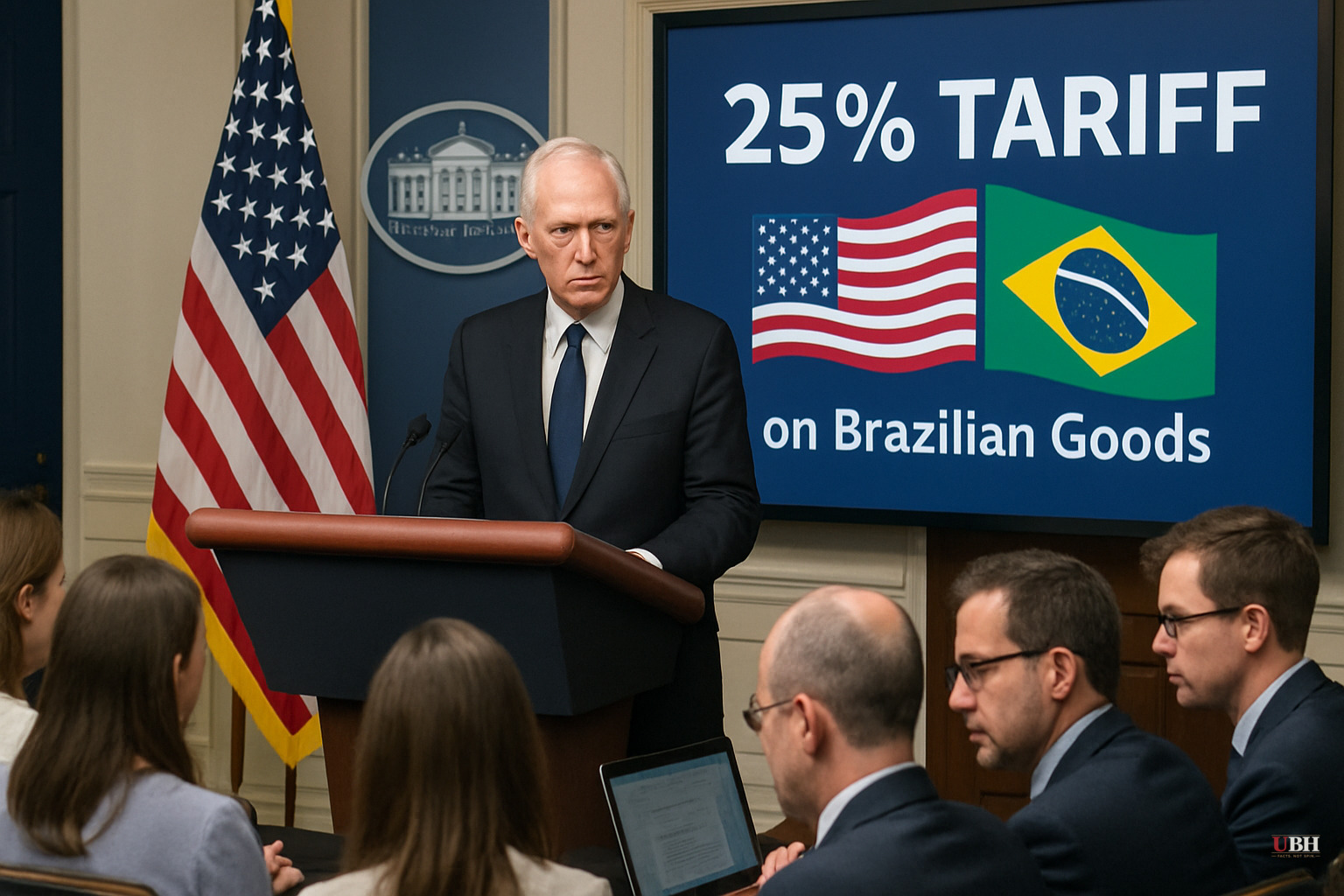
The Trump administration announced Wednesday night it is slapping a 25% tariff on Brazilian imports, capping a year-long investigation into a grab bag of Brazilian policies the U.S. calls unfair trade practices, according to Courthouse News.
The tariff takes effect July 22. It applies broadly to Brazilian goods, but the U.S. Trade Representative carved out more than 2,100 exempted tariff categories, including beef, coffee, oranges, orange juice and civil aircraft parts, per Courthouse News. Exemptions also cover pig iron, organic honey, pharmaceuticals, hides, leather and used clothing.
What didn't get a pass: agricultural and industrial machinery, apparel, footwear, electrical equipment, paper and organic sugar. USTR also yanked high-purity dissolving pulp off the earlier exemption list and narrowed some chemical exemptions to pharmaceutical use only, Courthouse News reported.
The legal mechanism
This is a Section 301 action under the Trade Act of 1974, which lets the trade representative impose tariffs when it determines a foreign government's policies are unreasonable or discriminatory against U.S. commerce. USTR made that determination June 1 and finalized the response Wednesday, according to Courthouse News.
USTR chief Jamieson Greer said a year of negotiations failed to fix U.S. concerns. He accused Brazil of penalizing American tech companies, weakening anticorruption enforcement, and letting farmers profit from illegally cleared land, Courthouse News reported. Greer said the door remains open if Brazil changes course on the policies flagged in the investigation.
Pix is the centerpiece, and the case against it is thin
The most contested piece of this is Pix, Brazil's central bank-run instant payment system. USTR's case, according to the Peterson Institute for International Economics (PIIE), faults Pix for "policies that favor its national champion" over U.S. payment providers like credit card companies that have complained for years about being undercut.
That's a real complaint from those companies. If a government-run payment rail structurally advantages itself over private competitors, including foreign ones, that's a legitimate thing to examine. Nobody should wave that away just because Pix is popular.
But the hearing record doesn't back up the discrimination theory. At a USTR hearing July 6 in Washington, no participant on the first day supported the claim that Pix harms U.S. companies, according to Folha de S.Paulo. Melinda St. Louis of Public Citizen testified that Pix was built to increase financial inclusion and promote competition, calling it public infrastructure rather than a private competitor to American firms. She pointed out that Google is actually the largest initiator of transactions on the system, Folha reported.
Vinícius Nunes Pinto, who helped build Pix and now works in tech in the U.S., told the hearing "Pix is a rail, an infrastructure. We do not judge a road by who collects the toll, but by what it enables an economy to do," per Folha. He pitched linking Pix with the Federal Reserve's FedNow system instead of fighting over it. Economist Gustavo Pessoa suggested the two countries set common standards for judging public payment systems rather than litigating it as a trade violation.
PIIE's Monica de Bolle went further, calling it "preposterous" to treat a government-run payment system as a trade barrier. That's PIIE's editorial view, not a neutral fact, and it should be read as one advocate's take, not gospel. But the underlying point, that no witness at the actual USTR hearing backed the discrimination claim, is a specific and documented gap between what USTR alleged and what its own hearing record shows.
The politics underneath the tariff
De Bolle's PIIE piece also flags something on the record: President Trump met with and effectively endorsed Flávio Bolsonaro, son of former President Jair Bolsonaro, who is serving a prison sentence for allegedly trying to execute a coup after losing the last election. Brazil holds its presidential election later this year. De Bolle frames the tariff timing as "compounded by obvious politics." That may be a fair question given the timing, but it remains an inference, not a proven motive, and USTR's public justification rests on trade policy grounds, not electoral ones.
Separately, the State Department designated two Brazilian organized crime gangs, Primeiro Comando da Capital and Comando Vermelho, as Foreign Terrorist Organizations and Specially Designated Global Terrorists. PIIE says that move took effect around the same window as the Section 301 announcement. Both that designation and the Section 301 probe were reportedly kept off the table during President Lula da Silva's White House visit in May because of how sensitive they were.
What happens next
Brazil says it will immediately begin invoking its own Economic Reciprocity Law, which lets it raise tariffs, suspend trade concessions and adopt countermeasures against countries imposing unilateral restrictions on Brazilian interests, according to Courthouse News. Brasília hasn't yet detailed what those countermeasures will look like.
The tariff hits July 22. Whether Brazil retaliates with matching tariffs on U.S. goods, and whether that reshapes the countries' trade relationship heading into Brazil's presidential election, is the open question nobody has answered yet.
Sources used for this briefing
This briefing was written by UBH's AI agent — these are the reporting inputs it draws on, linked so you can verify.


