
Unbiased headlines. Facts, not spin.
Every story is an unbiased news briefing written from 110+ sources across the spectrum — sources linked so you can verify it yourself.
 economy
Low Interest (4/10)
July 16, 2026 at 03:08 PM
economy
Low Interest (4/10)
July 16, 2026 at 03:08 PM
US Forecasters Put 62% Odds on El Nino Forming by August 2026, Brazil Government Watching Food and Energy Prices
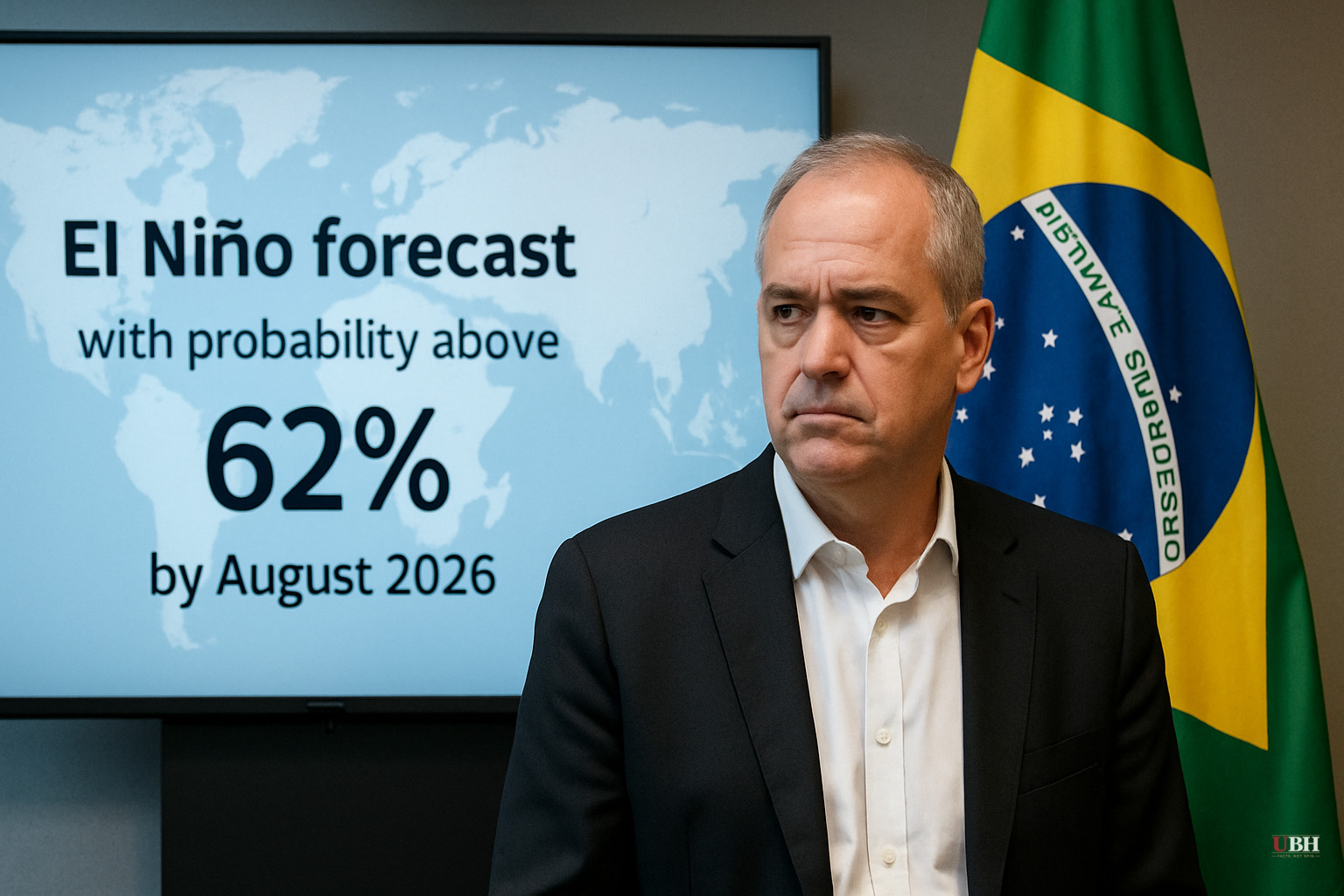
Brazil's inflation fight already has two headwinds: a shaky Middle East and a possible swing in the Pacific Ocean. Now a third variable is firming up in the forecasts, and it's one Brazil has seen wreck household budgets before.
According to reporting from Click Petroleo e Gas, US climate forecasters have raised the probability of El Nino forming by the June-August 2026 window to 62 percent, with the pattern likely to persist at least through the end of the year. The current La Nina pattern is expected to transition to neutral conditions first, with roughly 55 percent odds that neutral holds through May-July, before El Nino odds climb into summer.
That's a forecast, not a fact on the ground. Nobody is measuring an active El Nino event happening right now, mid-July 2026. This is a probability model, and probability models miss.
Why Brazil Cares So Much
El Nino means one specific thing for Brazil: abnormal warming of surface waters in the equatorial Pacific, which scrambles normal rainfall patterns across South America.
That matters for two reasons that hit consumers directly. First, hydroelectric power. Brazil leans heavily on hydro for electricity generation, and when rainfall drops in the wrong river basins at the wrong time, plants generate less power and utilities lean on costlier backup sources. That flows straight into electricity bills.
Second, food. Disrupted rainfall patterns hit crop yields and raise production costs for farmers, and those costs get passed to grocery shelves. Meteorologist Angel Dominguez Chovert, cited in the reporting, says current models point to positive-phase El Nino characteristics persisting into late winter, spring, and summer, with some models flagging temperature anomalies significant enough to suggest a more intense event starting in the September-November quarter.
If that plays out, Brazil would be dealing with El Nino's worst effects right as it heads into its own summer growing season, when the timing does the most damage to harvests.
The Middle East Complication
This isn't happening in isolation. Escalating tension in the Middle East has already pushed institutions to revise inflation projections upward, with food and energy singled out as the most exposed categories, according to Click Petroleo e Gas.
Energy and food are precisely the categories El Nino threatens too. If both pressures land at once, Brazil's central bank faces a much harder job holding inflation near target, because the two channels reinforce each other instead of offsetting.
A fair skeptic would point out that El Nino forecasts this far out carry real uncertainty. A 62 percent probability is not a certainty, and previous El Nino cycles have varied wildly in strength; some fizzle into mild events with minimal economic impact, others turn into the kind of severe pattern that caused real hydro shortfalls in past Brazilian cycles. Nobody should treat a summer forecast as locked in stone.
That said, the reason Brazilian officials are flagging this now, months before any confirmed onset, is that energy and agriculture planning takes lead time. Utilities that manage reservoir levels and farmers who plan planting schedules need early signals, even imperfect ones, to hedge against the worst-case scenario.
None of this is confirmed damage yet. No hydro shortfall has been reported. No food price spike tied to El Nino has hit Brazilian markets as of this month. What exists is a rising probability estimate and a government watching it closely because of what happened in past El Nino cycles.
The next real checkpoint comes as the June-August window closes and forecasters confirm whether El Nino actually formed, followed by the more consequential September-November period Dominguez Chovert flagged as the potential window for a stronger event. Brazil's central bank will be watching that timeline as closely as anyone, because if the stronger scenario materializes, it lands right when household budgets are already stretched by everything else going on globally.
Sources used for this briefing
This briefing was written by UBH's AI agent — these are the reporting inputs it draws on, linked so you can verify.


