
Unbiased headlines. Facts, not spin.
Every story is an unbiased news briefing written from 110+ sources across the spectrum — sources linked so you can verify it yourself.
 economy
Notable (5/10)
May 28, 2026 at 05:17 AM
economy
Notable (5/10)
May 28, 2026 at 05:17 AM
U.S. Farm Exports to China Dropped $15 Billion Under Trump's Tariff War — And Taxpayers Are Picking Up the Tab
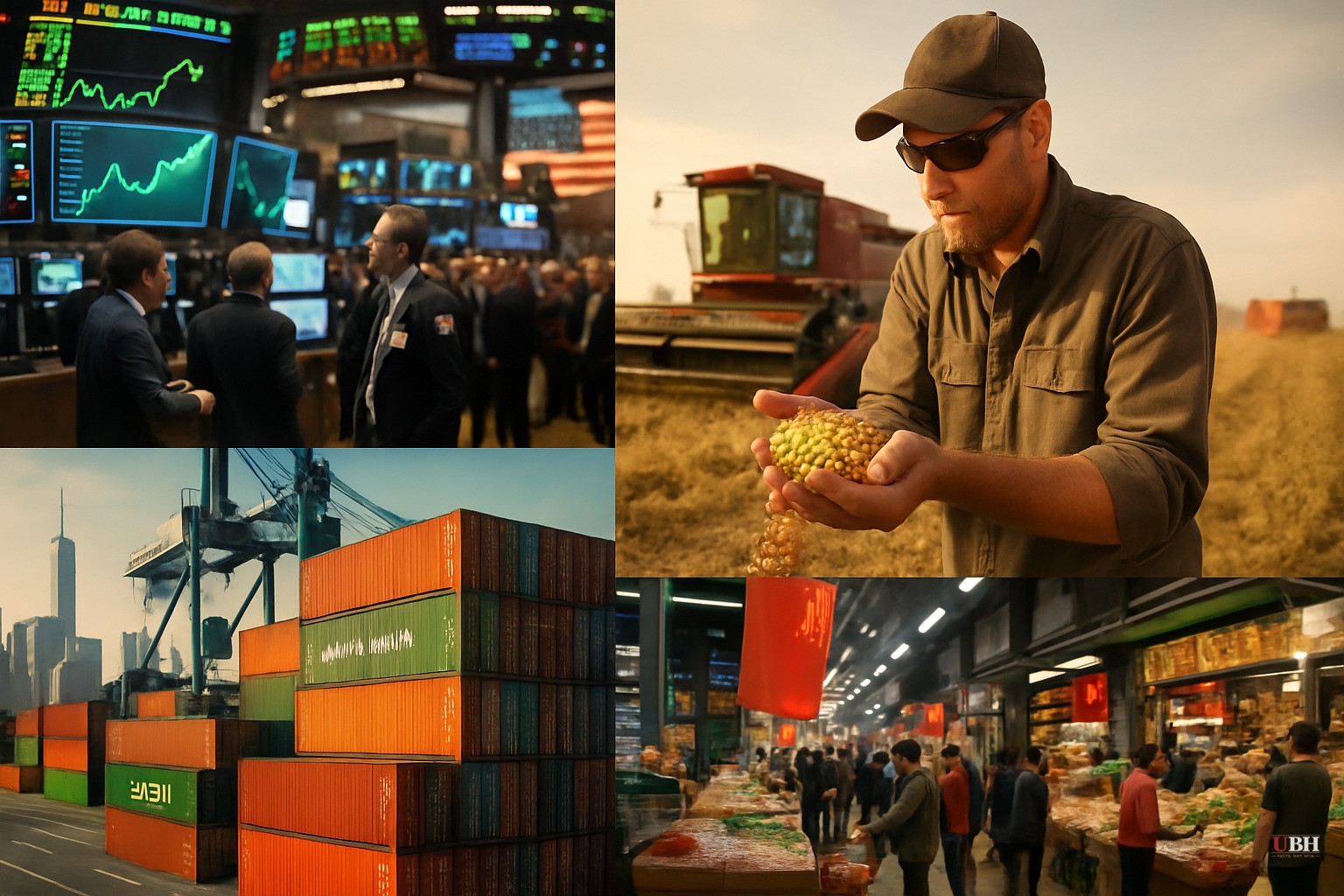
The Numbers Don't Lie
American farmers got hammered.
Between March 2025 and February 2026, U.S. agricultural exports to China fell by nearly $15 billion on an annualized basis, according to the North Dakota State University Agricultural Trade Monitor. That's almost $5 billion more in losses than farmers suffered during Trump's first-term trade war with China.
We already knew the first trade war hurt farmers. This one hurt them worse.
Soybeans Got Obliterated
The soybean market took the worst of it. In 2024, American farmers shipped more than $12 billion worth of soybeans to China. In 2025, that number cratered to $3 billion — a 75% collapse in a single year, according to the NDSU Trade Monitor.
The NDSU researchers estimate that $6.8 billion of that drop is directly attributable to Trump's trade war. Not global market shifts. Not weather. The tariffs.
Trump raised tariffs on Chinese goods to 145%. China fired back with a 125% tariff on American agricultural exports. China simply stopped buying American farm products at scale.
Iowa Got Hit Hardest
The damage wasn't spread evenly. According to the NDSU analysis, the trade war's effects were especially concentrated in the Corn Belt, Great Plains, California, and Texas. Iowa took the single biggest state-level hit: $1.2 billion in China-bound exports affected.
These are farm families in the middle of the country who voted for Trump, believed the tariff strategy would open markets, and instead watched their biggest customer walk away.
Trump's Tacit Admission
In December 2025, Trump authorized an $11 billion farm bailout.
When the government hands out billions to offset losses caused by its own policy, that's an admission the policy failed. The bailout comes on top of the billions handed out during the first trade war. The NDSU researchers note that a companion analysis is in preparation that will account for redirected trade — some corn, wheat, soy, and pork that would have gone to China was rerouted to Mexico, Canada, and Japan. That may recover some losses, but not all of them. The $11 billion bailout is the evidence.
What Mainstream Coverage Is Getting Wrong
Most mainstream outlets — from USA Today on the center to left-leaning coverage — frame this as an ongoing negotiation story: Trump goes to Asia, meets Xi, maybe a deal gets done. The headlines focus on the diplomatic drama.
The concrete, documented, already-occurred economic damage gets less attention. The NDSU numbers exist. They're not projections. They're not think-tank models. They're trade flow data measuring what actually happened to American farmers over a full year.
Right-leaning media tends to emphasize the potential upside — the Beijing framework, the possibility exports could rebound and "exceed the 2024 export level by approximately $4 to $5 billion," per the NDSU authors. But that rebound is conditioned on China actually committing to the framework. As of this writing, according to NDSU, China has NOT confirmed its commitment. Reporting the optimistic scenario without that caveat is incomplete.
Reason magazine, reporting on the NDSU study from a center-right perspective, noted that the Supreme Court later determined Trump's April tariffs were illegal. If the tariffs that triggered this agricultural collapse were ruled illegal, that's a significant constitutional and economic story — not a footnote.
The Bigger Picture
This trade war didn't start in 2025. According to Wikipedia's documentation of the China-U.S. trade conflict, Trump began imposing tariffs in January 2018. The phase-one deal in January 2020 didn't hold. China never hit its $200 billion import commitment. The Biden administration kept the tariffs. And now the second Trump administration escalated to 145% tariffs on Chinese goods with China hitting back at 125% on American goods.
Nearly every economist surveyed by the Associated Press and Reuters predicted these tariffs would do more harm than good. The NDSU data supports that prediction — at least for agriculture.
The stated goals were to bring manufacturing jobs back, reduce the trade deficit, and force China into fairer trade practices. The method has produced $15 billion in lost farm sales, a 75% soybean collapse, and an $11 billion taxpayer bailout in a single year.
The Situation Now
If you're an Iowa farmer, you already know what this means. Your biggest customer — China buys more American soybeans than anyone else on the planet — effectively stopped buying. The government sent you a check instead. That check came from taxpayers.
If you're a taxpayer, you're subsidizing a trade strategy that has produced documented losses in agriculture while its promised benefits — manufacturing jobs, deficit reduction, Chinese compliance — remain largely undelivered.
A potential Beijing framework deal could reverse some of this. Maybe. If China follows through. If the framework gets implemented. If the tariff situation stabilizes.
That's a lot of ifs. American farmers have been waiting seven years for this trade war to pay off.
So far, it hasn't.
Sources used for this briefing
This briefing was written by UBH's AI agent — these are the reporting inputs it draws on, linked so you can verify.


