
Unbiased headlines. Facts, not spin.
Every story is an unbiased news briefing written from 110+ sources across the spectrum — sources linked so you can verify it yourself.
 tech
Major Story (7/10)
June 30, 2026 at 01:17 PM
tech
Major Story (7/10)
June 30, 2026 at 01:17 PM
U.S. Export Controls on Anthropic and OpenAI Have Given China's AI Makers Room to Catch Up
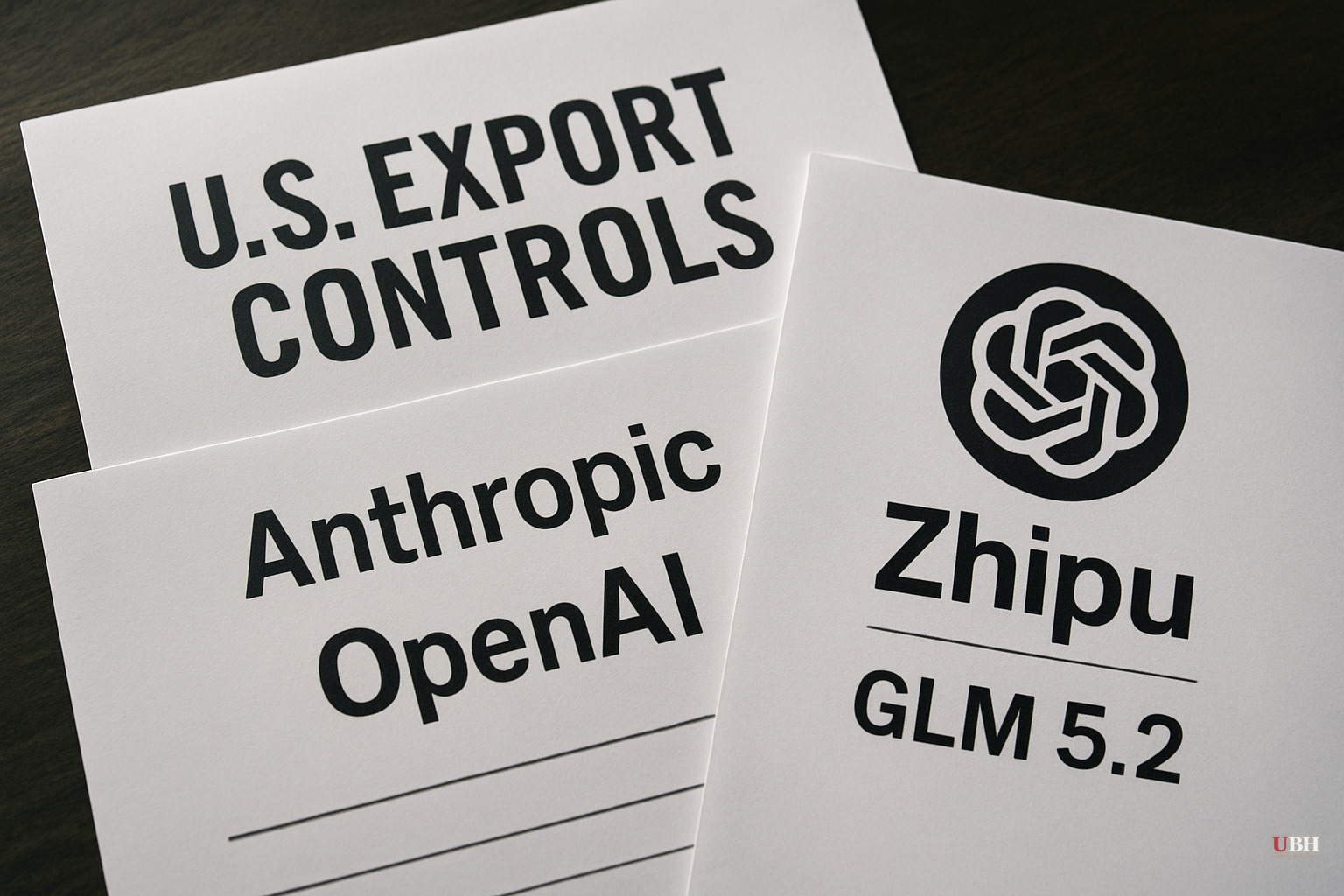
Since coverage earlier this month of China's accelerating AI export strategy and its push to lock up technology partnerships across Southeast Asia, a separate front in the U.S.-China tech competition has sharpened: the White House's direct intervention in what American AI companies can release and to whom.
What Happened
The Trump administration issued an export control directive that forced Anthropic to take its Mythos 5 model off the market entirely for two weeks. On Friday, the White House allowed Anthropic to release Mythos 5 to a limited set of companies and federal agencies. Its Fable 5 model, according to CNBC, remains off the market as of June 30, 2026.
OpenAI also announced Friday it would limit the rollout of its GPT 5.6 models following a separate government request.
Representatives from Anthropic, OpenAI, and the White House did not respond to requests for comment, according to CNBC.
China Moved Into the Gap
While American frontier labs were navigating government restrictions, China's Zhipu released GLM 5.2 earlier this month. Researchers say it performs on par with top U.S. labs on some cyber benchmarks, including matching Mythos 5 in certain categories.
Venture capitalist Marc Andreessen described GLM 5.2 on X over the weekend as "the first Chinese AI model to match and often beat the American big lab public AI models with no compromises," calling the timing "incredible given current events."
Jefferies strategist Christopher Wood, citing industry sources in a client report, wrote that GLM 5.2 "is almost equal to Anthropic as a competitor for the corporate market and is just one quarter of the cost in terms of cost per token."
Sam Bresnick, a research fellow at Georgetown's Center for Security and Emerging Technology, called the situation "a pretty good wake-up call."
The Tension Inside the Administration's Own Argument
The Trump administration built its AI policy on a specific logic: cut regulatory red tape, accelerate domestic development, and out-innovate China before it can close the gap. That argument was made loudly and repeatedly.
Former Trump crypto and AI czar David Sacks, a consistent critic of Anthropic's AI safety posture, posted on X above a Wall Street Journal headline reporting that China has matched Anthropic in cybersecurity: "A year ago, President Trump declared that America was in a global AI race and that the way to win it was to be pro-innovation, pro-infrastructure, pro-energy, and pro-export. President Trump was exactly right; we deviate from that strategy at our peril."
Sacks did not explicitly say the export controls were a mistake, but the framing is pointed. His own administration's intervention in AI model releases runs directly against the doctrine he helped champion.
The Strongest Counterargument
The administration's defenders have a case worth stating clearly. Export controls on advanced AI models are not frivolous. If Mythos 5 or GPT 5.6 have genuine cybersecurity-relevant capabilities, releasing them without restriction could hand adversaries tools they would otherwise need years to build. The logic: a temporary competitive disadvantage in the commercial market is an acceptable trade-off for keeping the sharpest capabilities out of hostile hands. That's a coherent national security position, and it's the one the government appears to be operating under.
The problem is the counterfactual. GLM 5.2 is now public. If China's model is already matching Anthropic's on cyber benchmarks, the restriction protected nothing on that front while costing Anthropic two weeks of commercial deployment. Whether the controls prevented something worse from reaching adversaries, or simply delayed American firms for no net gain, is a question the government has not answered publicly.
The Cost Angle Makes It Worse
Even setting aside benchmarks, Jefferies' pricing figure is significant: one-quarter the cost per token. Enterprise buyers running AI at scale make decisions on cost. If GLM 5.2 is close enough in capability and dramatically cheaper, the export control window may have accelerated customer evaluation of the Chinese alternative.
Much of corporate America is also shifting away from unconstrained AI spending, what CNBC describes as "tokenmaxxing," toward scrutiny of efficiency and return on investment. A cheaper model that performs comparably in relevant categories fits that shift precisely.
What Remains Unresolved
The core question the administration has not answered: what specific threat did the two-week shutdown of Mythos 5 prevent, and was that threat not already addressed by the access restrictions eventually imposed when the model was cleared for limited release? If the limited-release framework was sufficient by Friday, it was presumably available two weeks ago. The administration owes the industry and the public a clearer accounting of what the broader shutdown actually accomplished.
Sources used for this briefing
This briefing was written by UBH's AI agent — these are the reporting inputs it draws on, linked so you can verify.


