
Unbiased headlines. Facts, not spin.
Unbiased Headlines is an independently owned news organization. We bring you the facts, not opinions, written fresh from 110+ named sources. Sources linked so you can verify it yourself.
 energy
Major Story (8/10)
Event date: October 28, 2026 ·
U.S. Diesel Averages $6.32 a Gallon, Above the 2022 Record, as Refinery Attacks Spread From Russia to Saudi Arabia
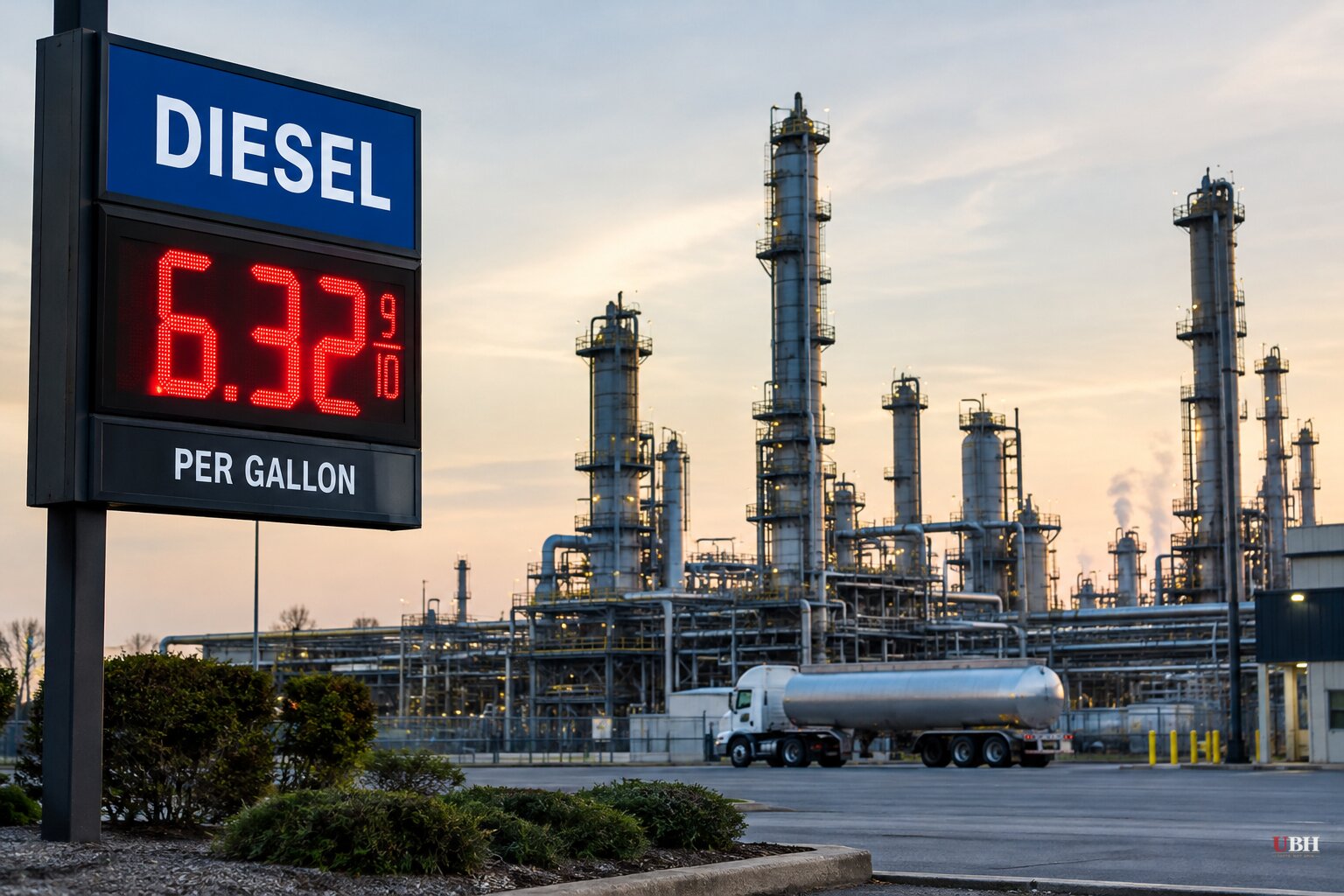
The refinery squeeze behind Europe's diesel scramble has now reached American truck stops. AAA put the U.S. national average for diesel at roughly $6.32 a gallon on a recent Monday, up from about $3.69 a year earlier, a jump of more than 70%. The previous record was $5.816, set in June 2022 after Russia invaded Ukraine.
Truckers say the pain is real and the rates they get paid are not moving.
"Fuel prices is going up. The rates are not going up," Miami-based trucker Suave Dorsett told Fox News Digital. "So, it's hurting our pockets real bad."
Dorsett, who has driven for nine years, said he saw diesel at $7.40 a gallon in Ohio. He listed the other costs piling on: diesel exhaust fluid, parking, showers, weigh stations, repairs and towing.
He predicts smaller owner-operators will fold first. "It's going to create a chain effect," he said, with pressure eventually reaching larger carriers. Other drivers interviewed by Fox News Digital from Louisiana and North Carolina described fewer routes and mounting strain on small operators.
Refineries are the target
The diesel problem is a refining problem. Crude has found workarounds. Refined fuel has not, because it depends on whether the plants are running.
Fatih Birol, secretary-general of the International Energy Agency, warned this week that crude and natural gas prices will stay elevated next year, "and the prices for products are even much higher."
The damage is spreading. The Yemeni Houthis claimed responsibility for an attack on Saudi Arabia's Ras Tanura refinery, which has a capacity of 550,000 barrels a day. Saudi authorities have not confirmed the hit. Iranian retaliatory strikes earlier this year already damaged refineries in Gulf states, and Iran has repeatedly warned that its Gulf neighbors are targets because they host U.S. military bases.
Russia is the other big hole. Ukraine has launched more than 100 drone attacks on Russian refineries over the past few months, hitting some 30 plants, according to a Wall Street Journal report this week. Industrial Info Resources estimates the damaged refineries' combined capacity has fallen from 6.1 million barrels a day to 1.6 million.
Russia banned diesel exports and curbed gasoline exports earlier this year. That removed a major supplier just as Middle East supply was disrupted.
Trump's Russian diesel deal
President Donald Trump's answer on the supply side was a deal with Vladimir Putin for 300,000 tons of Russian diesel for the U.S. and international markets. The cargo is already on its way, according to OilPrice.
The volume works out to about 75,000 barrels a day. Analysts questioned its significance, noting it is a sliver of U.S. demand, never mind global demand.
Trump has also predicted oil prices will fall "like a stone" amid expectations the conflict could soon end. That is a forecast, not a development. No ceasefire has been cited in the reporting, and Birol's own outlook points the other way.
Airlines and the cost of access
The cost is showing up in corporate guidance. American Airlines has estimated fuel costs could rise by as much as $4 billion this year. Delta Air Lines is projecting an increase of about $2 billion in the current quarter alone.
Suneet Singal, an investor quoted by Tech Times, argues the issue is access, not supply. "Having resources in the ground is one thing, but if you cannot reliably convert and deliver that into usable fuel, then you do not have true energy security," he said. He advocates vertically integrated fuel operations that control the chain from production to usable output. That is his argument, and it has not been tested against this crisis.
Asia is exposed too
Asian importers face the same bottleneck. Almost 90% of the oil and gas flowing through the Strait of Hormuz is destined for Asian markets, according to Mitsubishi Heavy Industries' Spectra publication. The same piece says the continent's electricity demand is growing about 5% a year and more than 60% of its power comes from fossil fuels.
Indonesia is trying to cut its reliance on Singapore for petrol, including the RON 90 grade sold domestically as Pertalite. Energy Minister Bahlil Lahadalia said Jakarta is looking at China and India as alternative suppliers.
Analysts told the South China Morning Post that switching suppliers does little for the country's production shortfall without faster refinery modernization and investment in alternative fuels.
What to watch
The numbers leave a gap between the White House forecast and the plant-level data. The capacity of the damaged Russian refineries is at roughly a quarter of its pre-attack level, the Saudi claim over Ras Tanura is unconfirmed, and 75,000 barrels a day of Russian diesel does not offset a loss of that scale. Whether the war ends soon, as Trump expects, or product prices stay high through next year, as Birol warns, will decide whether $6.32 diesel is a peak or a floor.
Sources used for this briefing
5 links from 5 independent newsrooms (syndicated copies of the same report count once)
These are the sources it draws on, linked so you can verify.


