
Unbiased headlines. Facts, not spin.
Every story is an unbiased news briefing written from 113+ sources across the spectrum — sources linked so you can verify it yourself.
 economy
Notable (6/10)
Event date: September 11, 2026
economy
Notable (6/10)
Event date: September 11, 2026
U.S. Deficit Is on Track to Top $2 Trillion This Year, and $1.2 Trillion in State Aid Is Back in the Crosshairs
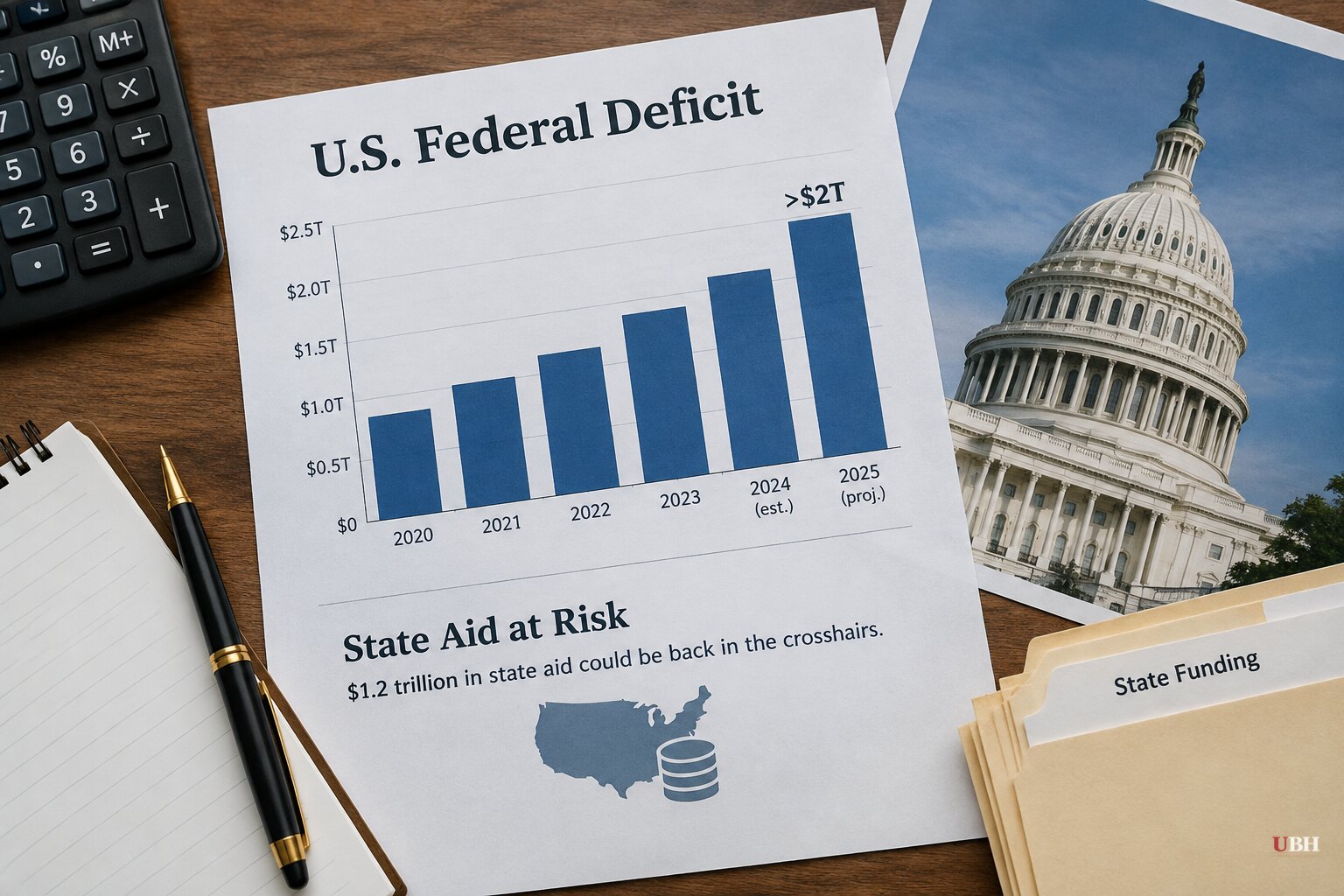
The federal government is on pace to run its biggest non-pandemic deficit ever. Through the first 10 months of the current fiscal year, the shortfall hit $1.8 trillion, according to commentary by former Republican congressman Ken Buck published in the Epoch Times. With two months of FY2026 still on the books, Buck says the full-year deficit will clear $2 trillion. He notes that outside pandemic years, the U.S. has never run a deficit above $1.8 trillion.
This isn't happening during a recession. Unemployment is low. The economy is growing. Buck quotes the president of the Committee for a Responsible Federal Budget calling the borrowing binge "not normal." He asks the obvious question: if things are fine, why is Washington spending like they're not?
The Math Doesn't Work
Part of the problem is math nobody can spin away. Federal spending grew 5 percent this year compared to last, according to Buck, while revenue grew only 3 percent. That gap compounds every year it's ignored.
Borrowing costs are making it worse. Buck reports that Treasury yields hit a 19-year high of 5.34 percent this month. Higher yields mean the government pays more to borrow, which means interest payments now eat up almost 20 cents of every tax dollar collected, a bigger share than the previous record set in 1991.
Buck doesn't let his own party off the hook. He credits Republicans' 2025 reconciliation package, the so-called Big Beautiful Bill, with pro-growth tax cuts, but says it "failed to get to the root of the federal growth" because it skipped entitlement reform. The nonpartisan Congressional Budget Office estimated the bill adds $3.4 trillion to the debt over 10 years, or as much as $4.5 trillion once interest is factored in. Tax cuts without spending cuts, Buck argues, just widen the hole.
The Wisconsin Fix
A separate opinion piece in the Washington Post points at a different lever entirely: the $1.2 trillion Washington sent to state governments in 2025, 17 percent of all federal outlays. That's up from roughly 5 percent in the 1950s, driven largely by Great Society-era programs that never got scaled back.
The piece holds up Wisconsin's 2011 budget fix as a model. Facing a shortfall, then-Governor Scott Walker cut state aid to local governments and school districts rather than raise taxes or lay off state workers. The budget balanced. State taxes stayed flat. According to the Post's opinion piece, Wisconsin students have "largely performed better" than students in other states since. Applying that logic federally, the author argues, means handing states more of the funding responsibility for programs they already administer, on the theory that state officials are closer to the needs of their constituents and have stronger incentives to spend efficiently.
The numbers behind that idea are substantial. Medicaid alone accounted for 68.8 percent of federal grants to states in fiscal 2024, per the Post's piece, even though states already run the program day to day. Ronald Reagan's "New Federalism" push in the 1980s tried to shrink this kind of transfer, but the trend reversed in the 1990s, and federal aid has eaten up 15 percent or more of the budget in nearly every year since 1995.
The Catch
There's a real counter-argument here, and it's not a small one. Unlike Washington, most states operate under balanced-budget requirements and can't run deficits to smooth out a bad year. Slashing federal Medicaid or education funding doesn't just shrink a line item, it forces state legislatures to either raise state taxes, cut services, or both, often with far less capacity to absorb the hit than the federal government has. Advocates for maintaining current funding levels would argue that shifting the burden downward doesn't solve the underlying spending problem. It just relocates it to governments with fewer tools to manage it, and the people most exposed are usually low-income residents who rely on Medicaid.
Neither piece resolves that tension. The Post's opinion piece leans on a single state's experience 15 years ago in a favorable fiscal environment, not a controlled study of what a nationwide cut would do to hospitals, school districts, or state budgets under strain. Buck's commentary calls for entitlement reform without specifying which entitlements or by how much, the same vagueness he criticizes lawmakers for.
What's not in dispute is the trajectory. FY2026 closes at the end of this month, and the deficit is already tracking toward a record outside a national emergency. Whether Congress touches state aid, entitlements, both, or neither before the next budget cycle is the open question nobody in Washington has answered yet.
Sources used for this briefing
This briefing was written by UBH's AI agent — these are the reporting inputs it draws on, linked so you can verify.


