
Unbiased headlines. Facts, not spin.
Unbiased Headlines is an independently owned news organization. We bring you the facts, not opinions, written fresh from 110+ named sources. Sources linked so you can verify it yourself.
 economy
Major Story (7/10)
Event date: October 14, 2026 ·
US Deficit Hits Nearly $2 Trillion as Global Debt Reaches Record $365 Trillion
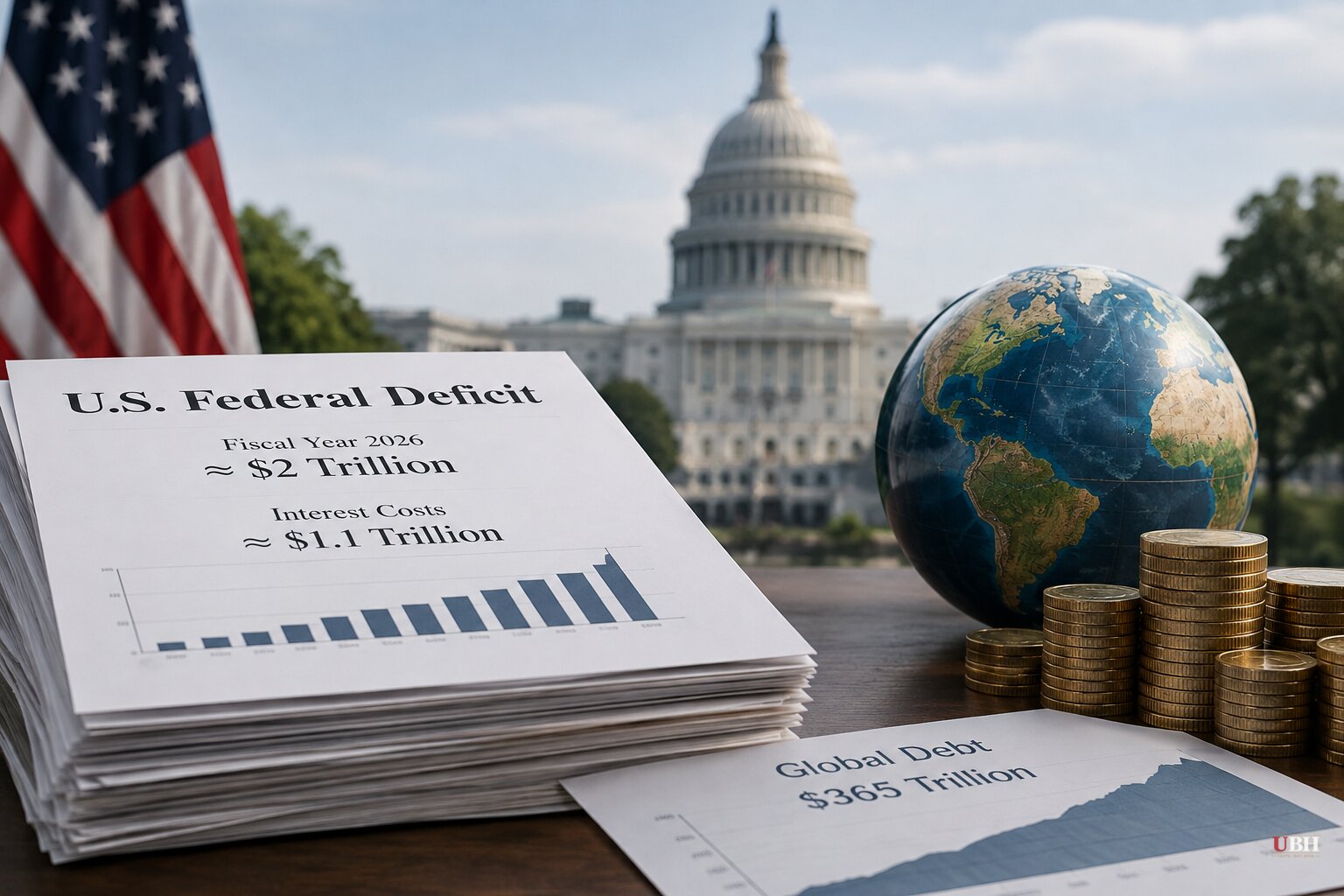
The federal government ended fiscal year 2026 on Sept. 30 with a deficit of nearly $2 trillion, according to the Congressional Budget Office. Only the pandemic years of 2020 and 2021 were worse.
This is not a recession year. Revenue rose by $169 billion, or about 3 percent, to more than $5.4 trillion. Spending rose by nearly $400 billion, about 6 percent, to $7.4 trillion.
Where the money went
Social Security, Medicare and Medicaid together cost $3.5 trillion, up $218 billion, or 7 percent. That is faster than total spending growth. Defense grew 5 percent.
Interest on the debt rose $115 billion, or 11 percent, to more than $1.1 trillion. That is more than the defense budget. Among federal programs, only Social Security costs more.
CBO's numbers also show how far spending has drifted. National Review notes that 2026 spending ran 20 percent above what CBO projected in March 2020, just before the pandemic lockdowns. The federal workforce cuts pushed by the Department of Government Efficiency did not make a noticeable dent, the magazine wrote.
On tariffs, economist Veronique de Rugy noted in a commentary that the Supreme Court struck down most of President Trump's tariffs and forced refunds. She calculates that even keeping the roughly $130 billion in those levies would have covered less than a tenth of the gap.
National Review argues the debt was built over decades by both parties. Democrats expanded social programs, it says, and Republicans cut taxes without offsetting cuts. The magazine says Trump has made the problem worse.
The global picture
The U.S. is not alone. The Institute of International Finance's Global Debt Monitor, published Sept. 23, put worldwide debt at a record $365 trillion, up $10 trillion in six months. The institute attributes the rise to emerging-market borrowing, AI infrastructure spending and military outlays.
Emerging-market debt alone climbed $6.5 trillion to $110 trillion, with China the largest contributor.
At the IMF and World Bank autumn meetings in Bangkok on Oct. 14, IMF Managing Director Kristalina Georgieva said U.S. Treasury Secretary Scott Bessent and other American leaders recognize the deficit and debt, now above $40 trillion, have grown too high. But she said growth will not solve it on its own.
"At the fund, we believe that, growth, of course, helps, but it cannot deliver fast enough the necessary adjustments," Georgieva said. "There is no magic. You have to go in a direction of tightening bringing the deficit down."
Rodrigo Valdes, director of the IMF's Fiscal Affairs Department, said fiscal risks are rising and "a proper reaction is largely absent in many countries." He added that the effects of indiscipline in major advanced economies "travel to the rest of the world."
The IMF's latest Fiscal Monitor says interest payments in the world's poorest countries have reached historic highs relative to revenue. Rates are at multidecade highs, which the IMF ties partly to rising debt and to inflation from high energy costs during the Iran war.
UK Foreign Secretary Ed Miliband said at a sideline event that "the Global South is paying the price for rising interest rates in wealthier countries." He called for "a new deal on debt" with longer repayment periods and refinancing at better rates.
France shows the squeeze
France is where the arithmetic has reached the street. The Interior Ministry said more than 550,000 people demonstrated nationwide last Saturday amid weeks of student protests over education and living costs. Protests in Belgium, Italy and Portugal have also turned violent at times, though many have stayed peaceful.
France's borrowing costs are the highest since 2002. Its debt stands at about 120 percent of GDP, according to de Rugy. Higher yields mean more of each budget goes to bondholders and less to the schools, hospitals and pensions the protesters are demanding.
That is the opposite of the case de Rugy says big-government advocates made. She wrote that economist Paul Krugman and Sen. Bernie Sanders have cited France as proof that a large state is viable. She argues the lesson runs the other way, and that the same "anti-wealth and anti-growth forces" are gaining ground in the U.S. She also contends that the answer to deficits is not more revenue, since revenue is already growing. Protesters in France, by contrast, are pointing to underfunded services and low wages.
Who is buying the debt
The buyer base is shifting. A Federal Reserve Bank of San Francisco study found stablecoin issuers are becoming significant buyers of short-term U.S. Treasuries. Foreign ownership of Treasuries has fallen from over 50 percent in the late 2000s to about 30 percent in early 2026, according to the study. The San Francisco Fed projects stablecoin demand for short-term Treasuries will nearly double to about $400 billion by 2030.
Whether that new demand can offset retreating foreign buyers as annual interest costs pass $1.1 trillion is unresolved. The new Congress that takes office after the November elections will inherit a deficit of nearly $2 trillion with no recession to blame.
Sources used for this briefing
7 links from 7 independent newsrooms (syndicated copies of the same report count once)
These are the sources it draws on, linked so you can verify.


