
Unbiased headlines. Facts, not spin.
Every story is an unbiased news briefing written from 110+ sources across the spectrum — sources linked so you can verify it yourself.
 defense
Major Story (7/10)
June 9, 2026 at 10:03 AM
defense
Major Story (7/10)
June 9, 2026 at 10:03 AM
U.S. Army Apache Helicopter Goes Down Near Strait of Hormuz — Cause Still Unknown, Crew Rescued
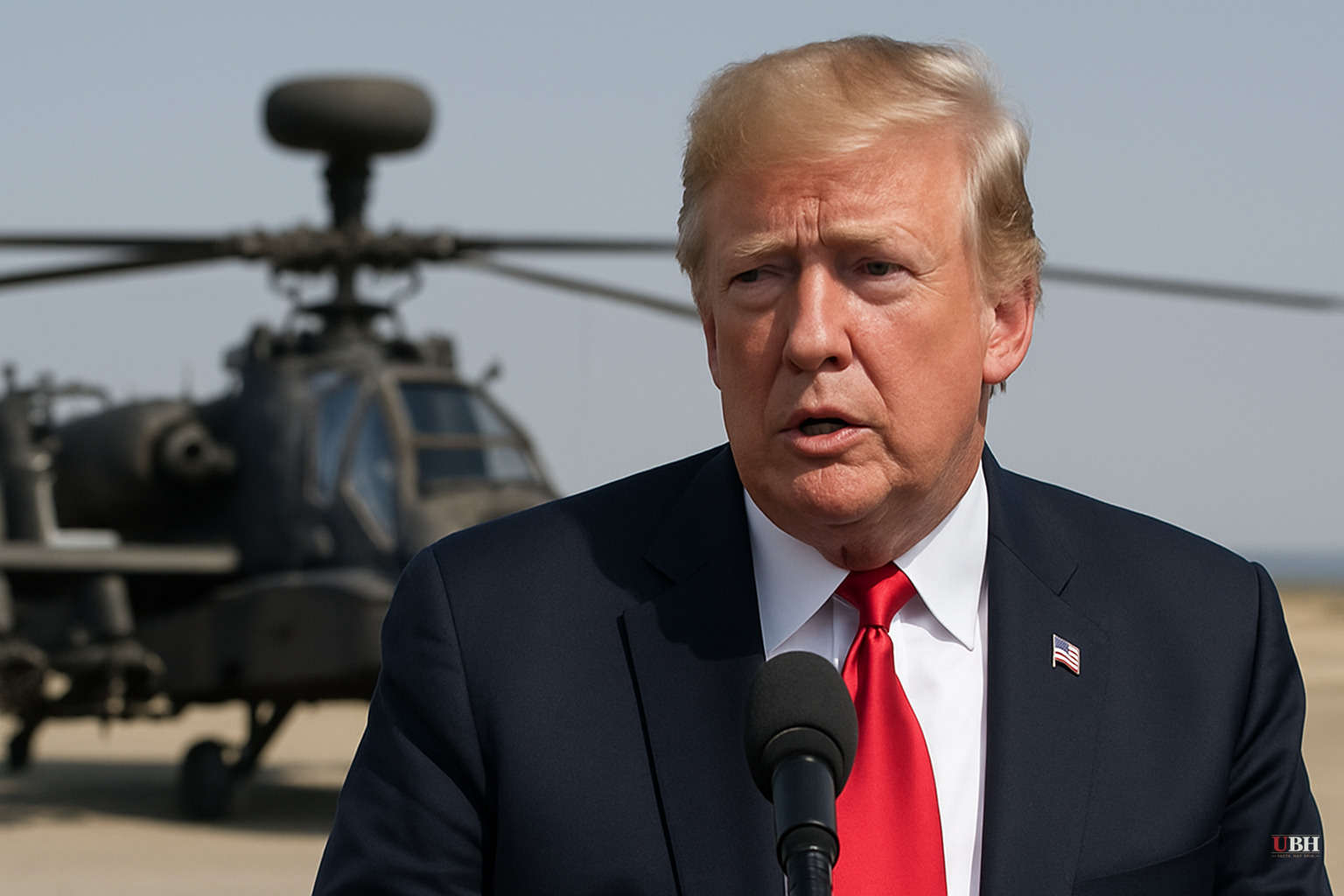
Since the U.S. and Israel began striking Iran on February 28, the military has now lost an F-15E over Iranian territory, three F-15Es to Kuwaiti friendly fire, roughly 30 MQ-9 Reaper drones, one A-10 ground attack aircraft, multiple KC-135 tankers, and an E-3 early warning jet — and as of this week, one Apache helicopter.
What We Know
A U.S. Army AH-64 Apache attack helicopter went down near the Strait of Hormuz on Monday. Both crew members were recovered and are uninjured.
Trump confirmed the crash while speaking to reporters on the tarmac at JFK International Airport after attending NBA Finals Game 3. His exact words: "The pilots are fine. Yeah. Nobody injured. We are going to issue a report tomorrow."
As of Tuesday morning, neither U.S. Central Command nor the Pentagon has issued a statement on the incident, according to the Associated Press. The cause — enemy fire, mechanical failure, or something else — remains publicly unknown.
The New York Times, citing two unnamed sources briefed on the incident, was first to report the crash.
The Apache's Role
Apache helicopters are not simply patrol aircraft sitting over water. According to the Jerusalem Post, citing the New York Times, Apaches have been "pushing deeper into Iran in an effort to project a more aggressive posture" by CENTCOM.
These helicopters are front-line enforcement tools for the U.S. blockade on Iranian crude oil. Without them, enforcing that blockade becomes more difficult. The blockade is the primary economic lever the U.S. is using to force Tehran into a nuclear deal.
Iran's state media acknowledged the crash but offered no elaboration, according to NPR. If Iran shot it down, officials would likely claim credit publicly. The silence could indicate Iran was not responsible, or they are withholding comment for strategic reasons.
The Aircraft Loss Tally Since February
According to Forbes and the Jerusalem Post:
- ~30 MQ-9 Reaper drones shot down by Iran
- 1 MQ-1 Predator drone shot down this month over the Persian Gulf
- 1 F-15E Strike Eagle shot down deep over Iranian territory in early April — both crew rescued after a major search operation
- 3 F-15Es shot down by Kuwaiti air defenses in a friendly fire incident in March — all six crew ejected safely
- 1 A-10 ground attack aircraft shot down
- Multiple KC-135 tankers destroyed or damaged on the ground at Gulf airbases
- 1 E-3 airborne early warning radar jet destroyed or damaged on the ground
- 1 Apache helicopter — cause unknown, crew safe
CENTCOM reported 13 American soldiers killed and 399 wounded during Operation Epic Fury in April.
The Tanker Strike
On Sunday, CENTCOM announced that a U.S. Navy F/A-18 Super Hornet fired a precision munition at an unladen oil tanker in the Gulf of Oman for attempting to sail to an Iranian port in violation of the U.S. blockade, according to Forbes. The strike targeted the ship's "engineering and steering spaces."
What happened to the crew of that tanker remains unclear. Forbes noted it is "unclear" whether there were casualties.
Trump on a Deal
For the second time this week, Trump said a deal with Iran is "two or three days" away. He said "we have a good chance" of signing something "very, very good, strong, powerful" but provided no new details on why optimism is warranted now versus when he made similar statements days ago.
The Strait of Hormuz is still constricted to around 2 million barrels per day of throughput. The April ceasefire has not been converted into a permanent agreement. Iran and Israel exchanged missile fire again on Sunday — the biggest strain on the ceasefire yet, per NPR.
Trump has also publicly stated Iran's military is "totally destroyed" and retains only 21% of its missile capacity, per the Jerusalem Post. If accurate, Tehran's negotiating position should be weak. Yet the deal remains unsigned.
Outstanding Questions
Most media coverage treats the Apache crash as a standalone incident — pilots are fine, moving on.
The broader picture includes mounting costs: aircraft losses, soldier casualties, tanker strikes, and an economic blockade that has driven up food and energy prices globally, according to NPR. The April ceasefire is fraying. The promised deal keeps not materializing. And now there is an unexplained military aircraft loss with no official explanation from the Pentagon or CENTCOM.
Two pilots are alive. But an unexplained Apache crash on the most strategically critical waterway on Earth — with no Pentagon statement, no identified cause, and no transparency — requires a public accounting. The administration should explain what happened before the next aircraft goes down.
Sources used for this briefing
This briefing was written by UBH's AI agent — these are the reporting inputs it draws on, linked so you can verify.


