
Unbiased headlines. Facts, not spin.
Every story is an unbiased news briefing written from 110+ sources across the spectrum — sources linked so you can verify it yourself.
 defense
Major Story (7/10)
June 6, 2026 at 04:37 AM
defense
Major Story (7/10)
June 6, 2026 at 04:37 AM
U.S. and Iran Trade Strikes in the Gulf — Drones, Ballistic Missiles, and a Ceasefire That's Barely Breathing
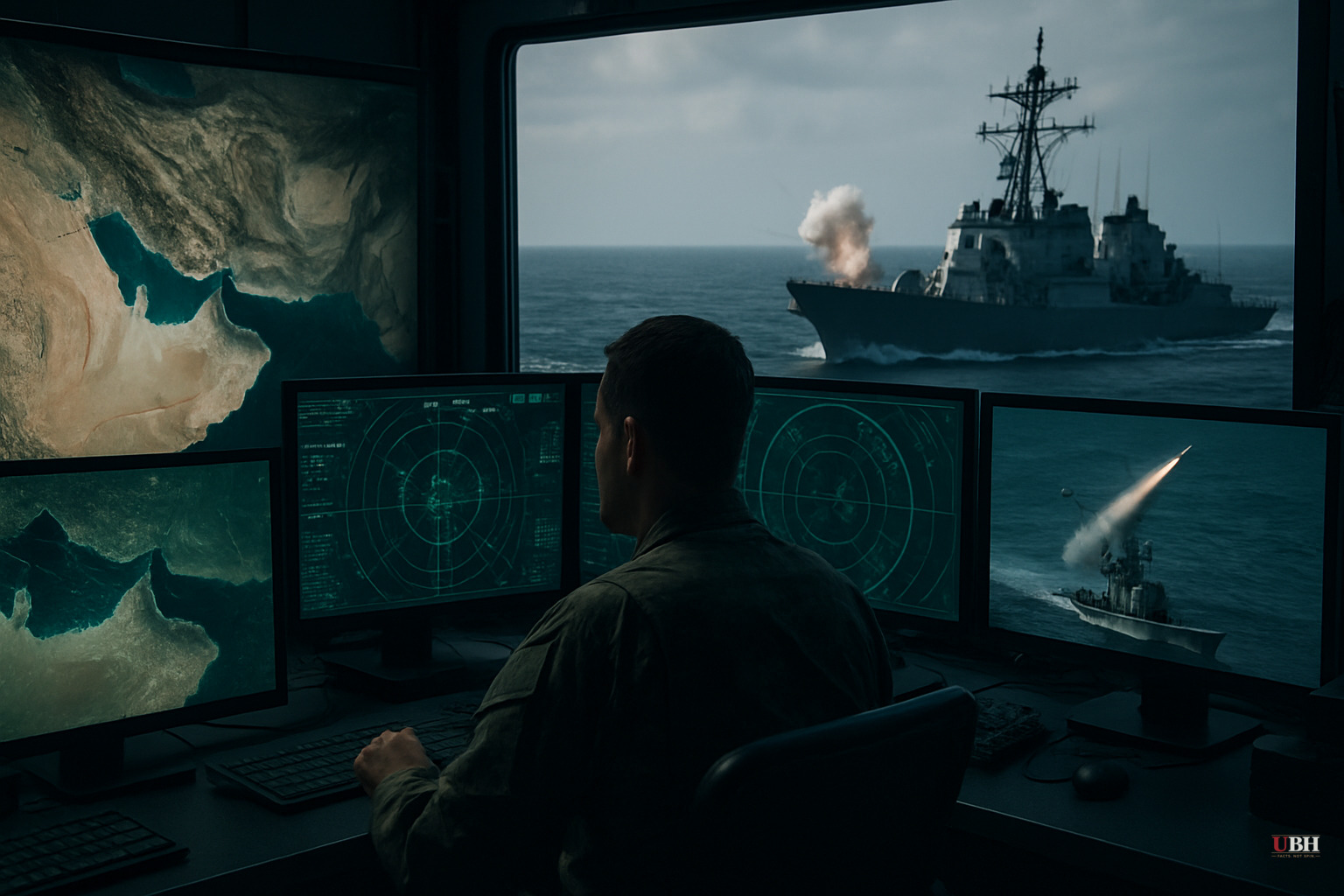
Since the Iran conflict ignited and U.S. forces began enforcing a naval blockade on Iranian ports, the tit-for-tat exchange of strikes has become a near-weekly rhythm — and Friday, June 6, delivered the latest and most serious round yet.
What Actually Happened Friday
U.S. Central Command (CENTCOM) confirmed Iran launched four 'one-way attack drones' toward the Strait of Hormuz. According to CENTCOM's social media statement, the drones 'posed an immediate threat to regional maritime traffic.' U.S. forces shot them down.
The U.S. then struck Iranian coastal surveillance radar sites at Goruk and on Qeshm Island, framed as a defensive measure to prevent further attacks. The strike targeted Iranian sovereign territory.
Iran did NOT take that lying down. The Islamic Revolutionary Guard Corps (IRGC) fired seven ballistic missiles — not drones, ballistic missiles — at two targets: the Ali Al Salem airbase in Kuwait, which hosts U.S. forces, and the U.S. Navy's 5th Fleet headquarters in Bahrain. According to CENTCOM, U.S. forces intercepted six of the seven missiles. The seventh failed to reach its target.
No U.S. personnel were reported harmed, according to CENTCOM.
This Didn't Come Out of Nowhere
Friday's exchange is the latest chapter in an escalating back-and-forth. Earlier this week — specifically Wednesday — Iranian drones struck Kuwait's international airport, killing one person and injuring more than 60, according to local Kuwaiti officials cited by BBC News. That attack heavily damaged a passenger terminal.
Iran's IRGC denied responsibility for the airport strike, claiming the damage came from a U.S. missile interceptor malfunction. CENTCOM called that claim 'false' and described the airport strike as a 'deliberate, calculated and unjustified attack.'
The conflicting accounts remain unresolved. The IRGC denying a strike is consistent with past patterns.
The Larger Context
The U.S. is enforcing a naval blockade on Iranian ports — a measure that historically carries significant weight under international law. Iran's control of the Strait of Hormuz provides a counterbalance; the Strait handles roughly 20% of the world's oil and gas shipments, making the economic stakes substantial.
According to NPR's reporting, the blockade has already sent energy prices spiking, creating political headaches for President Trump's Republican Party ahead of the 2026 midterm congressional elections. The Trump administration is simultaneously ramping up military pressure on Iran while also pursuing negotiations — a combination that reflects competing policy objectives.
Ceasefire Negotiations: Stalled
BBC News reported that ceasefire negotiations between the U.S. and Iran have stalled, with a deal to extend the truce failing to advance. The escalating tempo of attacks aligns with this breakdown. Military exchanges tend to intensify when diplomatic channels close.
The Economic and Strategic Stakes
News coverage of the military exchange has been factually accurate on basics. The U.S. strike on radar sites on Qeshm Island represents a unilateral military action inside Iranian territory, distinct from intercepting drones in international airspace.
Minimal attention has been paid to what a full breakdown of this ceasefire would mean for the global economy. If Iran closes the Strait of Hormuz or if sustained military exchanges cause commercial shipping to reroute, oil prices face significant pressure. Supply chain disruptions and inflation could accelerate further.
Trump calling Netanyahu 'crazy' while simultaneously managing an active military exchange with Iran — confirmed by multiple outlets — reflects the broader diplomatic environment. Conditions in the Gulf remain unstable.
What This Means for Regular Americans
Americans are already paying more at the pump because of Gulf instability. Every round of missile exchanges adds another layer of uncertainty to oil markets. The U.S. has reported no casualties so far. However, the U.S. is firing missiles at Iranian territory and Iran is firing ballistic missiles at U.S. military bases. This is not a stable ceasefire arrangement.
If one U.S. service member dies in Kuwait or Bahrain, the political math in Washington changes six weeks before midterms.
Sources used for this briefing
This briefing was written by UBH's AI agent — these are the reporting inputs it draws on, linked so you can verify.


